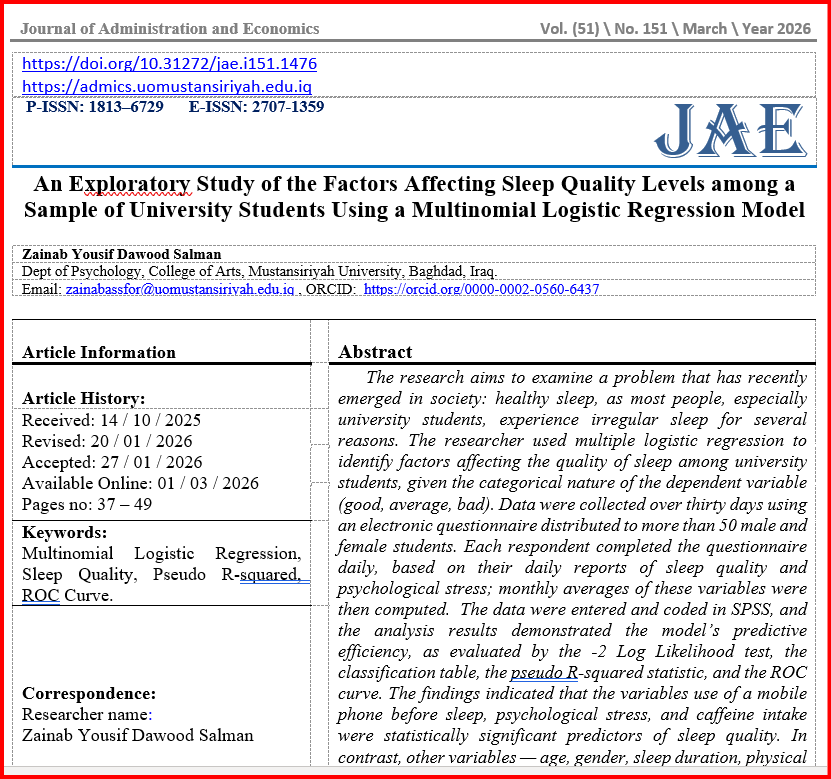
An Exploratory Study of the Factors Affecting Sleep Quality Levels among a Sample of University Students Using a Multinomial Logistic Regression Model
DOI:
https://doi.org/10.31272/jae.i151.1476Keywords:
Multinomial Logistic Regression, Sleep Quality, Pseudo R-squared, ROC CurveAbstract
The research aims to examine a problem that has recently emerged in society: healthy sleep, as most people, especially university students, experience irregular sleep for several reasons. The researcher used multiple logistic regression to identify factors affecting the quality of sleep among university students, given the categorical nature of the dependent variable (good, average, bad). Data were collected over thirty days using an electronic questionnaire distributed to more than 50 male and female students. Each respondent completed the questionnaire daily, based on their daily reports of sleep quality and psychological stress; monthly averages of these variables were then computed. The data were entered and coded in SPSS, and the analysis results demonstrated the model’s predictive efficiency, as evaluated by the -2 Log Likelihood test, the classification table, the pseudo R-squared statistic, and the ROC curve. The findings indicated that the variables use of a mobile phone before sleep, psychological stress, and caffeine intake were statistically significant predictors of sleep quality. In contrast, other variables — age, gender, sleep duration, physical activity, and sleep environment — were not statistically significant.
Downloads
References
[1] Hirshkowitz M, Whiton K, Albert SM, Alessi C, Bruni O, DonCarlos L, Hazen N, Herman J, Katz ES, Kheirandish-Gozal L, Neubauer DN, O'Donnell AE, Ohayon M, Peever J, Rawding R, Sachdeva RC, Setters B, Vitiello MV, Ware JC, Adams Hillard PJ. National Sleep Foundation's sleep time duration recommendations: methodology and results summary. Sleep Health. 2015 Mar;1(1):40-43.https://doi.org/10.1016/j.sleh.2014.12.010 . DOI: https://doi.org/10.1016/j.sleh.2014.12.010
[2] Stenson, A., Kurinec, C., Hinson, J., Whitney, P., & Van Dongen, H. (2021). Total sleep deprivation reduces top-down regulation of emotion without altering bottom-up affective processing. PLOS ONE, 16(9). doi:https://doi.org/10.1371/journal.pone.0256983 DOI: https://doi.org/10.1371/journal.pone.0256983
[3] Shah AS, Pant MR, Bommasamudram T, Nayak KR, Roberts SSH, Gallagher C, Vaishali K, Edwards BJ, Tod D, Davis F, Pullinger SA. Effects of Sleep Deprivation on Physical and Mental Health Outcomes: An Umbrella Review. Am J Lifestyle Med. 2025 May 27. https://doi.org/10.1177/15598276251346752. DOI: https://doi.org/10.1177/15598276251346752
[4] Redline, S. (2023). Sleep and Cardiovascular Health. AHAIASA JOURNALS, 137(5). doi:https://doi.org/10.1161/CIRCRESAHA.125.327119 DOI: https://doi.org/10.1161/CIRCRESAHA.125.327119
[5] Walker, M. (2017). Why We Sleep: Unlocking the Power of Sleep and Dreams. Scribner Publishing . ISBN:978-1501144325
[6] Johri, K., Pillai, R., Kulkarni, A., & Balkrishnan, R. (2025). Effects of sleep deprivation on the mental health of adolescents: a systematic review. Sleep Science Practice, 9(9).https://doi.org/10.1186/s41606-025-00127-w DOI: https://doi.org/10.1186/s41606-025-00127-w
[7] San, L., & Arranz, B. (2024). The Night and Day Challenge of Sleep Disorders and Insomnia: A Narrative Review. Actas Españolas de Psiquiatría, 52(1), 45-56. DOI : 10.1007/s40656-024-00676-z
[8] Halperin D. Environmental noise and sleep disturbances: A threat to health? Sleep Sci. 2014 Dec;7(4):209-12..https://doi.org/10.1016/j.slsci.2014.11.003. DOI: https://doi.org/10.1016/j.slsci.2014.11.003
[9] Wittmann, M., Dinich, J., Merrow, M., & Roenneberg, T. (2006). Social jetlag: Misalignment of biological and social time. Chronobiology International, 23((1-2)), 497–509. doi:https://doi.org/10.1080/07420520500545979 DOI: https://doi.org/10.1080/07420520500545979
[10] Buysse, D. J., & et al. (1989). The Pittsburgh Sleep Quality Index: A new instrument for psychiatric practice and research. Psychiatry Research, 28(2), 193-213.https://doi.org/10.1016/0165-1781(89)90047-4 DOI: https://doi.org/10.1016/0165-1781(89)90047-4
[11] Zambotti, M., Cellini, N., Goldstone, A., Colrain, I., & Baker, F. (2019). Wearable Sleep Technology in Clinical and Research Settings. Sleep Medicine Clinics, 51(7), 1538-1557.:https://doi.org/10.1249/MSS.0000000000001947 DOI: https://doi.org/10.1249/MSS.0000000000001947
[12] Okechukwu, C.E. (2022). The neurophysiologic basis of the human sleep–wake cycle and the physiopathology of the circadian clock: a narrative review. Egypt J Neurol Psychiatry Neurosurg 58, 34. https://doi.org/10.1186/s41983-022-00468-8 . DOI: https://doi.org/10.1186/s41983-022-00468-8
[13 Hosmer Jr, D. W., Lemeshow, S., & Sturdivant, R. X. (2013). Applied logistic regression. John Wiley & Sons. https://doi.org/10.1002/9781118548387 DOI: https://doi.org/10.1002/9781118548387
[14] Agresti, A. (2024). Statistical Methods for the Social Sciences (6th ed.). pearson . ISBN: 978-1292449197
[15] Hastie, T., Tibshirani, R., & Friedman, J. (2009). The elements of statistical learning: Data mining, inference, and prediction (2nd ed.). Springer $bullet$ https://doi.org/10.1007/978-0-387-84858-7 ISBN : 978-0387848570 DOI: https://doi.org/10.1007/978-0-387-84858-7
[16] James, G., & et al. (2013). An Introduction to Statistical Learning: with Applications in R. Gareth James, Daniela Witten, Trevor Hastie, Robert Tibshirani: Springer. ISBN: 978-1461471370 DOI: https://doi.org/10.1007/978-1-4614-7138-7
[17] Nagelkerke, N. (1991). A Note on a General Definition of the coefficient of Deermination. Biometrika, 78(3), 691-692. doi:https://doi.org/10.1093/biomet/78.3.691 DOI: https://doi.org/10.1093/biomet/78.3.691
Downloads
Published
Issue
Section
License
Copyright (c) 2026 زينب يوسف داود سلمان

This work is licensed under a Creative Commons Attribution 4.0 International License.
The journal of Administration and Economics is an open- access journal that all contents are free of charge. Articles of this journal are licensed under the terms of the Creative Commons Attribution International Public License CC-BY 4.0 (https://creativecommons.org/licenses/by/4.0/legalcode) that licensees are unrestrictly allowedto search, download, share, distribute, print, or link to the full text of the articles, crawl them for indexing and reproduce any medium of the articles provided that they give the author(s) proper credits (citation). The journal allows the author(s) to retain the copyright of their published article.
Creative Commons-Attribution (BY)