Estimation of the Joint Model for High-Dimensional Longitudinal Survival Data Using the Hybrid Genetic Algorithm–EM Method (HGA-EM)
DOI:
https://doi.org/10.31272/jae.i151.1537Keywords:
Joint Model, Survival Hazard, Survival Data, Longitudinal DataAbstract
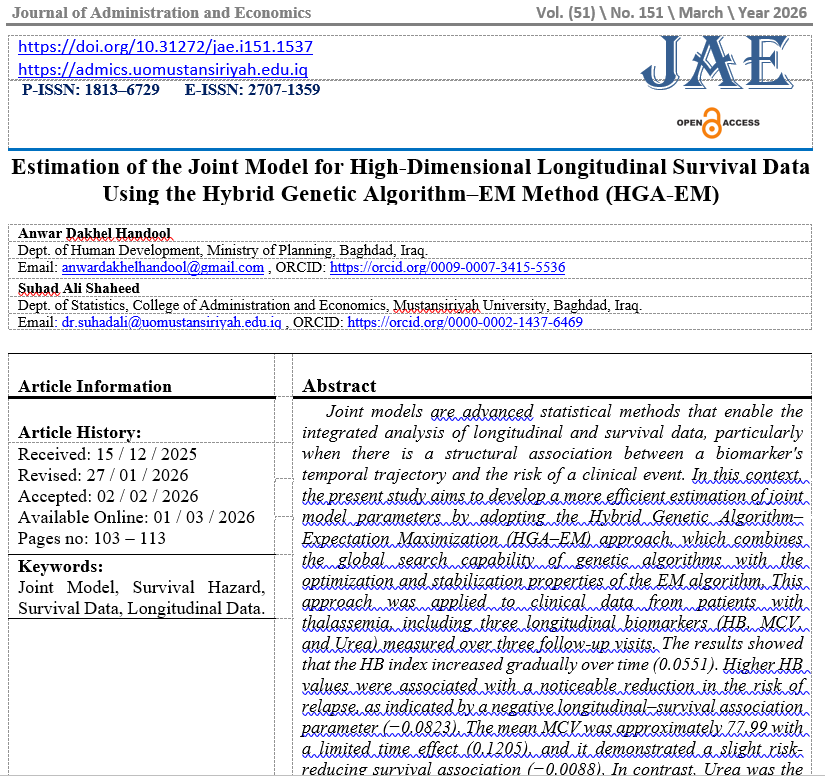
Joint models are advanced ststistical methods that allow the integrated analysis of longitudinal data and survival data, particularly when there is a structural association between the temporal trajectory of biomarker and the risk of a clinical event .
In this context, the present study aims to develop a more efficient estimation of joint model parameters by adopting the Hybrid Genetic Algorithm-Expectation Maximization (HGA_GA)approach ,which combines the global search capability of genetic algorithms with the optimization and stabilization properties of the EM algorithm ,This thalassemia , including three longitudinal biomarkers (HB,MCV and Urea ) measured over three follow -up visits . The results showed that the HB index exhibited a gradual increase over time (0.0551),and higher HB values were associated with anoticeable reduction in the risk of relapse , as indicated by anegative longitudinal - survival association parameter (-0.0823) the mean MCV was approximately 77.99 with alimited time effect (0.1205) , and it demonstrated a slight risk-reducing survival association (-0.0088) in cntrast , urea was the most variable biomarker , increasing over time (0.2835) and showing a clearer association with increased probability of the event reflected by a relatively larger negative survival cofficient (-0.02745) overall these findings higlight the efficiency of the HGA_EM hybrid approach in achieving more stzble and accurate estimation than conventional methods and in precisely capturing the dynamic relationship between longitudinal biomarkres and the risk of clinical events.
Downloads
References
1. Ahmed Meri, Marwa, Aaya Hamid Al-Hakeem, and Rukaya Saad Al-Abeadi. 2022. “Overview on Thalassemia: A Review Article.” Medical Science Journal for Advance Research 3(1):26–32. doi:10.46966/msjar.v3i1.36. DOI: https://doi.org/10.46966/msjar.v3i1.36
2. Alkhathami, A. (2021). Joint Modeling of Longitudinal and Survival Data (Doctoral dissertation, Carleton University). Ottawa-Carleton Institute for Mathematics and Statistics.
3. Baghfalaki, T., M. Ganjali, and R. Martins. 2025. “Approximate Bayesian Inference for Joint Partially Linear Modeling of Longitudinal Measurements and Spatial Time-to-Event Data.” Journal of Statistical Computation and Simulation. doi:10.1080/00949655.2025.2538116. DOI: https://doi.org/10.1080/00949655.2025.2538116
4. Caillebotte, Antoine, Estelle Kuhn, and Sarah Lemler. 2023. “Estimation and Variable Selection in a Joint Model of Survival Times and Longitudinal Outcomes with Random Effects.” 1–12. http://arxiv.org/abs/2306.16765.
5. Crowther, Michael J., Keith R. Abrams, and Paul C. Lambert. 2013. “Joint Modeling of Longitudinal and Survival Data.” Stata Journal 13(1):165–84. doi:10.1177/1536867x1301300112. DOI: https://doi.org/10.1177/1536867X1301300112
6. Leiva-Yamaguchi, V., & Alvares, D. (2021). A two-stage approach for Bayesian joint models of longitudinal and survival data: Correcting bias with informative prior. Entropy, 23(1), 50. https://doi.org/10.3390/e23010050 DOI: https://doi.org/10.3390/e23010050
7. Nguyen, Hieu T., Henrique D. Vasconcellos, Kimberley Keck, Jared P. Reis, Cora E. Lewis, Steven Sidney, Donald M. Lloyd-Jones, Pamela J. Schreiner, Eliseo Guallar, Colin O. Wu, João A. C. Lima, and Bharath Ambale-Venkatesh. 2023. “Multivariate Longitudinal Data for Survival Analysis of Cardiovascular Event Prediction in Young Adults: Insights from a Comparative Explainable Study.” BMC Medical Research Methodology 23(1). doi:10.1186/s12874-023-01845-4. DOI: https://doi.org/10.1186/s12874-023-01845-4
8. Qiu, Xianxin, Jing Gao, Jing Yang, Jiyi Hu, Weixu Hu, Lin Kong, and Jiade J. Lu. 2020a. “A Comparison Study of Machine Learning (Random Survival Forest) and Classic Statistic (Cox Proportional Hazards) for Predicting Progression in High-Grade Glioma after Proton and Carbon Ion Radiotherapy.” Frontiers in Oncology 10(October):1–10. doi:10.3389/fonc.2020.551420. DOI: https://doi.org/10.3389/fonc.2020.551420
9. Rizopoulos, D. (2012). Joint Models for Longitudinal and Time-to-Event Data: With Applications in R. Chapman & Hall/CRC. DOI: https://doi.org/10.1201/b12208
10. Shen, Nan, and Bárbara González. 2021. “Bayesian Information Criterion for Linear Mixed-Effects Models.” http://arxiv.org/abs/2104.14725.
11. Taher, A. T., D. Farmakis, J. B. Porter, M. D. Cappellini, and K. M. Musallam. 2025. “Thalassaemia International Federation Guidelines for the Management of Transfusion-Dependent Thalassemia.”
Downloads
Published
Issue
Section
License
Copyright (c) 2026 Anwar Dakhel Hindool, & Suhad Ali Shaheed

This work is licensed under a Creative Commons Attribution 4.0 International License.
The journal of Administration and Economics is an open- access journal that all contents are free of charge. Articles of this journal are licensed under the terms of the Creative Commons Attribution International Public License CC-BY 4.0 (https://creativecommons.org/licenses/by/4.0/legalcode) that licensees are unrestrictly allowedto search, download, share, distribute, print, or link to the full text of the articles, crawl them for indexing and reproduce any medium of the articles provided that they give the author(s) proper credits (citation). The journal allows the author(s) to retain the copyright of their published article.
Creative Commons-Attribution (BY)