The Impact of Adopting Artificial Intelligence Technologies in Accounting Practices on Earnings Management Behaviours in Iraqi Banks
DOI:
https://doi.org/10.31272/jae.i152.1570Keywords:
Artificial Intelligence, Earnings Management, Bank Accounting, Internal Control, Iraqi BanksAbstract
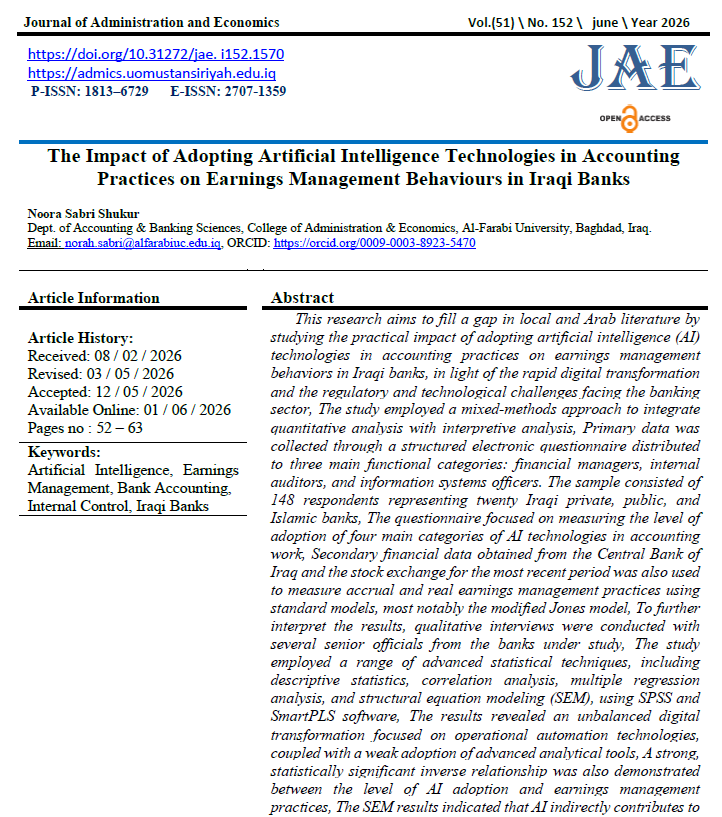
This research aims to fill a gap in local and Arab literature by studying the practical impact of adopting artificial intelligence (AI) technologies in accounting practices on earnings management behaviors in Iraqi banks, in light of the rapid digital transformation and the regulatory and technological challenges facing the banking sector, The study employed a mixed-methods approach to integrate quantitative analysis with interpretive analysis, Primary data was collected through a structured electronic questionnaire distributed to three main functional categories: financial managers, internal auditors, and information systems officers. The sample consisted of 148 respondents representing twenty Iraqi private, public, and Islamic banks, The questionnaire focused on measuring the level of adoption of four main categories of AI technologies in accounting work, Secondary financial data obtained from the Central Bank of Iraq and the stock exchange for the most recent period was also used to measure accrual and real earnings management practices using standard models, most notably the modified Jones model, To further interpret the results, qualitative interviews were conducted with several senior officials from the banks under study, The study employed a range of advanced statistical techniques, including descriptive statistics, correlation analysis, multiple regression analysis, and structural equation modeling (SEM), using SPSS and SmartPLS software, The results revealed an unbalanced digital transformation focused on operational automation technologies, coupled with a weak adoption of advanced analytical tools, A strong, statistically significant inverse relationship was also demonstrated between the level of AI adoption and earnings management practices, The SEM results indicated that AI indirectly contributes to reducing earnings management by enhancing the effectiveness of internal control systems, The study concludes that maximizing the positive impact of AI requires adopting a comprehensive strategic vision that invests in advanced analytical technologies, develops human capital, and fosters a corporate culture that supports transparency and accountability.
Downloads
References
[1] Fadhil Hanoon, W., Abdulridha, M., & Ali, A. A. M. (2025). Investigating the impact of earnings management and internal control on the financial performance of banks using a spatial artificial intelligence approach. International Journal of Management, Accounting and Economics, 12(1), 1–30. https://doi.org/10.5281/zenodo.14885003
[2] Kang, S., & Park, S. (2021). Artificial intelligence-based detection and prediction of corporate earnings management. In P. K. Kim (Ed.), Fintech with artificial intelligence, big data, and blockchain (pp. 191–203). Springer. https://doi.org/10.1007/978-981-33-6137-9_10
[3] Kadhim, Y. A., & Al Ani, S. A. M. (2024a). The effect of using an accounting information system based on artificial intelligence in detecting earnings management to enhance the sustainability of economic units. In M. Al-Emran (Ed.), Business development via AI and digitalization (pp. 323–336). Springer. https://doi.org/10.1007/978-3-031-53923-3_24 DOI: https://doi.org/10.1007/978-3-031-62106-2_26
[4] Kadhim, Y. A., & Al Ani, S. A. M. (2024b). Using artificial intelligence and metaverse techniques to reduce earning management. In M. Al-Emran (Ed.), Beyond reality: Navigating the power of metaverse and its applications (pp. 171–189). Springer. https://doi.org/10.1007/978-3-031-54243-7_13 DOI: https://doi.org/10.1007/978-3-031-51716-7_12
[5] Peng, R. (2025). Research On the Impact of Artificial Intelligence on Corporate Earning Management. In SHS Web of Conferences (Vol. 225, p. 03015). EDP Sciences. https://doi.org/10.1051/shsconf/202522503015 DOI: https://doi.org/10.1051/shsconf/202522503015
[6] Siladjaja, M., Thamrin, H., & Hasan, A. (2022). The influence of real earnings quality and tax management on future market value: An implication of decision tree model and game theory. ACRN Journal of Finance and Risk Perspectives, 11, 33–54. https://doi.org/10.35944/jofrp.2022.11.1.003
[7] Kang, S., & Park, S. (2021). Artificial intelligence-based detection and prediction of corporate earnings management. In P. K. Kim (Ed.), Fintech with artificial intelligence, big data, and blockchain (pp. 191–203). Springer. https://doi.org/10.1007/978-981-33-6137-9_10 DOI: https://doi.org/10.1007/978-981-33-6137-9_8
[8] AbdelGalil, M. S. A., Ali, A. M., & Elsayed, M. (2024). The effect of using artificial intelligence on the relation between earning management and earning persistence and future earnings predictability: Applied study on Egyptian stock listed companies. Journal of Contemporary Business Research, 1(1), 49–74. https://doi.org/10.21608/jcbre.2024.422433 DOI: https://doi.org/10.21608/jcbre.2024.422433
[9] Siladjaja, M., Anwar, Y., & Djan, I. (2022). The impact of real manipulation and tax management on future market value: An artificial intelligence simulation of high earnings quality. ACRN Journal of Finance and Risk Perspectives, 11(1), 33-54. https://doi.org/10.35944/jofrp.2022.11.1.003 DOI: https://doi.org/10.35944/jofrp.2022.11.1.003
[10] Roychowdhury, S. (2006). Earnings management through real activities manipulation. Journal of accounting and economics, 42(3), 335-370. https://doi.org/10.1016/j.jacceco.2006.01.002 DOI: https://doi.org/10.1016/j.jacceco.2006.01.002
Downloads
Published
Issue
Section
License
Copyright (c) 2026 Noora Sabri Shukur Shukur

This work is licensed under a Creative Commons Attribution 4.0 International License.
The journal of Administration and Economics is an open- access journal that all contents are free of charge. Articles of this journal are licensed under the terms of the Creative Commons Attribution International Public License CC-BY 4.0 (https://creativecommons.org/licenses/by/4.0/legalcode) that licensees are unrestrictly allowedto search, download, share, distribute, print, or link to the full text of the articles, crawl them for indexing and reproduce any medium of the articles provided that they give the author(s) proper credits (citation). The journal allows the author(s) to retain the copyright of their published article.
Creative Commons-Attribution (BY)