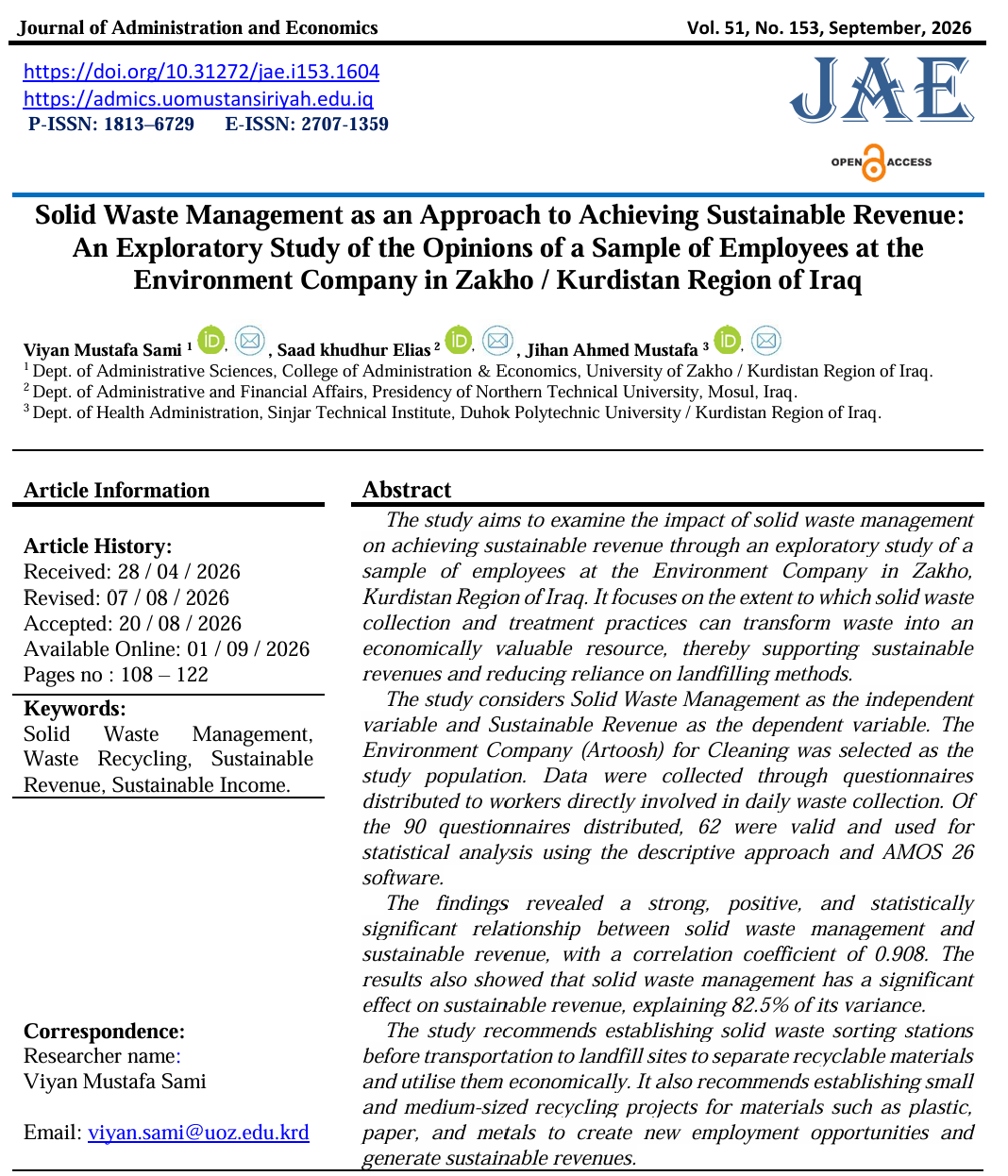
Solid Waste Management as an Approach to Achieving Sustainable Revenue: An Exploratory Study of the Opinions of a Sample of Employees at the Environment Company in Zakho / Kurdistan Region of Iraq
DOI:
https://doi.org/10.31272/jae.i153.1604Keywords:
Solid Waste Management, Waste Recycling, Sustainable Revenue, Sustainable IncomeAbstract
The research highlights the key challenges related to waste management and recycling, and examines how waste can be converted into reusable raw materials to generate financial profit and achieve sustainable income through modern waste collection and processing methods.
The research presents theoretical frameworks concerning Solid Waste Management as the independent variable and Sustainable Revenue as the dependent variable. The "Al-Beea" Environmental Cleaning Company was selected as the field for the practical application of study, as it meets the necessary research conditions, ranging from infrastructure and workforce to the availability of all equipment required for collecting and transporting solid waste from the city and its surrounding areas. To achieve this, a questionnaire was utilized as the primary data collection tool, targeting direct workers involved in daily waste collection (approximately 500 workers). A total of 90 questionnaires were distributed, of which 62 were deemed valid for statistical analysis. The study adopted a descriptive-analytical approach, utilizing the AMOS 26 software.
The results indicate a strong and significant positive correlation between solid waste management and sustainable revenue, with a correlation coefficient of 0.908. This demonstrates that improving waste management methods directly contributes to enhancing opportunities for sustainable revenue. The findings proved that solid waste management has a significant impact on sustainable revenue, explaining 82.5% of the variances in sustainable revenue—a clear indicator of the strength of the explanatory model used in research.
Establish sorting stations for solid waste prior to its transport to landfills to separate recyclable materials and utilize them economically. Develop small and medium-sized enterprises (SMEs) focused on recycling plastic, paper, and minerals, thereby contributing to job creation and generating sustainable revenue.
Downloads
References
[1] Nwachukwu, M. A., Mersky, R., & Feng, H. (2017). Global capacity, potentials and trends of solid waste research and management. Waste Management & Research, 35(9), 923–934. https://doi.org/10.1177/0734242X17715099
[2] Al-Ashqar, J. (2022). Sustainable management of solid waste: Towards a comprehensive and effective strategy. Arab Journal of Science, Technology and Innovation Policy, 3(3), 9–17. https://doi.org/10.22034/ajstips.2022.03.03.02
[3] Aqila, I. T., & Jibril, A. S. I. (2023). Evaluation of household solid waste management in Al-Marj City. Sorman Journal of Science and Technology, 5(1). https://sjst.scst.edu.ly/index.php/sjst/article/view/65
[4] Awotomilusi, N. S., Oso, O. O., Oluwagbade, O. I., & Dagunduro, M. E. (2023). Examining the roles of government accounting officers and their implications on achieving sustainable revenue budget: A case study of the Ekiti State Government, Nigeria. Journal of Accounting and Finance Management, 4(6). https://dinastires.org/JAFM/article/view/272
[5] Aziz, S. Q., Ismael, S. O., & Omer, I. A. (2023). New approaches in solid waste recycling and management in Erbil City. Environmental Protection Research, 3(1), 1–13. https://doi.org/10.37256/epr.3120231758
[6] Budiasni, N. W. N., Putri, M. B., & Sarbaeni. (2024). The role of human capital aspects as sustainable revenue in the public sector of the Singaraja District Court Office. INVEST: Jurnal Inovasi Bisnis dan Akuntansi, 5(1), 108–113. https://journal.al-matani.com/index.php/invest/article/view/657
[7] Chepkoech, N., Gichana, J. O., & Agong, D. (2022). Effect of e-services, mobile payment system, and e-banking system on sustainable revenue collection in Nairobi City County Government. International Journal of Accounting, Finance and Economic Issues, 3(7), 238–253. https://iajournals.org/articles/iajef_v3_i7_238_253.pdf
[8] Feyzipour, F., & Janbozorgi, S. (2025). Challenges and suggestions for sustainable urban revenue from instability to sustainability: Addressing urban revenue challenges in the 21st century. ICCAUA Proceedings Journal, 8, 616–622. https://doi.org/10.38027/ICCAUA2025EN0340
[9] Gupta, S., Mohan, K., Prasad, R., & Kansal, A. (1998). Solid waste management in India: Options and opportunities. Resources, Conservation and Recycling, 24(2), 137–154. https://doi.org/10.1016/S0921-3449(98)00059-8
[10] Humairoh, I., Suharti, E., & S., A. (2025). The future of chatbots in the digital economy: Opportunities for sustainable revenue growth (SDG) MSMEs. Journal of Lifestyle and SDG's Review, 5. https://doi.org/10.47172/2965-730x.sdgsreview.v5.n02.pe03352
[11] Ismail, Y., Adji, R., Santoso, A. D., Wahyono, S., Kholiq, M. A., Handayani, T., Pahri, S. D. R., Putiamini, S., Pratama, R. A., Nurfatriani, F., Sahwan, F. L., Suryanto, F., Prasetiyadi, R. D., & Tilottama, R. (2025). Multi-dimensional perspectives on sustainability in domestic waste management. Global Journal of Environmental Science and Management, 11(2), 747–770. https://doi.org/10.22034/gjesm.2025.02.21
[12] Japan International Cooperation Agency, & Yachiyo Engineering Co., Ltd. (2022). Data collection study on solid waste management in Iraq: Final report. JICA. https://openjicareport.jica.go.jp
[13] Juthair, S. H. (2016). Development of a solid waste management system: An applied study in Al-Hillah City. Journal of Economic and Administrative Sciences, 22(91). https://doi.org/10.33095/jeas.v22i91.478
[14] Kafle, S., Karki, B. K., Sakhakarmy, M., & Adhikari, S. (2025). A review of global municipal solid waste management and valorization pathways. Recycling, 10(3), Article 113. https://doi.org/10.3390/recycling10030113
[15] Mcheri, H., & Sofiane, M. (2021). Valorization of the recycling process of household solid waste and similar materials in light of sustainable development requirements: A case study of (Ecoset) Setif. Journal of Strategy and Development, 11(4), 189–206. https://asjp.cerist.dz/en/article/161870
[16] Mohammed, A. J., & Abboud, S. I. (2020). The extent of implementing the solid waste management strategy in Baqubah City – An exploratory study. Journal of Economics and Administrative Sciences, 26(119). https://doi.org/10.33095/jeas.v26i119.1883
[17] Teniwut, W. A. (2016). For sustainable revenue of fisheries sector in small islands: Evidence of Maluku, Indonesia. AACL Bioflux, 9(3), 722–732. https://doi.org/10.5281/zenodo.245507
[18] Teqrart, Y., Boujamaa, S., & Meziani, M. S. (2019). The reality of solid waste management in Algeria: A case study of (Sokara-Net) Corporation (2017–2019). Nour Journal of Economic Studies, 5(2), 23–36. https://asjp.cerist.dz/en/article/131441
[19] Wagner, J., Merner, S., & Innocenti, S. (2024). Can solar water kiosks generate sustainable revenue streams for rural water services? World Development, 185, Article 106787. https://doi.org/10.1016/j.worlddev.2024.106787
[20] Yuan, H., Wang, L., Su, F., & Hu, G. (2006). Urban solid waste management in Chongqing: Challenges and opportunities. Waste Management, 26(9), 1052–1062. https://doi.org/10.1016/j.wasman.2005.09.002
Downloads
Published
Issue
Section
License
Copyright (c) 2026 Viyan Mustafa Sami, Jihan Ahmed Mustafa, Saad Khader Elias

This work is licensed under a Creative Commons Attribution 4.0 International License.
The journal of Administration and Economics is an open- access journal that all contents are free of charge. Articles of this journal are licensed under the terms of the Creative Commons Attribution International Public License CC-BY 4.0 (https://creativecommons.org/licenses/by/4.0/legalcode) that licensees are unrestrictly allowedto search, download, share, distribute, print, or link to the full text of the articles, crawl them for indexing and reproduce any medium of the articles provided that they give the author(s) proper credits (citation). The journal allows the author(s) to retain the copyright of their published article.
Creative Commons-Attribution (BY)