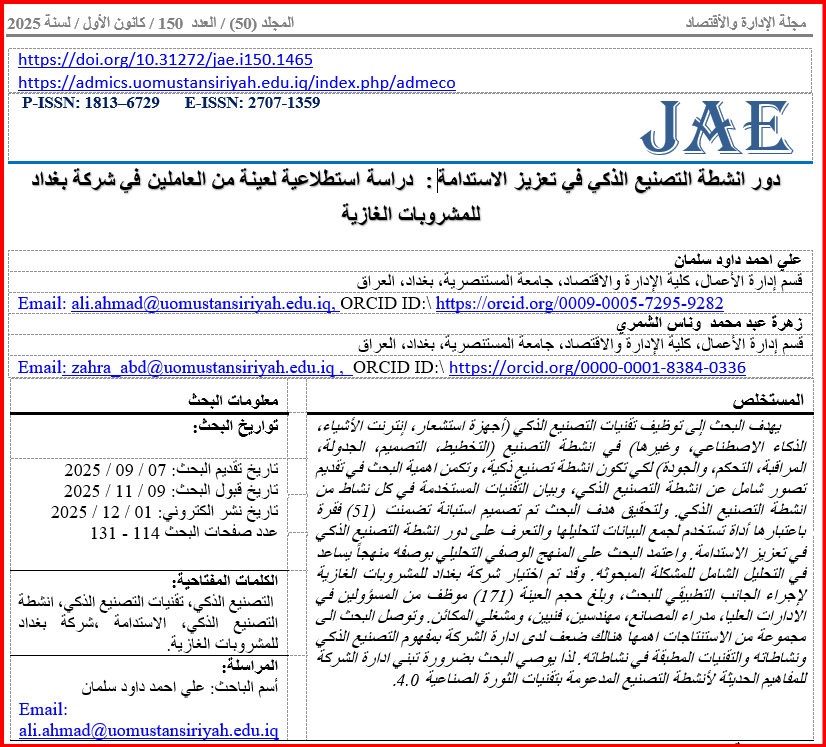
دور انشطة التصنيع الذكي في تعزيز الاستدامة : دراسة استطلاعية لعينة من العاملين في شركة بغداد للمشروبات الغازية
DOI:
https://doi.org/10.31272/jae.i150.1465الكلمات المفتاحية:
التصنيع الذكي، تقنيات التصنيع الذكي، انشطة التصنيع الذكي، الاستدامة، شركة بغداد للمشروبات الغازيةالملخص
يحظى التصنيع الذكي باهتمام كبرى الشركات الصناعية العالمية لدوره الكبير في تحسين انشطة التصنيع عبر تحقيق الاستخدام الأمثل في استهلاك المواد الأولية والطاقة، تقليل المخلفات الصناعية، تقليل الهدر، تحسين كفاءة العمليات، تقليل انبعاث الغازات في جميع العمليات التصنيعية، وتقديم منتجات بجودة عالية. تكمن مشكلة البحث في مازال هنالك ضعف في ادخال التكنولوجيا المتقدمة في بعض انشطة شركة بغداد للمشروبات. يهدف البحث إلى توظيف تقنيات التصنيع الذكي (أجهزة استشعار، إنترنت الأشياء، الذكاء الاصطناعي، تحليل البيانات الضخمة، الحوسبة السحابية، وغيرها) في انشطة التصنيع (التخطيط، التصميم، الجدولة، المراقبة، التحكم، والجودة) لكي تكون انشطة تصنيع ذكية، وتكمن اهمية البحث في تقديم تصور شامل عن انشطة التصنيع الذكي والتي تعد الركيزة الاساسية التي يقوم عليها التصنيع الذكي، وبيان التقنيات المستخدمة في كل نشاط من انشطة التصنيع الذكي. ولتحقيق هدف البحث تم تصميم استبانة تضمنت(51) فقرة باعتبارها أداة تستخدم لمعرفة مدى تأثير انشطة التصنيع الذكي في تعزيز الاستدامة (البيئية، الاقتصادية، والاجتماعية). واعتمد البحث على المنهج الوصفي التحليلي بوصفه منهجاً يساعد في التحليل الشامل للمشكلة المبحوثة. وقد تم اختيار شركة بغداد للمشروبات الغازية لإجراء الجانب التطبيقي للبحث، وبلغ حجم العينة (171) موظف من المسؤولين في الادارات العليا، مدراء المصانع، مهندسين، فنيين، ومشغلي المكائن. وتوصل البحث الى مجموعة من الاستنتاجات اهمها هنالك ضعف لدى ادارة الشركة بمفهوم التصنيع الذكي ونشاطاته والتقنيات المطبقة في نشاطاته، على الرغم من تطبيق بعض التقنيات في انشطة التصنيع الذكي. لذا يوصي البحث بضرورة تبني ادارة الشركة للمفاهيم الحديثة لأنشطة التصنيع المدعومة بتقنيات الثورة الصناعية 4.0 فضلاً عن تبني ابعاد الاستدامة ونشر تلك المفاهيم بين الأفراد العاملين في كافة المستويات لتحقيق اقصى استفادة منها في الشركة.
التنزيلات
المراجع
[1] Al-Rumi, Noura Abdul Karim Mahdi, (2018), Evaluating the Application of Environmental Sustainability Requirements Using the Analytical Hierarchy Process, Master’s Thesis, Administrative Technical College/Baghdad, Middle Technical University, Republic of Iraq.
[2] Al-Saeedi, Karar Fadhel Khalaf, (2024), Green operations practices and their role in achieving environmental sustainability through smart quality management: An analytical study of the opinions of a sample of employees in Ur General Company - Dhi Qar, PhD thesis, Technical College / Baghdad, Middle Technical University, Republic of Iraq.
[3] Al-Shammari, Tabarak Fadhel Muhammad, (2023), Evaluating the Reality of Compliance Management According to the Standard (ISO 37301: 2021) and Its Role in Achieving the Dimensions of Sustainability: A Case Study in the General Administration of Rafidain Bank, Master’s Thesis, Administrative Technical College / Baghdad, Middle Technical University, Republic of Iraq.
[4] Nieuwenhuize, G. (2016). Smart manufacturing for Dutch SMEs: Why and how. Rotterdam school of Management–Erasmus University.
Format for journals available online:
[5] Abd al Salam, Alaa Abd al Wahab, Muhammad, Susan Mahmoud, Saleh, Moatasem Hood Muhammad, (2022), The possibility of digitizing the foundations of smart manufacturing: A case study in the General Company for the Manufacture of Cars and Equipment, Journal of Business Economics, Volume 3, Issue 5, pp. 389-405.
[6] Ahmed, Abd al Nasser Mohamed Sayed, (2024), Organizational Sustainability: Definition, Objectives, Importance, Types, Principles, and Dimensions, Arab Journal of Literature and Humanities, Arab Organization for Education, Science, and Culture, Egypt, 8(30), February, pp. 237-248.
[7] Ajor, L., & Alikor, L. O. (2020). Innovative mindset and organizational sustainability of small and medium enterprises in rivers state, Nigeria. British Journal of Management and Marketing Studies, 3(1), p: 20 – 36.
[8] Al-Adhahi, Musa Misfir Abdullah, The Role of Entrepreneurship Projects in Achieving Sustainable Development: A Field Study in the Asir Region. Journal of Economics and Management Research, Volume 3, Issue 2, pp. 31-51.
[9] Ali, Raghad Hussein, (2025), Artificial Intelligence Technology and its Role in Achieving Sustainable Development Goals, Journal of Administration and Economics, Vol. (50), No. 147, pp. 63-70.
[10] Al-Jawzi, Jamila, (2012), The Importance of Transparency in Achieving Sustainable Development, University of Algiers, pp. 105-114.
[11] Arcagök, U. (2023). The sustainability concept and its historical development. In International Research and Reviews in Economics and Administrative Sciences, p: 1 – 17. Serüven Yayınevi.
[12] Arevalo, J. A., Castelló, I., De Colle, S., Lenssen, G., Neumann, K., & Zollo, M. (2011). Introduction to the special issue: integrating sustainability in business models. Journal of Management Development, 30(10), p: 941-954. DOI: https://doi.org/10.1108/02621711111182466
[13] Arowoshegbe, A. O., Emmanuel, U., & Gina, A. (2016). Sustainability and triple bottom line: An overview of two interrelated concepts. Igbinedion University Journal of Accounting, 2(16), p: 88-126.
[14] Besharati-Foumani, H., Lohtander, M., & Varis, J. (2019). Intelligent process planning for smart manufacturing systems: A state-of-the-art review. Procedia Manufacturing, 38, 156-162. DOI: https://doi.org/10.1016/j.promfg.2020.01.021
[15] Cao, Q., Giustozzi, F., Zanni-Merk, C., de Bertrand de Beuvron, F., & Reich, C. (2019). Smart condition monitoring for industry 4.0 manufacturing processes: An ontology-based approach. Cybernetics and Systems, 50(2), 82-96. DOI: https://doi.org/10.1080/01969722.2019.1565118
[16] Correia, M. S. (2019). Sustainability: An overview of the triple bottom line and sustainability implementation. International Journal of Strategic Engineering (IJoSE), 2(1), 29-38. DOI: https://doi.org/10.4018/IJoSE.2019010103
[17] Cunha, B., Madureira, A., Fonseca, B., & Matos, J. (2021). Intelligent scheduling with reinforcement learning. Applied Sciences, 11(8), 3710. DOI: https://doi.org/10.3390/app11083710
[18] Doane, D., & MacGillivray, A. (2001). Economic sustainability: The business of staying in business. New Economics Foundation, 1, 52.
[19] Ebni, M., Bamakan, S. M. H., & Qu, Q. (2023). Digital twin based smart manufacturing; from design to simulation and optimization schema. Procedia Computer Science, 221, 1216-1225. DOI: https://doi.org/10.1016/j.procs.2023.08.109
[20] Egger, J., & Masood, T. (2020). Augmented reality in support of intelligent manufacturing–a systematic literature review. Computers & Industrial Engineering, 140, 106195. DOI: https://doi.org/10.1016/j.cie.2019.106195
[21] Elkington, J. (2004). Enter the triple bottom line. In A. Henriques & J. Richardson (Eds.), The triple bottom line: Does it all add up? (pp. 1–16). Earthscan.
[22] Frederick, W. C. (1960). The growing concern over business responsibility. California Management Review, 2(4), 54–61. DOI: https://doi.org/10.2307/41165405
[23] Galindo-Salcedo, M., Pertúz-Moreno, A., Guzmán-Castillo, S., Gómez-Charris, Y., & Romero-Conrado, A. R. (2022). Smart manufacturing applications for inspection and quality assurance processes. Procedia Computer Science, 198, 536-541. DOI: https://doi.org/10.1016/j.procs.2021.12.282
[24] Ghaithan, A. M., Alshammakhi, Y., Mohammed, A., & Mazher, K. M. (2023). Integrated impact of circular economy, industry 4.0, and lean manufacturing on sustainability performance of manufacturing firms. International journal of environmental research and public health, 20(6), 5119. DOI: https://doi.org/10.3390/ijerph20065119
[25] Hawas, Thamer Akab, (2020), The availability of smart manufacturing pillars: A survey study of the opinions of a sample of employees at Crown Beit Company, Tikrit Journal of Administrative and Economic Sciences, Volume 16, Issue 52, Part 3, pp. 30-49.
[26] Irbite, A., & Strode, A. (2021, May). Artificial intelligence vs designer: The impact of artificial intelligence on design practice. In Society. Integration. education. Proceedings of the international scientific conference (Vol. 4, pp. 539-549). DOI: https://doi.org/10.17770/sie2021vol4.6310
[27] Koul, P. (2025). Green manufacturing in the age of smart technology: A comprehensive review of sustainable practices and digital innovations. Journal of Materials and Manufacturing, 4(1), 1-20.
[28] Kusiak, A., (2018)., Smart manufacturing. International journal of production Research, 56(1-2), p: 508-517. DOI: https://doi.org/10.1080/00207543.2017.1351644
[29] Leutheuser, V., Müller, J. M., & Voigt, K. I. (2024). Weighing sustainability potentials: A DEMATEL analysis of interrelationships in smart manufacturing technologies. DOI: https://doi.org/10.21203/rs.3.rs-4835864/v1
[30] Lin, Y. J., Wei, S. H., & Huang, C. Y. (2019). Intelligent manufacturing control systems: The core of smart factory. Procedia manufacturing, 39, 389-397. DOI: https://doi.org/10.1016/j.promfg.2020.01.382
[31] Meng, Y., Yang, Y., Chung, H., Lee, P. H., & Shao, C. (2018). Enhancing sustainability and energy efficiency in smart factories: A review. Sustainability, 10(12), 4779. DOI: https://doi.org/10.3390/su10124779
[32] Oluyisola, O. E., Bhalla, S., Sgarbossa, F., & Strandhagen, J. O. (2022). Designing and developing smart production planning and control systems in the industry 4.0 era: a methodology and case study. Journal of Intelligent Manufacturing, 33(1), 311-332. DOI: https://doi.org/10.1007/s10845-021-01808-w
[33] Qi, Q., & Tao, F. (2018). Digital twin and big data towards smart manufacturing and industry 4.0: 360 degree comparison. Ieee Access, 6, 3585-3593. DOI: https://doi.org/10.1109/ACCESS.2018.2793265
[34] Rojko, A. (2017). Industry 4.0 concept: Background and overview. International journal of interactive mobile technologies, 11(5). DOI: https://doi.org/10.3991/ijim.v11i5.7072
[35] Rossit, D. A., Tohmé, F., & Frutos, M. (2019), Industry 4.0: smart scheduling. International Journal of Production Research, 57(12), 3802-3813. DOI: https://doi.org/10.1080/00207543.2018.1504248
[36] Salem, Haitham Hamid, Mohsen, Riyadh Malik, and Reda, Nour Naeem, (2024), Smart leadership and its impact on achieving sustainable development/an applied study in the Babylon Business Incubator, Journal of Administration and Economics, Volume (49), Issue 147, pp. 27-34. DOI: https://doi.org/10.31272/jae.i145.1277
[37] Soori, M., Arezoo, B., & Dastres, R. (2023). Digital twin for smart manufacturing, A review. Sustainable Manufacturing and Service Economics, 2, 100017. DOI: https://doi.org/10.1016/j.smse.2023.100017
[38] Spangenberg, J. H. (2005). Economic sustainability of the economy: concepts and indicators. International journal of sustainable development, 8(1-2), 47-64. DOI: https://doi.org/10.1504/IJSD.2005.007374
[39] Subramanian, S. (2024). IoT and edge computing for smart manufacturing, Architecture and future trends. International Journal of Engineering and Computer Science, 13(10), 26504–26522. DOI: https://doi.org/10.18535/ijecs/v13i10.4922
[40] Thoben, K. D., Wiesner, S., & Wuest, T. (2017). “Industrie 4.0” and smart manufacturing-a review of research issues and application examples. International journal of automation technology, 11(1), 4-16. DOI: https://doi.org/10.20965/ijat.2017.p0004
[41] Tooranloo, H. S., Azadi, M. H., & Sayyahpoor, A. (2017). Analyzing factors affecting implementation success of sustainable human resource management (SHRM) using a hybrid approach of FAHP and Type-2 fuzzy DEMATEL. Journal of cleaner production, 162, 1252-1265. DOI: https://doi.org/10.1016/j.jclepro.2017.06.109
[42] Trstenjak, M., & Cosic, P. (2017). Process planning in Industry 4.0 environment. Procedia Manufacturing, 11, 1744-1750. DOI: https://doi.org/10.1016/j.promfg.2017.07.303
[43] Ullah, Z., Al-Turjman, F., Mostarda, L., & Gagliardi, R. (2020). Applications of artificial intelligence and machine learning in smart cities. Computer communications, 154, 313-323. DOI: https://doi.org/10.1016/j.comcom.2020.02.069
[44] Younis, F., & Chaudhary, M. A. (2017). Sustainable development: Economic, social, and environmental sustainability in Asian economies.
[45] Youssef, Rafat Fathi Metwally, 2021), The economic role of standing and the possibility of achieving sustainable development in the Kingdom of Saudi Arabia according to Vision 2030, Journal of Administration and Economics, Volume (46), Issue 128, pp. 119-145.
[46] Zaghbib, Shahrazad, and Omani, Lamia, (2011), Environment and Sustainable Development. Journal of Economics, Management and Business Sciences, Issue (6), pp. 246-263.
[47] Zheng, P., Wang, H., Sang, Z., Zhong, R. Y., Liu, Y., Liu, C., ... & Xu, X. (2018). Smart manufacturing systems for Industry 4.0: Conceptual framework, scenarios, and future perspectives. Frontiers of Mechanical Engineering, 13, 137-150. DOI: https://doi.org/10.1007/s11465-018-0499-5
[48] Zhong, R. Y., Xu, X., Klotz, E., & Newman, S. T. (2017). Intelligent manufacturing in the context of industry 4.0: a review. Engineering, 3(5), 616-630. DOI: https://doi.org/10.1016/J.ENG.2017.05.015
[49] Zwain, A. A., & Abdulkarim, K. Z. (2021). The Impact of Intelligence Quality Management system on Sustainable Manufacturing. Rigeo, 11(12).
Book format:
[50] National Research Council. (2011). Sustainability and the US EPA. Committee on Incorporating Sustainability in the US Environmental Protection Agency
[51] Suresh, P., Poongodi, T., Balamurugan, B., & Sharma, M. (Eds.). (2022). Big Data Analytics in Smart Manufacturing: Principles and Practices. CRC Press. U.S.A. DOI: https://doi.org/10.1201/9781003202776
[52] Tarantino, A. (2022). Smart manufacturing: The Lean Six Sigma way. John Wiley & Sons. New Jersey. DOI: https://doi.org/10.1002/9781119846642
[53] Tran, K. P. (2023). Artificial intelligence for smart manufacturing. Springer. New Jersey. DOI: https://doi.org/10.1007/978-3-031-30510-8
[54] Tyagi, A. K., Tiwari, S., Arumugam, S. K., & Sharma, A. K. (Eds.). (2024). Artificial Intelligence-Enabled Digital Twin for Smart Manufacturing. John Wiley & Sons. U.S.A. DOI: https://doi.org/10.1002/9781394303601
التنزيلات
منشور
إصدار
القسم
الرخصة
الحقوق الفكرية (c) 2025 Ali Ahmed Dawood Salman, Zahra Abd Mohammad

هذا العمل مرخص بموجب Creative Commons Attribution 4.0 International License.
مجلة الإدارة والاقتصاد هي مجلة مفتوحة المصدر حيث تكون جميع محتوياتها مجانية. تخضع مقالات هذه المجلة لشروط ترخيص المشاع الإبداعي المنسوب إلى المؤلف (CC-BY 4.0) (https://creativecommons.org/licenses/by/4.0/legalcode) الذي يسمح للمرخص لهم دون قيود بالبحث عن النص الكامل للمقالات أو تنزيله أو مشاركته أو توزيعه أو طباعته أو ربطه به، وفحصه للفهرسة وإعادة إنتاج أي وسيلة للمقالات بشرط أن ينسبوا إلى المؤلفين الفضل في ذلك (الاستشهاد). تسمح المجلة للمؤلفين بالاحتفاظ بحقوق الطبع والنشر لمقالهم المنشور.
. Creative Commons-Attribution (BY)