كيف يسهم الذكاء العاطفي والقيادة الأخلاقية في تعزيز الصحة النفسية للموظفين لدعم التنمية المستدامة في المنظمات: الدور الوسيط للثقافة التنظيمية
DOI:
https://doi.org/10.31272/jae.i150.1466الكلمات المفتاحية:
الذكاء العاطفي، القيادة الأخلاقية، الصحة النفسية للموظفين، التنمية المستدامة، الثقافة التنظيميةالملخص
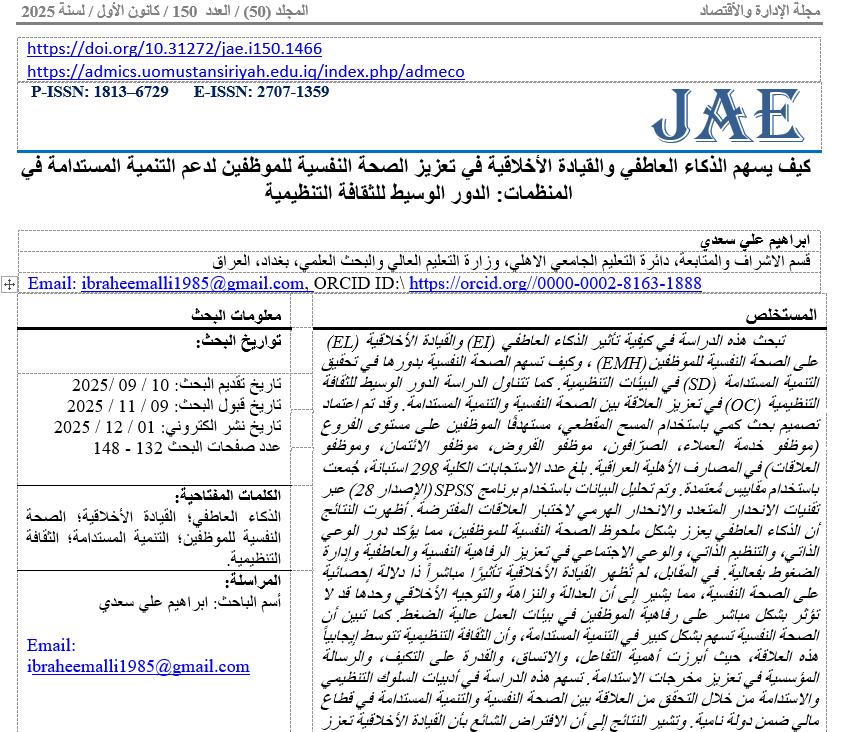
تبحث هذه الدراسة في كيفية تأثير الذكاء العاطفي (EI) والقيادة الأخلاقية (EL) على الصحة النفسية للموظفين (EMH)، وكيف تسهم الصحة النفسية بدورها في تحقيق التنمية المستدامة (SD) في البيئات التنظيمية. كما تتناول الدراسة الدور الوسيط للثقافة التنظيمية (OC) في تعزيز العلاقة بين الصحة النفسية والتنمية المستدامة. وقد تم اعتماد تصميم بحث كمي باستخدام المسح المقطعي، مستهدفًا الموظفين على مستوى الفروع (موظفو خدمة العملاء، الصرّافون، موظفو القروض، موظفو الائتمان، وموظفو العلاقات) في المصارف الأهلية العراقية. بلغ عدد الاستجابات الكلية 298 استبانة، جُمعت باستخدام مقاييس مُعتمدة. وتم تحليل البيانات باستخدام برنامج SPSS (الإصدار 28) عبر تقنيات الانحدار المتعدد والانحدار الهرمي لاختبار العلاقات المفترضة. أظهرت النتائج أن الذكاء العاطفي يعزز بشكل ملحوظ الصحة النفسية للموظفين، مما يؤكد دور الوعي الذاتي، والتنظيم الذاتي، والوعي الاجتماعي في تعزيز الرفاهية النفسية والعاطفية وإدارة الضغوط بفعالية. في المقابل، لم تُظهر القيادة الأخلاقية تأثيرًا مباشراً ذا دلالة إحصائية على الصحة النفسية، مما يشير إلى أن العدالة والنزاهة والتوجيه الأخلاقي وحدها قد لا تؤثر بشكل مباشر على رفاهية الموظفين في بيئات العمل عالية الضغط. كما تبين أن الصحة النفسية تسهم بشكل كبير في التنمية المستدامة، وأن الثقافة التنظيمية تتوسط إيجابياً هذه العلاقة، حيث أبرزت أهمية التفاعل، والاتساق، والقدرة على التكيف، والرسالة المؤسسية في تعزيز مخرجات الاستدامة. تسهم هذه الدراسة في أدبيات السلوك التنظيمي والاستدامة من خلال التحقق من العلاقة بين الصحة النفسية والتنمية المستدامة في قطاع مالي ضمن دولة نامية. وتشير النتائج إلى أن الافتراض الشائع بأن القيادة الأخلاقية تعزز الصحة النفسية بشكل دائم قد لا يكون صحيحًا في جميع السياقات، كما توسع الأطر النظرية القائمة عبر تسليط الضوء على دور الوسيط للثقافة التنظيمية.
التنزيلات
المراجع
[1] Ahmed Al-Dawoodi, S. A., Al-Abdallah, G., & Večeřová, V. (2025). Leveraging Business Model Innovation for Digital Transformation in Iraq. DOI: https://doi.org/10.36689/uhk/hed/2025-01-001
[2] Ahsan, M. J., & Khawaja, S. (2024). Sustainable leadership impact on environmental performance: exploring employee well-being, innovation, and organizational resilience. Discover Sustainability, 5(1), 317. DOI: https://doi.org/10.1007/s43621-024-00422-z
[3] Ajmal, M., Khan, M., Hussain, M., & Helo, P. (2018). Conceptualizing and incorporating social sustainability in the business world. International Journal of Sustainable Development & World Ecology, 25(4), 327–339. DOI: https://doi.org/10.1080/13504509.2017.1408714
[4] Akanni, A. A., Kareem, D. B., & Oduaran, C. A. (2019). Emotional intelligence and work engagement among bank workers: moderated mediation model of ethical leadership and job burnout. International Journal of Work Organisation and Emotion, 10(4), 357–371. DOI: https://doi.org/10.1504/IJWOE.2019.106885
[5] Ali, M., Qu, Y., Shafique, S., Pham, N. T., & Usman, M. (2022). The role of ethical leadership in enhancing exploitative and explorative learning simultaneously: what does it matter if employees view work as central? Personnel Review, 51(2), 787–804. DOI: https://doi.org/10.1108/PR-12-2019-0708
[6] Alkhalefy, S., Piroozfar, P., & Church, A. (2016). Urban management and resilience in post-conflict settings through housing interventions in post-war Iraq.
[7] Al-Samarraie, H., Sarsam, S. M., Lonsdale, M., & Alzahrani, A. I. (2023). Emotional intelligence and individual visual preferences: A predictive machine learning approach. International Journal of Human–Computer Interaction, 39(12), 2392–2400. DOI: https://doi.org/10.1080/10447318.2022.2075630
[8] Amory, J., Wille, B., Wiernik, B. M., & Dupré, S. (2024). Ethical leadership on the rise? A cross-temporal and cross-cultural meta-analysis of its means, variability, and relationships with follower outcomes across 15 years. Journal of Business Ethics, 194(2), 455–483. DOI: https://doi.org/10.1007/s10551-024-05632-z
[9] Banerjee, R., Chauhan, A. S., & Banerjee, S. (2024). Understanding Employee Well-Being in the Education Industry Through the Innovative Approach of Sustainable Leadership. In Fostering Industry-Academia Partnerships for Innovation-Driven Trade (pp. 131–146). IGI Global. DOI: https://doi.org/10.4018/979-8-3693-3096-8.ch010
[10] Baruch, Y., & Holtom, B. (2008). Survey response rate levels and trends in organizational research. Human Relations, 61(8), 1139–1160. DOI: https://doi.org/10.1177/0018726708094863
[11] Brasseur, S., & Mikolajczak, M. (2023). Emotional intelligence and workplace well-being: A systematic review and future research agenda. Journal of Organizational Behavior, 44(1), 45–62.
[12] Carmeli, A. (2003). The relationship between emotional intelligence and work attitudes, behavior and outcomes: An examination among senior managers. Journal of Managerial Psychology, 18(8), 788–813. DOI: https://doi.org/10.1108/02683940310511881
[13] Chillakuri, B., & Vanka, S. (2021). Examining the effects of workplace well-being and high-performance work systems on health harm: a Sustainable HRM perspective. Society and Business Review, 16(1), 71–93. DOI: https://doi.org/10.1108/SBR-03-2020-0033
[14] Chung, S. R., Cichocki, M. N., & Chung, K. C. (2023). Building emotional intelligence. Plastic and Reconstructive Surgery, 151(1), 1–5. DOI: https://doi.org/10.1097/PRS.0000000000009756
[15] Deb Biswas, D., & Sengupta, R. (2025). Perceived authentic leadership style and the resource spiral: unlocking employee well-being through support and balance. Leadership & Organization Development Journal, 1–17. DOI: https://doi.org/10.1108/LODJ-06-2025-0403
[16] Denison. (1990). Corporate culture and organizational effectiveness. Wiley.
[17] Denison, & Kotrba, L. (2014). Diagnosing organizational cultures: A conceptual and empirical review of culture effectiveness research. European Journal of Work and Organizational Psychology, 23(1), 145–161. DOI: https://doi.org/10.1080/1359432X.2012.713173
[18] Dennerlein, T., & Kirkman, B. L. (2022). The hidden dark side of empowering leadership: The moderating role of hindrance stressors in explaining when empowering employees can promote moral disengagement and unethical pro-organizational behavior. Journal of Applied Psychology, 107(12), 2220. DOI: https://doi.org/10.1037/apl0001013
[19] Fornell, C., & Larcker, D. F. (1981). Evaluating structural equation models with unobservable variables and measurement error. Journal of Marketing Research, 18(1), 39–50. DOI: https://doi.org/10.1177/002224378101800104
[20] Gaikwad, S., Swaminathan, L., & George, S. (2021). Impact of work-life balance on job performance-analysis of the mediating role of mental well-being and work engagement on women employees in IT sector. 2021 International Conference on Decision Aid Sciences and Application (DASA), 204–209. DOI: https://doi.org/10.1109/DASA53625.2021.9681920
[21] Grobelny, J., Radke, P., & Paniotova-Maczka, D. (2021). Emotional intelligence and job performance: A meta-analysis. International Journal of Work Organisation and Emotion, 12(1), 1–47. DOI: https://doi.org/10.1504/IJWOE.2021.115620
[22] Gupta, V., & Singh, S. (2024). Linking mental health and sustainability: The role of psychological well-being in achieving sustainable development goals. Sustainability, 16(2).
[23] Hair Jr, J. F., Hult, G. T. M., Ringle, C. M., Sarstedt, M., Danks, N. P., & Ray, S. (2021). Partial least squares structural equation modeling (PLS-SEM) using R: A workbook. Springer Nature. DOI: https://doi.org/10.1007/978-3-030-80519-7
[24] Hariram, N. P., Mekha, K. B., Suganthan, V., & Sudhakar, K. (2023). Sustainalism: An integrated socio-economic-environmental model to address sustainable development and sustainability. Sustainability, 15(13), 10682. DOI: https://doi.org/10.3390/su151310682
[25] Hobfoll, S. (1989). Conservation of resources: A new attempt at conceptualizing stress. American Psychologist, 44, 513–524. DOI: https://doi.org/10.1037/0003-066X.44.3.513
[26] Hristov, I., Appolloni, A., Cheng, W., & Huisingh, D. (2022). Aligning corporate social responsibility practices with the environmental performance management systems: A critical review of the relevant literature. Total Quality Management & Business Excellence, 1–25. DOI: https://doi.org/10.1080/14783363.2022.2048951
[27] Iman, B. A., Tjahjono, H. K., & Qamari, I. N. (2024). Examining the influence of organizational justice and workplace spirituality on mental health: exploring the interplay of interpersonal trust. Educ. Admin. Theory and Prac, 30, 7666–7677. DOI: https://doi.org/10.53555/kuey.v30i5.3052
[28] Imperatives, S. (1987). Report of the World Commission on Environment and Development: Our common future. Accessed Feb, 10(42,427), 1–223.
[29] Ispiryan, A., Pakeltiene, R., Ispiryan, O., & Giedraitis, A. (2024). Fostering organizational sustainability through employee collaboration: An integrative approach to environmental, social, and economic dimensions. Encyclopedia, 4(4), 1806–1826. DOI: https://doi.org/10.3390/encyclopedia4040119
[30] Karmazínová, A. (2025). Koncept gramotnosti v oblasti duševního zdraví: Implementace do výuky ZŠ.
[31] Keyes, C. L. M. (2005). Mental illness and/or mental health? Investigating axioms of the complete state model of health. Journal of Consulting and Clinical Psychology, 73(3), 539. DOI: https://doi.org/10.1037/0022-006X.73.3.539
[32] Kharchyshyna, O., & Trushkina, N. (2021). Diagnosis of organizational culture and trends in its development in higher education. Modern Management: Theories, Concepts, Implementation: Monograph. Opole: The Academy of Management and Administration in Opole, 294–308.
[33] Kim, M., & Kim, J. (2021). Corporate social responsibility, employee engagement, well-being and the task performance of frontline employees. Management Decision, 59(8), 2040–2056. DOI: https://doi.org/10.1108/MD-03-2020-0268
[34] Kim, S., Jeong, S. H., & Seo, M. H. (2022). Nurses’ ethical leadership and related outcome variables: Systematic review and meta‐analysis. Journal of Nursing Management, 30(7), 2308–2323. DOI: https://doi.org/10.1111/jonm.13726
[35] Klewitz, J., & Hansen, E. G. (2018). Sustainability-oriented innovation in SMEs: A systematic literature review of existing practices and actors involved. SSRN.
[36] Kota, V., & Solomon, C. (2024). Exploring the impact of organizational culture and leadership support onemployee engagement in achieving green sustainability-A manufacturing sectorperspective.
[37] Lu, L., Ko, Y.-M., Chen, H.-Y., Chueh, J.-W., Chen, P.-Y., & Cooper, C. L. (2022). Patient safety and staff well-being: organizational culture as a resource. International Journal of Environmental Research and Public Health, 19(6), 3722. DOI: https://doi.org/10.3390/ijerph19063722
[38] Madero-Gómez, S. M., Rubio Leal, Y. L., Olivas-Luján, M., & Yusliza, M. Y. (2023). Companies could benefit when they focus on employee wellbeing and the environment: a systematic review of Sustainable Human Resource Management. Sustainability, 15(6), 5435. DOI: https://doi.org/10.3390/su15065435
[39] Munira, K. S., Rahman, M. S., & Akhter, S. (2022). Impact of Emotional Intelligence on Sustainable Leadership: A. DOI: https://doi.org/10.38157/bpr.v4i2.446
[40] Nunnally, J., & Bernstein, I. (1994). Psychometric theory (3rd ed.). McGraw-Hill.
[41] Onesti, G. (2023). Exploring the impact of leadership styles, ethical behavior, and organizational identification on workers’ well-being. Administrative Sciences, 13(6), 149. DOI: https://doi.org/10.3390/admsci13060149
[42] Opferkuch, K., Caeiro, S., Salomone, R., & Ramos, T. B. (2021). Circular economy in corporate sustainability reporting: A review of organisational approaches. Business Strategy and the Environment, 30(8), 4015–4036. DOI: https://doi.org/10.1002/bse.2854
[43] Organization, W. H. (2023). WHO policy brief on the health aspects of decriminalization of suicide and suicide attempts. World Health Organization.
[44] Otsuka, Y., Itani, O., Matsumoto, Y., & Kaneita, Y. (2022). Associations between coping profile and work performance in a cohort of Japanese employees. International Journal of Environmental Research and Public Health, 19(8), 4806. DOI: https://doi.org/10.3390/ijerph19084806
[45] Pallant, J. (2020). SPSS survival manual: A step by step guide to data analysis using IBM SPSS. Routledge. DOI: https://doi.org/10.4324/9781003117407
[46] Saadi, I. A. (2023). Effect of Organisational Strategy on Sustainable Competitive Advantage of Manufacturing SMEs: Mediating Role of Managerial Creativity.
[47] Saadi, I. A., & Razak, R. C. (2019). Organizational Change and Organizational Sustainability: The mediating effect of Innovative Human Capital. Opción: Revista de Ciencias Humanas y Sociales, 89, 180.
[48] Saadi, I. A., Sawadi, Z. T., & Al-Salami, Q. H. (2023). An evaluation study on leadership styles and its impact on academic employees’ job satisfaction (Private Iraqi universities as an example). Journal Port Science Research, 6(3), 240–250. DOI: https://doi.org/10.36371/port.2023.3.6
[49] Singh, B., Malviya, R., & Kaunert, C. (2024). Elevating workplace sustainability for employees lensing mental health advancements: runway for future ready healthcare services projecting SDG 3 (good health and well-being). In Impact of Corporate Social Responsibility on Employee Wellbeing (pp. 285–310). IGI Global. DOI: https://doi.org/10.4018/979-8-3693-3470-6.ch014
[50] Soto, C. J., Napolitano, C. M., Sewell, M. N., Yoon, H. J., & Roberts, B. W. (2022). An integrative framework for conceptualizing and assessing social, emotional, and behavioral skills: The BESSI. Journal of Personality and Social Psychology, 123(1), 192. DOI: https://doi.org/10.1037/pspp0000401
[51] Stuber, F., Seifried-Dübon, T., Rieger, M. A., Gündel, H., Ruhle, S., Zipfel, S., & Junne, F. (2021). The effectiveness of health-oriented leadership interventions for the improvement of mental health of employees in the health care sector: a systematic review. International Archives of Occupational and Environmental Health, 94(2), 203–220. DOI: https://doi.org/10.1007/s00420-020-01583-w
[52] Takona, J. P. (2024). Research design: qualitative, quantitative, and mixed methods approaches. Quality & Quantity, 58(1), 1011–1013. DOI: https://doi.org/10.1007/s11135-023-01798-2
[53] Winton, B. G. (2022). Emotional intelligence congruence: the influence of leader and follower emotional abilities on job satisfaction. Leadership & Organization Development Journal, 43(5), 788–801. DOI: https://doi.org/10.1108/LODJ-04-2021-0163
[54] Wong, C., & Law, K. (2002). The effects of leader and follower emotional intelligence on performance and attitude. The Leadership Quarterly, 13(3), 243–274. DOI: https://doi.org/10.1016/S1048-9843(02)00099-1
[55] Xenikou, A., & Furnham, A. (2022). Leadership and organizational culture. Handbook of Research Methods for Organisational Culture, 23–38. DOI: https://doi.org/10.4337/9781788976268.00009
[56] Zaidi, S. Y. A., Waqas, M., Jamshed, S., & Mahmood, F. (2023). Role of GHRMPs and religiosity in determining the equilibrium between environmental-sustainability and subjective wellbeing through pro-environmental behaviors: A cross-domain model for Pakistani corporate sector. International Journal of Business Reflections, 3(2). DOI: https://doi.org/10.56249/ijbr.03.01.31
التنزيلات
منشور
إصدار
القسم
الرخصة
الحقوق الفكرية (c) 2025 Ibraheem Ali Saadi

هذا العمل مرخص بموجب Creative Commons Attribution 4.0 International License.
مجلة الإدارة والاقتصاد هي مجلة مفتوحة المصدر حيث تكون جميع محتوياتها مجانية. تخضع مقالات هذه المجلة لشروط ترخيص المشاع الإبداعي المنسوب إلى المؤلف (CC-BY 4.0) (https://creativecommons.org/licenses/by/4.0/legalcode) الذي يسمح للمرخص لهم دون قيود بالبحث عن النص الكامل للمقالات أو تنزيله أو مشاركته أو توزيعه أو طباعته أو ربطه به، وفحصه للفهرسة وإعادة إنتاج أي وسيلة للمقالات بشرط أن ينسبوا إلى المؤلفين الفضل في ذلك (الاستشهاد). تسمح المجلة للمؤلفين بالاحتفاظ بحقوق الطبع والنشر لمقالهم المنشور.
. Creative Commons-Attribution (BY)