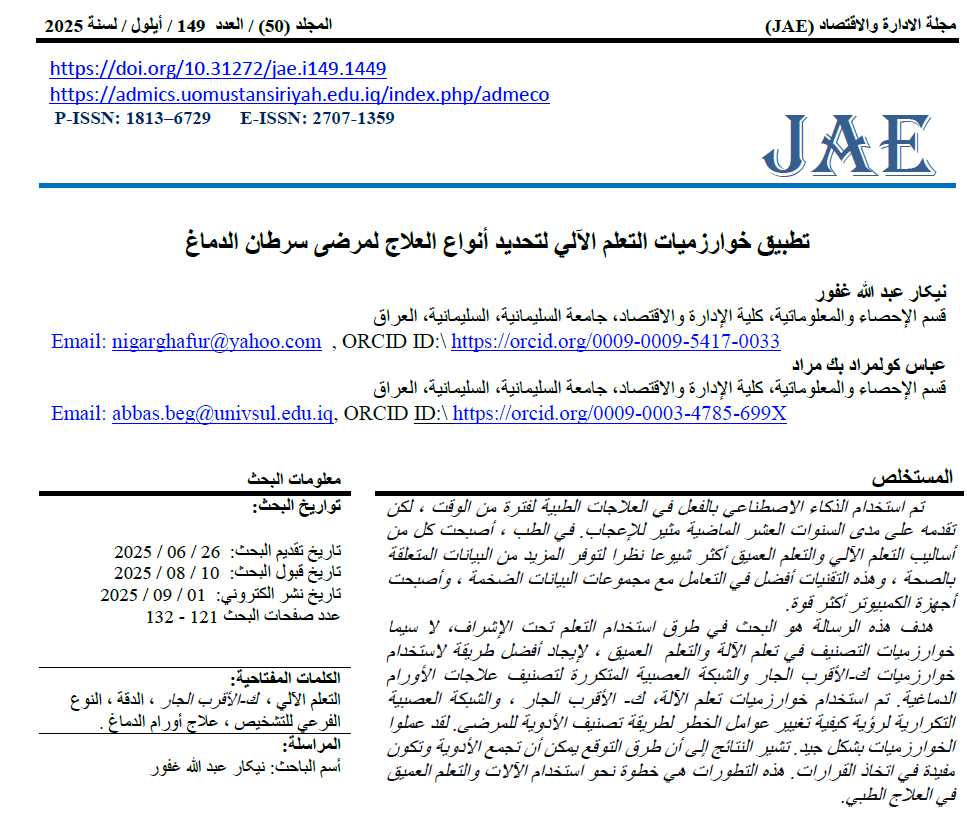
تطبيق خوارزميات التعلم الآلي لتحديد أنواع العلاج لمرضى سرطان الدماغ
DOI:
https://doi.org/10.31272/jae.i149.1449الكلمات المفتاحية:
التعلم الآلي ، K-nearest neighbor، الدقة، النوع الفرعي للتشخيص ، علاج أورام الدماغالملخص
يعمل التعلم الآلي، وهو فرع من الذكاء الاصطناعي، على تحويل القطاع الطبي من خلال تمكين إنشاء أدوات ذكية وأنظمة خبراء لمعالجة البيانات. تستخدم هذه التقنية البيانات لإنتاج توقعات أو أحكام دون برمجة مباشرة، مما يعزز الإنتاجية والدقة في اكتشاف الأدوية وتطويرها، ويحدث ثورة في البحث العلمي والمجتمع. الغرض من هذه الورقة هو التحقيق في كيفية استخدام التعلم الخاضع للإشراف، وبشكل أكثر تحديدًا خوارزميات التعلم الآلي للتصنيف، لاكتشاف أفضل طريقة لتصنيف علاج أورام الدماغ باستخدام خوارزمية الجيران الأقرب (K-Nearest Neighbor). نتيجة لاختبار الدقة بنسبة 92-94٪ ودقة التدريب بنسبة 94-96٪، فإن تقنية تصنيف الجيران الأقرب (K-Nearest Neighbor) دقيقة وموثوقة بشكل لا يصدق.إنه ممتاز في التنبؤ بالعمر، وحجم الورم، ودرجة السرطان، وردود الفعل تجاه الأدوية. تُظهر درجات الدقة والاستدعاء وF1، جميعها فوق 0.95، موثوقيته. ومع ذلك، نظرًا لأن الدقة تستقر مع حجم مجموعة التدريب، قد تؤدي البيانات الأكثر إلى أداء أفضل.
التنزيلات
المراجع
[1] Alnuaimi, A. F., & Albaldawi, T. H. (2024). “An overview of machine learning classification techniques”. In BIO Web of Conferences (Vol. 97, p. 00133). EDP Sciences. 10.1051/bioconf/20249700133 DOI: https://doi.org/10.1051/bioconf/20249700133
[2] Bottrighi, A., & Pennisi, M. (2023). “Exploring the state of machine learning and deep learning in medicine: A survey of the italian research community”. Information, 14(9), 513. DOI: https://doi.org/10.3390/info14090513
10.3390/info14090513 DOI: https://doi.org/10.3390/info14090513
[3] Chavda, V. P., Anand, K., & Apostolopoulos, V. (Eds.). (2023). “Bioinformatics tools for pharmaceutical drug product development”. John Wiley & Sons. DOI: https://doi.org/10.1002/9781119865728
10.1002/9781119865728 DOI: https://doi.org/10.1002/9781119865728
[4] Hu, L. Y., Huang, M. W., Ke, S. W., & Tsai, C. F. (2016). “The distance function effect on k-nearest neighbor classification for medical datasets”. SpringerPlus, 5, 1-9. DOI: https://doi.org/10.1186/s40064-016-2941-7
https://doi.org/10.1186/s40064 016 2941 7
[5] Iqbal, M. J., Javed, Z., Sadia, H., Qureshi, I. A., Irshad, A., Ahmed, R., ... & Sharifi-Rad, J. (2021). “Clinical applications of artificial intelligence and machine learning in cancer diagnosis: looking into the future”. Cancer cell international, 21(1), 270. DOI: https://doi.org/10.1186/s12935-021-01981-1
10.1186/s12935-021-01981-1 DOI: https://doi.org/10.1186/s12935-021-01981-1
[6] Jain, G. (2022). “Application of Machine Learning in Drug Discovery and Development Lifecycle”. Int J Med Phar Drug Re, 16. 10.22161/ijmpd.6.6.4 DOI: https://doi.org/10.22161/ijmpd.6.6.4
[7] Khaldi, B., Babelhadj, Z., & Khemgani, S. (2021). “Classification of brain tumor using some approaches of machine learning” (Doctoral dissertation, University of Kasdi Merbah Ouargla). https://dspace.univ-ouargla.dz/jspui/handle/123456789/35039
[8] Krzyszczyk, P., Acevedo, A., Davidoff, E. J., Timmins, L. M., Marrero-Berrios, I., Patel, M., ... &Yarmush, M. L. (2018). “The growing role of precision and personalized medicine for cancer treatment”. Technology, 6(03n04), 79-100.10.1142/s2339547818300020 DOI: https://doi.org/10.1142/S2339547818300020
[9] Kumar, L. A., Satapathy, B. S., Pattnaik, G., Barik, B., Patro, C. S., & Das, S. (2021). “Malignant brain tumor: Current progresses in diagnosis, treatment and future strategies”. Ann Rom Soc Cell Biol, 25(6), 16922-32.
(PDF) Malignant brain tumor: Current progresses in diagnosis, treatment and future strategies
[10] Maleki Varnosfaderani, S., & Forouzanfar, M. (2024). “The role of AI in hospitals and clinics: transforming healthcare in the 21st century”. Bioengineering, 11(4), 337. https://doi: 10.3390/bioengineering11040337 DOI: https://doi.org/10.3390/bioengineering11040337
[11] Mitusova, K., Peltek, O. O., Karpov, T. E., Muslimov, A. R., Zyuzin, M. V., & Timin, A. S. (2022). “Overcoming the blood–brain barrier for the therapy of malignant brain tumor: current status and prospects of drug delivery approaches”. Journal of nanobiotechnology, 20(1), 412. 10.1186/s12951-022-01610-7 DOI: https://doi.org/10.1186/s12951-022-01610-7
[12] Nababan, A., Khairi, M., & Harahap, B. (2022). “Implementation of K-Nearest Neighbors (KNN) algorithm in classification of data water quality”. J. Mantik, 6(1), 30-35.
https://iocscience.org/ejournal/index.php/mantik/article/download/2130/1669
[13] Naimi, A., Deng, J., Shimjith, S. R., & Arul, A. J. (2022). “Fault detection and isolation of a pressurized water reactor based on neural network and k-nearest neighbor”. IEEE Access, 10,17113-17121. 10.1109/ACCESS.2022.3149772 DOI: https://doi.org/10.1109/ACCESS.2022.3149772
https://doi.org/10.2174/1570159X18666200626204005 DOI: https://doi.org/10.2174/1570159X18666200626204005
[14] Osisanwo, F. Y., Akinsola, J. E. T., Awodele, O., Hinmikaiye, J. O., Olakanmi, O., & Akinjobi,J. (2017). “Supervised machine learning algorithms: classification and comparison”. International Journal of Computer Trends and Technology (IJCTT), 48(3), 128-138. 10.14445/22312803/IJCTT-V48P126 DOI: https://doi.org/10.14445/22312803/IJCTT-V48P126
[15] Parvin, H., Alizadeh, H., & Minaei-Bidgoli, B. (2008). “MKNN: Modified k-nearest neighbor”. In Proceedings of the world congress on engineering and computer science (Vol. 1). Newswood Limited. Microsoft Word - Final CameraReady_MKNN_WCECS2008.doc
[16] Qian, T., Zhu, S., & Hoshida, Y. (2019). “Use of big data in drug development for precision medicine: an update”. Expert review of precision medicine and drug development, 4(3), 189-200. DOI: https://doi.org/10.1080/23808993.2019.1617632
https://doi.org/10.1080/23808993.2019.1617632 DOI: https://doi.org/10.1080/23808993.2019.1617632
[17] Raghavapudi, H., Singroul, P., & Kohila, V. (2021). “Brain tumor causes, symptoms, diagnosis and radiotherapy treatment”. Current Medical Imaging Reviews, 17(8), 931-942. DOI: https://doi.org/10.2174/1573405617666210126160206
https://doi.org/10.2174/1573405617666210126160206 DOI: https://doi.org/10.2174/1573405617666210126160206
[18] Sarwar, A., Ali, M., Manhas, J., & Sharma, V. (2020). “Diagnosis of diabetes type-II using hybrid machine learning based ensemble model”. International Journal of Information Technology, 12, 419-428. https://doi.org/10.1007/s41870-018-0270-5 DOI: https://doi.org/10.1007/s41870-018-0270-5
[19] Shetty, S. H., Shetty, S., Singh, C., & Rao, A. (2022). “Supervised machine learning: algorithms and applications”. Fundamentals and methods of machine and deep learning: algorithms, tools and applications, 1-16. http://dx.doi.org/10.1002/9781119821908.ch1 DOI: https://doi.org/10.1002/9781119821908.ch1
[20] Suyal, M., & Goyal, P. (2022). “A review on analysis of k-nearest neighbor classification machine learning algorithms based on supervised learning”. International Journal of Engineering Trends and Technology, 70(7), 43-48 / https://doi.org/10.14445/22315381/IJETT-V70I7P205 DOI: https://doi.org/10.14445/22315381/IJETT-V70I7P205
[21] Taha, A. M., Ariffin, D. S. B. B., & Abu-Naser, S. S. (2023). “A systematic literature review of deep and machine learning algorithms in brain tumor and meta-analysis”. Journal of Theoretical and Applied Information Technology, 101(1), 21-36. www.jatit.org .
Microsoft Word - 3 47528 44252851 jatit-A Systematic Literature Review-ashraf -28-11-2022
[22] Woodman, R. J., & Mangoni, A. A. (2023). “A comprehensive review of machine learning algorithms and their application in geriatric medicine: present and future”. Aging Clinical and Experimental Research, 35(11), 2363-2397. 10.1007/s40520-023-02552-2 DOI: https://doi.org/10.1007/s40520-023-02552-2
التنزيلات
منشور
إصدار
القسم
الرخصة
الحقوق الفكرية (c) 2025 Nigar Abdulla Ghafur , Abbas Gulmurad Beg Murad

هذا العمل مرخص بموجب Creative Commons Attribution 4.0 International License.
مجلة الإدارة والاقتصاد هي مجلة مفتوحة المصدر حيث تكون جميع محتوياتها مجانية. تخضع مقالات هذه المجلة لشروط ترخيص المشاع الإبداعي المنسوب إلى المؤلف (CC-BY 4.0) (https://creativecommons.org/licenses/by/4.0/legalcode) الذي يسمح للمرخص لهم دون قيود بالبحث عن النص الكامل للمقالات أو تنزيله أو مشاركته أو توزيعه أو طباعته أو ربطه به، وفحصه للفهرسة وإعادة إنتاج أي وسيلة للمقالات بشرط أن ينسبوا إلى المؤلفين الفضل في ذلك (الاستشهاد). تسمح المجلة للمؤلفين بالاحتفاظ بحقوق الطبع والنشر لمقالهم المنشور.
. Creative Commons-Attribution (BY)