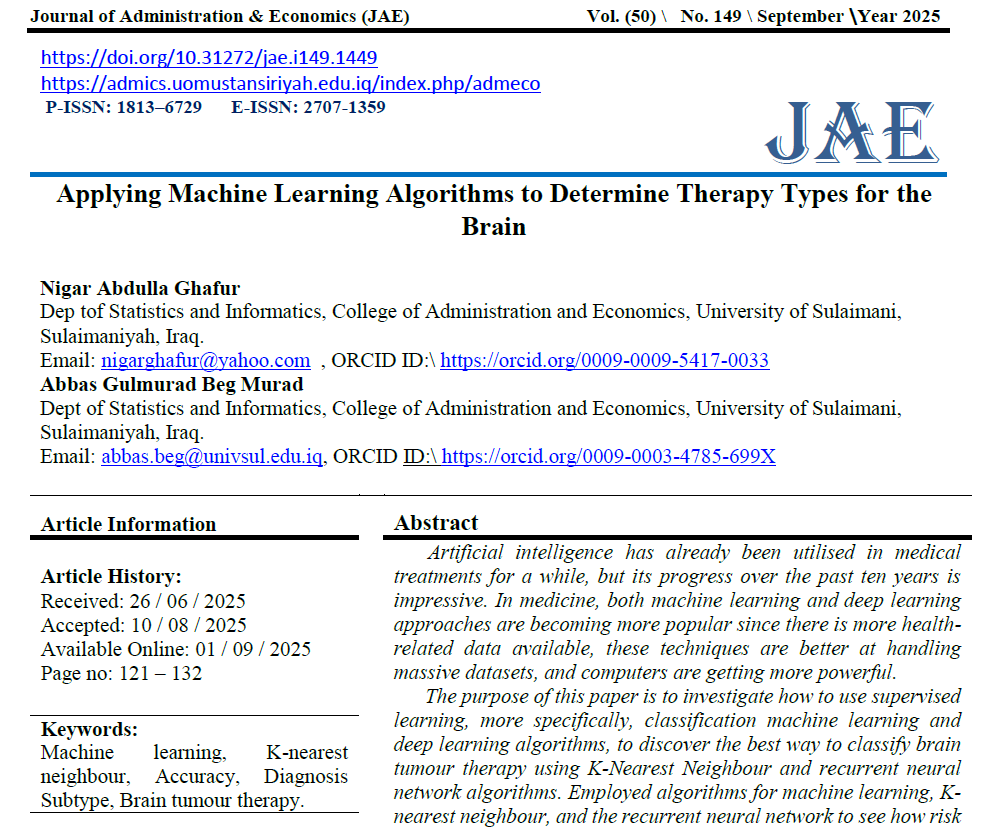
Applied Machine Learning Algorithms to Determine Therapy Types for Brain Cancer Patients
DOI:
https://doi.org/10.31272/jae.i149.1449Keywords:
Machine learning, K-nearest neighbor , Accuracy, Diagnosis Subtype , Brain tumor therapyAbstract
Machine learning, a branch of artificial intelligence, is revolutionizing the medical sector by enabling the creation of smart tools and expert systems for data processing. This technology, which uses data to generate predictions or judgments without direct programming, is enhancing productivity and precision in drug discovery and development, revolutionizing scientific research and society.
The purpose of this paper is to investigate how to use supervised learning, more specifically classification machine learning algorithms, to discover the best way to classify brain tumor therapy using K-Nearest Neighbor. The result of testing accuracy of 92-94% and training accuracy of 94-96% is that the K-Nearest Neighbor classification technique is incredibly accurate and dependable. It is excellent at predicting age, tumor size, cancer grade, and drug reactions. Precision, recall, and F1 scores, all above 0.95, demonstrate its reliability. However, since accuracy stabilizes with the size of the training set, more data may result in better performance.
Downloads
References
[1] Alnuaimi, A. F., & Albaldawi, T. H. (2024). “An overview of machine learning classification techniques”. In BIO Web of Conferences (Vol. 97, p. 00133). EDP Sciences. 10.1051/bioconf/20249700133 DOI: https://doi.org/10.1051/bioconf/20249700133
[2] Bottrighi, A., & Pennisi, M. (2023). “Exploring the state of machine learning and deep learning in medicine: A survey of the italian research community”. Information, 14(9), 513. DOI: https://doi.org/10.3390/info14090513
10.3390/info14090513 DOI: https://doi.org/10.3390/info14090513
[3] Chavda, V. P., Anand, K., & Apostolopoulos, V. (Eds.). (2023). “Bioinformatics tools for pharmaceutical drug product development”. John Wiley & Sons. DOI: https://doi.org/10.1002/9781119865728
10.1002/9781119865728 DOI: https://doi.org/10.1002/9781119865728
[4] Hu, L. Y., Huang, M. W., Ke, S. W., & Tsai, C. F. (2016). “The distance function effect on k-nearest neighbor classification for medical datasets”. SpringerPlus, 5, 1-9. DOI: https://doi.org/10.1186/s40064-016-2941-7
https://doi.org/10.1186/s40064 016 2941 7
[5] Iqbal, M. J., Javed, Z., Sadia, H., Qureshi, I. A., Irshad, A., Ahmed, R., ... & Sharifi-Rad, J. (2021). “Clinical applications of artificial intelligence and machine learning in cancer diagnosis: looking into the future”. Cancer cell international, 21(1), 270. DOI: https://doi.org/10.1186/s12935-021-01981-1
10.1186/s12935-021-01981-1 DOI: https://doi.org/10.1186/s12935-021-01981-1
[6] Jain, G. (2022). “Application of Machine Learning in Drug Discovery and Development Lifecycle”. Int J Med Phar Drug Re, 16. 10.22161/ijmpd.6.6.4 DOI: https://doi.org/10.22161/ijmpd.6.6.4
[7] Khaldi, B., Babelhadj, Z., & Khemgani, S. (2021). “Classification of brain tumor using some approaches of machine learning” (Doctoral dissertation, University of Kasdi Merbah Ouargla). https://dspace.univ-ouargla.dz/jspui/handle/123456789/35039
[8] Krzyszczyk, P., Acevedo, A., Davidoff, E. J., Timmins, L. M., Marrero-Berrios, I., Patel, M., ... &Yarmush, M. L. (2018). “The growing role of precision and personalized medicine for cancer treatment”. Technology, 6(03n04), 79-100.10.1142/s2339547818300020 DOI: https://doi.org/10.1142/S2339547818300020
[9] Kumar, L. A., Satapathy, B. S., Pattnaik, G., Barik, B., Patro, C. S., & Das, S. (2021). “Malignant brain tumor: Current progresses in diagnosis, treatment and future strategies”. Ann Rom Soc Cell Biol, 25(6), 16922-32.
(PDF) Malignant brain tumor: Current progresses in diagnosis, treatment and future strategies
[10] Maleki Varnosfaderani, S., & Forouzanfar, M. (2024). “The role of AI in hospitals and clinics: transforming healthcare in the 21st century”. Bioengineering, 11(4), 337. https://doi: 10.3390/bioengineering11040337 DOI: https://doi.org/10.3390/bioengineering11040337
[11] Mitusova, K., Peltek, O. O., Karpov, T. E., Muslimov, A. R., Zyuzin, M. V., & Timin, A. S. (2022). “Overcoming the blood–brain barrier for the therapy of malignant brain tumor: current status and prospects of drug delivery approaches”. Journal of nanobiotechnology, 20(1), 412. 10.1186/s12951-022-01610-7 DOI: https://doi.org/10.1186/s12951-022-01610-7
[12] Nababan, A., Khairi, M., & Harahap, B. (2022). “Implementation of K-Nearest Neighbors (KNN) algorithm in classification of data water quality”. J. Mantik, 6(1), 30-35.
https://iocscience.org/ejournal/index.php/mantik/article/download/2130/1669
[13] Naimi, A., Deng, J., Shimjith, S. R., & Arul, A. J. (2022). “Fault detection and isolation of a pressurized water reactor based on neural network and k-nearest neighbor”. IEEE Access, 10,17113-17121. 10.1109/ACCESS.2022.3149772 DOI: https://doi.org/10.1109/ACCESS.2022.3149772
https://doi.org/10.2174/1570159X18666200626204005 DOI: https://doi.org/10.2174/1570159X18666200626204005
[14] Osisanwo, F. Y., Akinsola, J. E. T., Awodele, O., Hinmikaiye, J. O., Olakanmi, O., & Akinjobi,J. (2017). “Supervised machine learning algorithms: classification and comparison”. International Journal of Computer Trends and Technology (IJCTT), 48(3), 128-138. 10.14445/22312803/IJCTT-V48P126 DOI: https://doi.org/10.14445/22312803/IJCTT-V48P126
[15] Parvin, H., Alizadeh, H., & Minaei-Bidgoli, B. (2008). “MKNN: Modified k-nearest neighbor”. In Proceedings of the world congress on engineering and computer science (Vol. 1). Newswood Limited. Microsoft Word - Final CameraReady_MKNN_WCECS2008.doc
[16] Qian, T., Zhu, S., & Hoshida, Y. (2019). “Use of big data in drug development for precision medicine: an update”. Expert review of precision medicine and drug development, 4(3), 189-200. DOI: https://doi.org/10.1080/23808993.2019.1617632
https://doi.org/10.1080/23808993.2019.1617632 DOI: https://doi.org/10.1080/23808993.2019.1617632
[17] Raghavapudi, H., Singroul, P., & Kohila, V. (2021). “Brain tumor causes, symptoms, diagnosis and radiotherapy treatment”. Current Medical Imaging Reviews, 17(8), 931-942. DOI: https://doi.org/10.2174/1573405617666210126160206
https://doi.org/10.2174/1573405617666210126160206 DOI: https://doi.org/10.2174/1573405617666210126160206
[18] Sarwar, A., Ali, M., Manhas, J., & Sharma, V. (2020). “Diagnosis of diabetes type-II using hybrid machine learning based ensemble model”. International Journal of Information Technology, 12, 419-428. https://doi.org/10.1007/s41870-018-0270-5 DOI: https://doi.org/10.1007/s41870-018-0270-5
[19] Shetty, S. H., Shetty, S., Singh, C., & Rao, A. (2022). “Supervised machine learning: algorithms and applications”. Fundamentals and methods of machine and deep learning: algorithms, tools and applications, 1-16. http://dx.doi.org/10.1002/9781119821908.ch1 DOI: https://doi.org/10.1002/9781119821908.ch1
[20] Suyal, M., & Goyal, P. (2022). “A review on analysis of k-nearest neighbor classification machine learning algorithms based on supervised learning”. International Journal of Engineering Trends and Technology, 70(7), 43-48 / https://doi.org/10.14445/22315381/IJETT-V70I7P205 DOI: https://doi.org/10.14445/22315381/IJETT-V70I7P205
[21] Taha, A. M., Ariffin, D. S. B. B., & Abu-Naser, S. S. (2023). “A systematic literature review of deep and machine learning algorithms in brain tumor and meta-analysis”. Journal of Theoretical and Applied Information Technology, 101(1), 21-36. www.jatit.org .
Microsoft Word - 3 47528 44252851 jatit-A Systematic Literature Review-ashraf -28-11-2022
[22] Woodman, R. J., & Mangoni, A. A. (2023). “A comprehensive review of machine learning algorithms and their application in geriatric medicine: present and future”. Aging Clinical and Experimental Research, 35(11), 2363-2397. 10.1007/s40520-023-02552-2 DOI: https://doi.org/10.1007/s40520-023-02552-2
Downloads
Published
Issue
Section
License
Copyright (c) 2025 Nigar Abdulla Ghafur , Abbas Gulmurad Beg Murad

This work is licensed under a Creative Commons Attribution 4.0 International License.
The journal of Administration and Economics is an open- access journal that all contents are free of charge. Articles of this journal are licensed under the terms of the Creative Commons Attribution International Public License CC-BY 4.0 (https://creativecommons.org/licenses/by/4.0/legalcode) that licensees are unrestrictly allowedto search, download, share, distribute, print, or link to the full text of the articles, crawl them for indexing and reproduce any medium of the articles provided that they give the author(s) proper credits (citation). The journal allows the author(s) to retain the copyright of their published article.
Creative Commons-Attribution (BY)