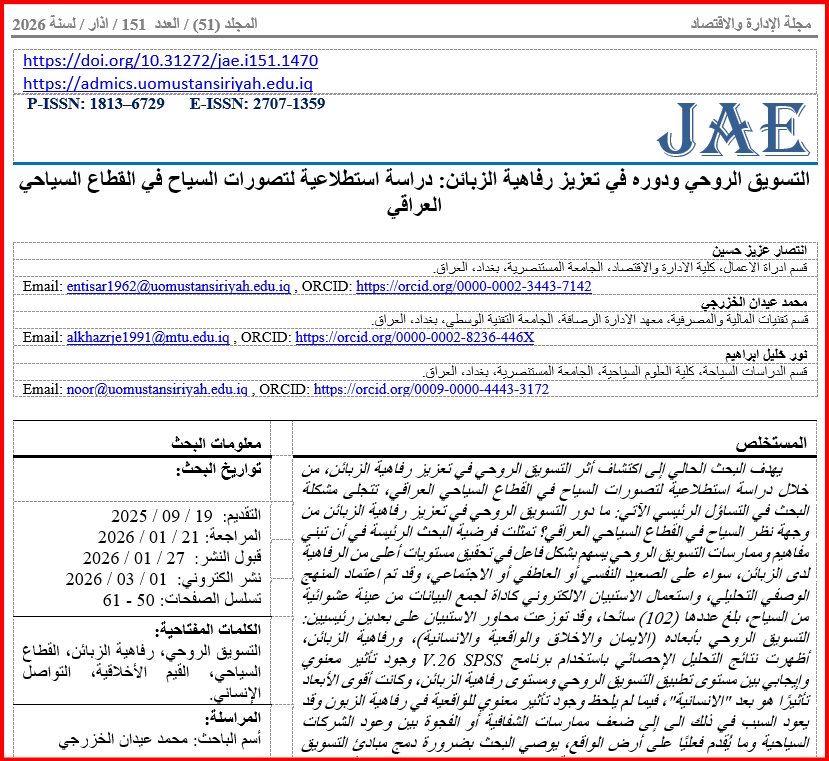
التسويق الروحي ودوره في تعزيز رفاهية الزبائن: دراسة استطلاعية لتصورات السياح في قطاع السياحة
DOI:
https://doi.org/10.31272/jae.i151.1470الكلمات المفتاحية:
التسويق الروحي، رفاهية الزبائن، القطاع السياحي، القيم الأخلاقية، التواصل الإنسانيالملخص
يهدف البحث الحالي إلى اكتشاف دور التسويق الروحي في تعزيز رفاهية الزبائن، من خلال دراسة استطلاعية لتصورات السياح في قطاع السياحة. تمثلت فرضية البحث الرئيسة في أن تبني مفاهيم وممارسات التسويق الروحي يسهم بشكل فاعل في تحقيق مستويات أعلى من الرفاهية لدى الزبائن، سواء على الصعيد النفسي أو العاطفي أو الاجتماعي. وقد تم اعتماد المنهج الوصفي التحليلي، واستخدام الاستبيان الالكتروني كاداة لجمع البيانات من عينة عشوائية من السياح، بلغ عددها (102) سائحا. وقد توزعت محاور الاستبيان على بعدين رئيسيين: التسويق الروحي بأبعاده (الايمان والاخلاق والواقعية والانسانية)، ورفاهية الزبائن. أظهرت نتائج التحليل الإحصائي باستخدام برنامج SPSS وجود علاقة ارتباط وتأثير معنوي وإيجابي بين مستوى تطبيق التسويق الروحي ومستوى رفاهية الزبائن، وكانت أقوى الأبعاد تأثيرًا هو بعد "الانسانية"، فيما لم يلحظ وجود تأثير معنوي للواقعية في رفاهية الزبون وقد يعود السبب في ذلك الى إلى ضعف ممارسات الشفافية أو الفجوة بين وعود الشركات السياحية وما يُقدم فعليًا على أرض الواقع. يوصي البحث بضرورة دمج مبادئ التسويق الروحي ضمن استراتيجيات التسويق في القطاع السياحي، لا سيما في ظل ارتفاع وعي الزبائن بأهمية القيم والرسائل العميقة في التجربة السياحية، بما يسهم في بناء علاقات طويلة الأمد وتعزيز صورة المؤسسة.
التنزيلات
المراجع
[1] Khairy, A., & Abidin, M. Z. (2018). The Effect of Spiritual Marketing on Consumer Loyalty. Islamic Business and Management Journal, 1(2), 1–15. https://doi.org/10.21111/ibmj.v1i2.2217
[2] Triatmo, A. W., Nugroho, A., Supandi, S., & Yuliar, A. (2022). Spiritual Marketing in Increasing Sales Turnover of Micro, Small, and Medium Enterprises in Indonesia. Global Review of Islamic Economics and Business, 10(2), 59–69. http://dx.doi.org/10.14421/grieb.2022.102-06 DOI: https://doi.org/10.14421/grieb.2022.102-06
[3] Fahamsyah, M. H. (2020). Spiritual Marketing Gontor dalam Mempertahankan Positioning. TSAQAFAH, 16(1), 147–162. http://dx.doi.org/10.21111/tsaqafah.v16i1.4337 DOI: https://doi.org/10.21111/tsaqafah.v16i1.4337
[4] Alkhazraje, M. E. (2025). Spiritual Marketing in Light of Paternal Leadership: An Applied Study in the General Company for Food Products. TIJAB (The International Journal of Applied Business), 9(1), 51–68. https://doi.org/10.20473/tijab.v9.I1.2025.57221 DOI: https://doi.org/10.20473/tijab.v9.I1.2025.57221
[5] Qasim, Zahraa Naeem. (2023). Spiritual Marketing and its Impact on Purchase Intention and Customer Trust through Brand Management System, Unpublished PhD Thesis, College of Administration and Economics, University of Al-Qadisiyah, Iraq.
[6] Bambang, A., Kusumawati, A., Nimran, U., & Suharyono, S. (2021). The effect of spiritual marketing and entrepreneurship orientation on determining sustainable competitive advantage. The Journal of Asian Finance, Economics and Business (JAFEB), 8(2), 231–241. https://doi.org/10.13106/jafeb.2021.vol8.no2.0231
[7] Nurjannah, A., Junaidi, H., & Maulana, C. Z. (2023). Pengaruh Shariah Compliance dan Spiritual Marketing terhadap Loyalitas Nasabah dengan Kepuasan sebagai Variabel Intervening di Bank Syariah Indonesia Kantor Cabang Palembang Sudirman. Al Maal: Journal of Islamic Economics and Banking, 4(2), 148–162. http://dx.doi.org/10.31000/almaal.v4i2.7616 DOI: https://doi.org/10.31000/almaal.v4i2.7616
[8] Janan Hassan Sahib, & Yousef Hajim Al-Taie. (2020). Spiritual Marketing and Its Role in the Sustainable Tourism Industry: An Analytical Study of the Opinions of a Sample of Tourist Guides in Najaf Governorate. Journals Eduction for Girls, 3(27). http://dx.doi.org/10.36327/ewjh.v3i27.11807 DOI: https://doi.org/10.36327/ewjh.v3i27.11807
[9] Hermawati, A., Anam, C., Suwarta, S., & Puspitosarie, E. (2022). Reconstruction of spiritual marketing, culture of innovation, quality of work life, and retainers for tourism industry SMEs in East Java. Administrative Sciences, 12(4), 152. https://doi.org/10.3390/admsci12040152 DOI: https://doi.org/10.3390/admsci12040152
[10] Abbas, Z. M., Jasim, S. A., & Alguraibawi, M. (2024, March). Investment of spiritual marketing in support of sustainable development: An applied study of opinions of a sample of employees at technical institute of dewaniya. In AIP Conference Proceedings, 3092(1). AIP Publishing LLC. 1-24. https://doi.org/10.1063/5.0199715 DOI: https://doi.org/10.1063/5.0199715
[11] Husaeni, U. A., Farhany, H., Nurkomalasari, N., & Faisal, F. (2021). Konsep Spiritual Marketing Dalam Pemasaran Program Studi Ekonomi Syariah Fakultas Ekonomi Dan Bisnis Islam Universitas Suryakancana. El-Ecosy: Jurnal Ekonomi Dan Keuangan Islam, 1(1), 75–88. http://dx.doi.org/10.35194/eeki.v1i1.1138 DOI: https://doi.org/10.35194/eeki.v1i1.1138
[12] VENUGOPAL, N., & ASHOK, H. (2019). A STUDY ON GENDER DIFFERENCES AND RELATIONSHIP BETWEEN SPIRITUAL BELIEF AND JOB SATISFACTION. International Journal of Educational, 9(1). https://doi.org/10.24247/ijesrapr20191 DOI: https://doi.org/10.24247/ijesrapr20191
[13] Hajizadeh, K., & Kazemi, A. (2022). The effect of spiritual marketing and entrepreneurial orientation on determining sustainable competitive advantage: A case study of Soliko Kale Company. Journal of Business and Management Studies, 4(4), 212–223. http://dx.doi.org/10.32996/jbms.2022.4.4.20 DOI: https://doi.org/10.32996/jbms.2022.4.4.20
[14] Rini, E. S., & Absah, Y. (2017). Rational, emotional and spiritual marketing strategies in Shariah banking in Medan, Indonesia. Banks & Bank Systems, 12, № 2, 68–77. http://dx.doi.org/10.21511/bbs.12(2).2017.07 DOI: https://doi.org/10.21511/bbs.12(2).2017.07
[15] Sadiq, Zahraa. (2019). The Importance of Marketing Responsibility in Achieving Well-being for Customers and Society. Annals of Bashar University in Economic Sciences, 6(2), 20-39.
[16] Akram, U., Fülöp, M. T., Tiron-Tudor, A., Topor, D. I., & Căpușneanu, S. (2021). Impact of digitalization on customers’ well-being in the pandemic period: Challenges and opportunities for the retail industry. International Journal of Environmental Research and Public Health, 18(14), 7533. https://doi.org/10.3390/ijerph18147533 DOI: https://doi.org/10.3390/ijerph18147533
[17] ALKHAZRAJE, M. E. (2025). The Impact of Peace Marketing on Customer Well-Being: Insights from Zain Iraq Telecommunications. Management Dynamics in the Knowledge Economy, 13(1), 68-84. https://orcid.org/0000-0002-8236-446X DOI: https://doi.org/10.2478/mdke-2025-0005
[18] Zowain, Ammar, Jabouri, Hakim, & Laith. (2019). Humorous Marketing and Its Impact on Achieving Customer Well-being by Enhancing the Quality of Social Communication: A Survey Study of the Opinions of a Sample of Mobile Telecommunications Company Customers in Iraq. University of Sharjah, 34(16), 635-665. http://dx.doi.org/10.36394/jhss/16/1B/3 DOI: https://doi.org/10.36394/jhss/16/1B/3
[19] Dakrouri, Mona Ibrahim, El-Satohi, Ahmed Mohamed, & Amira Kamal Ahmed. (2021). The Relationship between Deviant Online Marketing Behaviors and Customer Well-being: The Mediating Role of Participation in Value Destruction, Applied to Hotel Customers in Egypt. Scientific Journal of Financial and Commercial Studies and Research, 2(2), 511-552. https://doi.org/10.21608/cfdj.2021.171155 DOI: https://doi.org/10.21608/cfdj.2021.171155
[20] Al-Dakroury, Muhammad Al-Saeed Abdel Ghaffar. (2023). The Mediating Role of Customer Delight and Well-being in the Relationship between Online Retail Ethics and Productive Customer Relationships: An Empirical Study on Customers of Department Stores. Journal of Business Research, 45(4), 710-772. https://doi.org/10.21608/zcom.2023.215475.1264 DOI: https://doi.org/10.21608/zcom.2023.215475.1264
[21] Xie, L., Li, D., & Keh, H. T. (2020). Customer participation and well-being: the roles of service experience, customer empowerment, and social support. Journal of Service Theory and Practice, 30(6), 557-584. http://dx.doi.org/10.1108/JSTP-11-2019-0228 DOI: https://doi.org/10.1108/JSTP-11-2019-0228
[22] Shulga, L. V., Busser, J. A., & Bai, B. (2021). Hospitality business models, customer well-being and trust: the mediating role of competitive service advantage. International Journal of Contemporary Hospitality Management, 33(9), 3040-3064. https://psycnet.apa.org/doi/10.1108/IJCHM-09-2020-1033 DOI: https://doi.org/10.1108/IJCHM-09-2020-1033
[23] Furrer, O., Yu Kerguignas, J., & Landry, M. (2021). Customer captivity, negative word of mouth and well-being: a mixed-methods study. Journal of Services Marketing, 35(6), 755-773. http://dx.doi.org/10.1108/JSM-07-2020-0311 DOI: https://doi.org/10.1108/JSM-07-2020-0311
[24] Al-Dasouqi Abdel Aziz Al-Mashhad. (2023). Mediating Customer Perceived Value in the Relationship between Internet of Things Product Attributes and Smart Home Appliance Customer Well-being in Egypt. Journal of Business Research, 45(1), 382-424. https://doi.org/10.21608/zcom.2022.165547.1175 DOI: https://doi.org/10.21608/zcom.2022.165547.1175
[25] Ruggeri, K., Garcia-Garzon, E., Maguire, Á., Matz, S., & Huppert, F. A. (2020). Well-being is more than happiness and life satisfaction: a multidimensional analysis of 21 countries. Health and quality of life outcomes, 18, 1-16. https://doi.org/10.1186/s12955-020-01423-y DOI: https://doi.org/10.1186/s12955-020-01423-y
[26] Falter, M., & Hadwich, K. (2020). Customer service well-being: scale development and validation. The Service Industries Journal, 40(1-2), 181-202. https://DOI:10.1080/02642069.2019.1652599 DOI: https://doi.org/10.1080/02642069.2019.1652599
[27] Shaker Khamis, & Hani. (2022). The Impact of Determining Factors of Dining Room Atmosphere Quality in Upscale Restaurants in Egyptian Hotels on Customers' Sense of Well-being and Intention to Repeat Visit. Journal of the Faculty of Tourism and Hotels. Mansoura University, 12(2), 401-443. https://doi.org/10.21608/mkaf.2022.274851 DOI: https://doi.org/10.21608/mkaf.2022.274851
[28] Zahra, A. H. A. (2023). The Impact of Humor Marketing in Achieving Customer Happiness: An Analytical Study of A Sample of Employees of Three Electrical Appliances Trading Companies (Balsan, Al-Hafdh and Shinon). Journal of Al-Rafidain University College For Sciences (Print ISSN: 1681-6870, Online ISSN: 2790-2293), (1), 231-249. https://doi.org/10.55562/jrucs.v53i1.570 DOI: https://doi.org/10.55562/jrucs.v53i1.570
[29] Al Khazraje, M. E. (2024). The role of adopting green strategies in the development of eco-friendly products. Management Research and Practice, 16(3), 71-83. DOI: https://doi.org/10.62194/MRP.2024.16.3.06
[30] Amir, O. A. A., Al Khazraje, M. E. B., & Ghafoor, Q. A. A. (2024). Trading counterfeit products via the Internet and its impact on Iraqi consumer behavior An exploratory study of the opinions of a sample of consumer goods users (home appliances). Calitatea, 25(202), 85-96. http://dx.doi.org/10.47750/QAS/25.202.09 DOI: https://doi.org/10.47750/QAS/25.202.09
[31] Al Khazraje, M., & Sideeq, S. (2024). The role of wise leadership in managing strategic ignorance in the public sector. Administratie si Management Public, (43), 120-137. http://dx.doi.org/10.24818/amp/2024.43-07 DOI: https://doi.org/10.24818/amp/2024.43-07
[32] Hassan, K. A. Z., & Al-Jubouri, N. K. I. (2023). Ethical Leadership and Its Impact on Sustainable Performance–An Exploratory study of the Opinions of Employees at Al-Mustaqbal University. Futurity Economics&Law, 3(4), 134-151. https://doi.org/10.57125/FEL.2023.12.25.09 DOI: https://doi.org/10.57125/FEL.2023.12.25.09
[33] Al-Hadrawi, B. K., Al-Zurfi, A. R., & Hussein, H. G. (2022). Spiritual marketing and brand love: A study in Noor Al-Kafeel Corporation for animal and food products. Webology (ISSN: 1735-188X), 19(6), 446.
التنزيلات
منشور
إصدار
القسم
الرخصة
الحقوق الفكرية (c) 2026 انتصار عزيز حسين، محمد عيدان الخزرجي، نور خليل ابراهيم

هذا العمل مرخص بموجب Creative Commons Attribution 4.0 International License.
مجلة الإدارة والاقتصاد هي مجلة مفتوحة المصدر حيث تكون جميع محتوياتها مجانية. تخضع مقالات هذه المجلة لشروط ترخيص المشاع الإبداعي المنسوب إلى المؤلف (CC-BY 4.0) (https://creativecommons.org/licenses/by/4.0/legalcode) الذي يسمح للمرخص لهم دون قيود بالبحث عن النص الكامل للمقالات أو تنزيله أو مشاركته أو توزيعه أو طباعته أو ربطه به، وفحصه للفهرسة وإعادة إنتاج أي وسيلة للمقالات بشرط أن ينسبوا إلى المؤلفين الفضل في ذلك (الاستشهاد). تسمح المجلة للمؤلفين بالاحتفاظ بحقوق الطبع والنشر لمقالهم المنشور.
. Creative Commons-Attribution (BY)