The Effectiveness of Strategic Auditing in Assessing the Sustainability of Financial Performance and Structural Risks in Islamic and Conventional Banks in the Middle East: Toward a Balanced Model Between Governance Efficiency and Public Value Sustainability
DOI:
https://doi.org/10.31272/jae.i153.1526Keywords:
Strategic auditing, governance effectiveness,, structural risk,, sustainable financial performance,, public value,, Islamic banks,, structural equation modelingAbstract
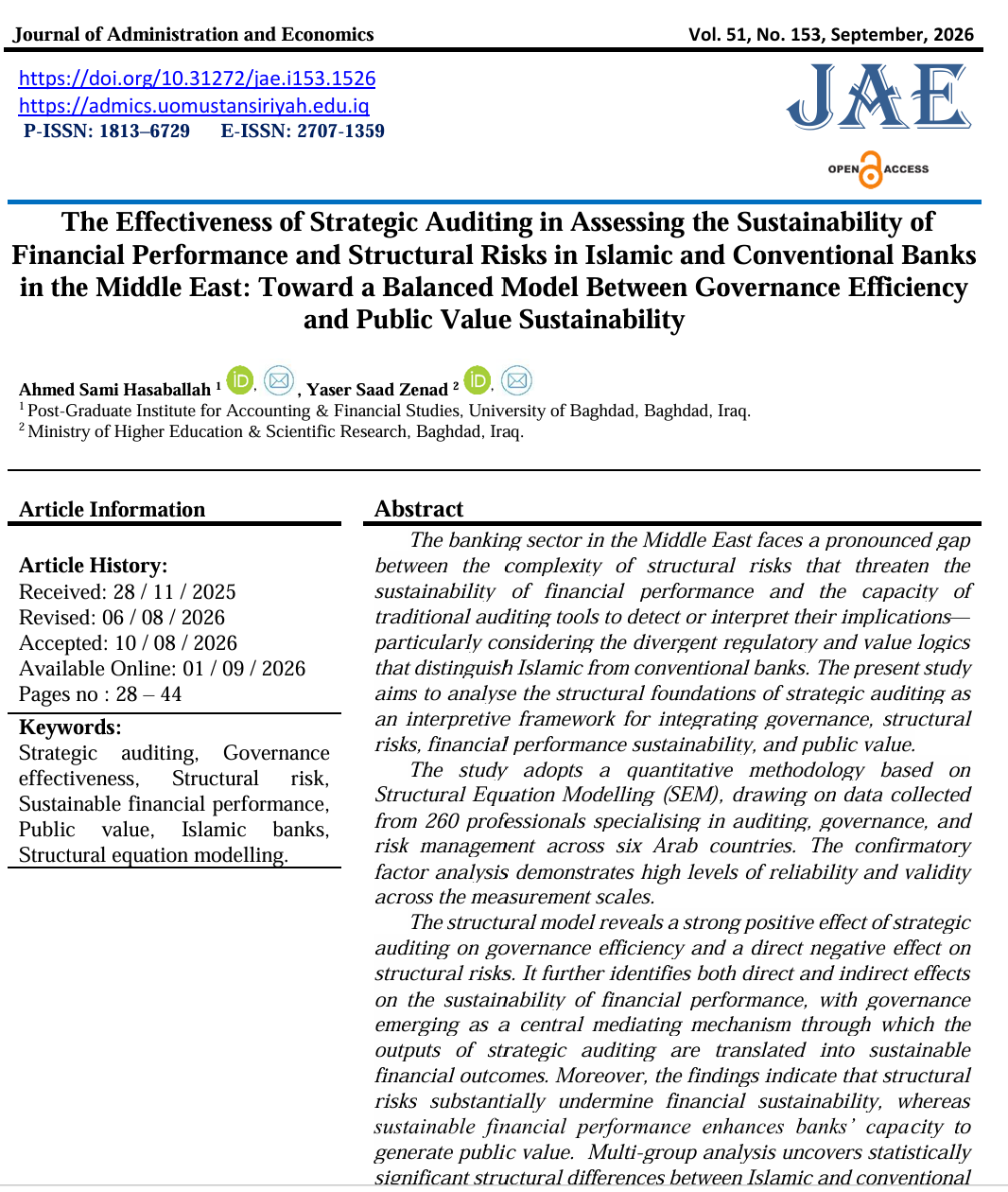
The banking sector in the Middle East faces a pronounced gap between the complexity of structural risks that threaten the sustainability of financial performance and the capacity of traditional auditing tools to detect or interpret their implications—particularly considering the divergent regulatory and value logics that distinguish Islamic from conventional banks. The present study aims to analyse the structural foundations of strategic auditing as an interpretive framework for integrating governance, structural risks, financial performance sustainability, and public value.
The study adopts a quantitative methodology based on Structural Equation Modelling (SEM), drawing on data collected from 260 professionals specialising in auditing, governance, and risk management across six Arab countries. The confirmatory factor analysis demonstrates high levels of reliability and validity across the measurement scales.
The structural model reveals a strong positive effect of strategic auditing on governance efficiency and a direct negative effect on structural risks. It further identifies both direct and indirect effects on the sustainability of financial performance, with governance emerging as a central mediating mechanism through which the outputs of strategic auditing are translated into sustainable financial outcomes. Moreover, the findings indicate that structural risks substantially undermine financial sustainability, whereas sustainable financial performance enhances banks’ capacity to generate public value. Multi-group analysis uncovers statistically significant structural differences between Islamic and conventional banks. Islamic banks appear more sensitive to the effects of strategic auditing and structural risks, reflecting the distinctiveness of their institutional configurations and dual regulatory frameworks. The study’s scholarly contribution lies in proposing an integrated explanatory model that brings together strategic auditing, governance, structural risk, and public value within a single causal framework. The institutional understanding of strategic auditing guides regulatory practices aimed at fostering a more resilient, sustainable banking sector capable of generating long-term public value.
Downloads
References
[1] Aguilera, R. V., Judge, W. Q., & Terjesen, S. (2018). Corporate governance deviance. Academy of Management Review, 43(1), 87–109. https://doi.org/10.5465/amr.2014.0394 DOI: https://doi.org/10.5465/amr.2014.0394
[2] Al-Saadi, A., Hassan, M. K., & Alkhan, A. M. (2022). Shari’a governance in Bahrain: Analysing the Islamic banking industry’s implementation of the newly issued regulatory Shari’a governance module. Journal of Risk and Financial Management, 15(10), 418. https://doi.org/10.3390/jrfm15100418 DOI: https://doi.org/10.3390/jrfm15100418
[3] Beck, T., Demirgüç-Kunt, A., & Merrouche, O. (2013). Islamic vs. conventional banking: Business model, efficiency and stability. Journal of Banking & Finance, 37(2), 433–447. https://doi.org/10.1016/j.jbankfin.2012.09.016 DOI: https://doi.org/10.1016/j.jbankfin.2012.09.016
[4] Bryson, J. M., Crosby, B. C., & Bloomberg, L. (2014). Public value governance: Moving beyond traditional public administration and the new public management. Public Administration Review, 74(4), 445–456. https://doi.org/10.1111/puar.12238 DOI: https://doi.org/10.1111/puar.12238
[5] Central Bank of Iraq. (2023). Financial stability report 2023. https://cbi.iq/static/uploads/up/file-173692818992040.pdf
[6] Garas, S. N., & Pierce, C. (2010). Sharia supervision of Islamic financial institutions. Journal of Financial Regulation and Compliance, 18(4), 386–407. https://doi.org/10.1108/13581981011093695 DOI: https://doi.org/10.1108/13581981011093695
[7] Habermas, J. (1996). Between facts and norms: Contributions to a discourse theory of law and democracy. MIT Press. DOI: https://doi.org/10.7551/mitpress/1564.001.0001
[8] Hasaballah, A. S., Zenad, Y. S., & Shlaka, J. K. (2019). The role of fundamental analysis in determining the market value of hospitality, tourism and company shares. African Journal of Hospitality, Tourism and Leisure, 8(4), 1–11.
[9] Hasan, Z., Abduh, M., & Rosman, R. (2025). Transparency, accountability, and customer trust in Islamic banking: A panel data analysis from selected OIC countries. Jurnal Magister Ekonomi Syariah, 4(2), 915–935.
[10] International Monetary Fund. (2024). Regional economic outlook: Middle East and Central Asia (April 2024). https://www.imf.org/en/Publications/REO/MECA/Issues/2024/04/18/regional-economic-outlook-middle-east-central-asia-april-2024
[11] Islamic Financial Services Board. (2009). Guiding principles on Shariah governance systems for institutions offering Islamic financial services (IFSB-10). https://www.ifsb.org/wp-content/uploads/2023/10/IFSB-10-December-2009_En.pdf
[12] Mollah, S., Hassan, M. K., Al Farooque, O., & Mobarek, A. (2017). The governance, risk-taking, and performance of Islamic banks. Journal of Financial Services Research, 51(2), 195–219. https://doi.org/10.1007/s10693-016-0245-2 DOI: https://doi.org/10.1007/s10693-016-0245-2
[13] Power, M. (1997). The audit society: Rituals of verification. Oxford University Press.
[14] Qaiser, A., Abbas, M. A., & Ahmed, A. (2025). Beyond the numeric: How the accountant’s role, moral justification, and cognitive flexibility form manipulation, moderated by competence: Insights from emerging economies. Advance Social Science Archive Journal, 4(2), 2806–2832. https://doi.org/10.5281/zenodo.18014468
[15] Salvador Carmona, & Ezzamel, M. (2023). Management accounting and strategy: A review and reflections on future research. European Accounting Review, 32(5), 1129–1156. https://doi.org/10.1080/09638180.2023.2215821 DOI: https://doi.org/10.1080/09638180.2023.2215821
[16] Sehen Issa, J., & Abbaszadeh, M. R. (2023). The effect of corporate governance in Islamic banking on the agility of Iraqi banks. Journal of Risk and Financial Management, 16(6), 292. https://doi.org/10.3390/jrfm16060292 DOI: https://doi.org/10.3390/jrfm16060292
[17] United Nations Development Programme. (2023). Promoting sustainable finance and climate finance in the Arab region. https://www.undp.org/arab-states/publications/promoting-sustainable-finance-and-climate-finance-arab-region
[18] Young, M. N., Peng, M. W., Ahlstrom, D., Bruton, G. D., & Jiang, Y. (2008). Corporate governance in emerging economies: A review of the principal–principal perspective. Journal of Management Studies, 45(1), 196–220. https://doi.org/10.1111/j.1467-6486.2007.00752.x DOI: https://doi.org/10.1111/j.1467-6486.2007.00752.x
[19] Zenad, Y. S., Hasaballah, A. S., & Shlaka, J. K. (2020). Promoting the dimensions of sustainable development in tourism using social auditing. African Journal of Hospitality, Tourism and Leisure, 9(1), 1–12, https://www.ajhtl.com/2020.html > .
Downloads
Published
Issue
Section
License
Copyright (c) 2026 ahmed Sami hasaballah, Yaser Saad Zenad

This work is licensed under a Creative Commons Attribution 4.0 International License.
The journal of Administration and Economics is an open- access journal that all contents are free of charge. Articles of this journal are licensed under the terms of the Creative Commons Attribution International Public License CC-BY 4.0 (https://creativecommons.org/licenses/by/4.0/legalcode) that licensees are unrestrictly allowedto search, download, share, distribute, print, or link to the full text of the articles, crawl them for indexing and reproduce any medium of the articles provided that they give the author(s) proper credits (citation). The journal allows the author(s) to retain the copyright of their published article.
Creative Commons-Attribution (BY)