The Role of Transcendent Leadership on reinforcing Organizational Wisdom: An Exploratory Study of Teachers’ Perceptions in International Schools in Duhok Governorate
DOI:
https://doi.org/10.31272/jae.i149.1409Keywords:
Leadership, Transcendent Leadership , International Schools , Wisdom, Organizational WisdomAbstract
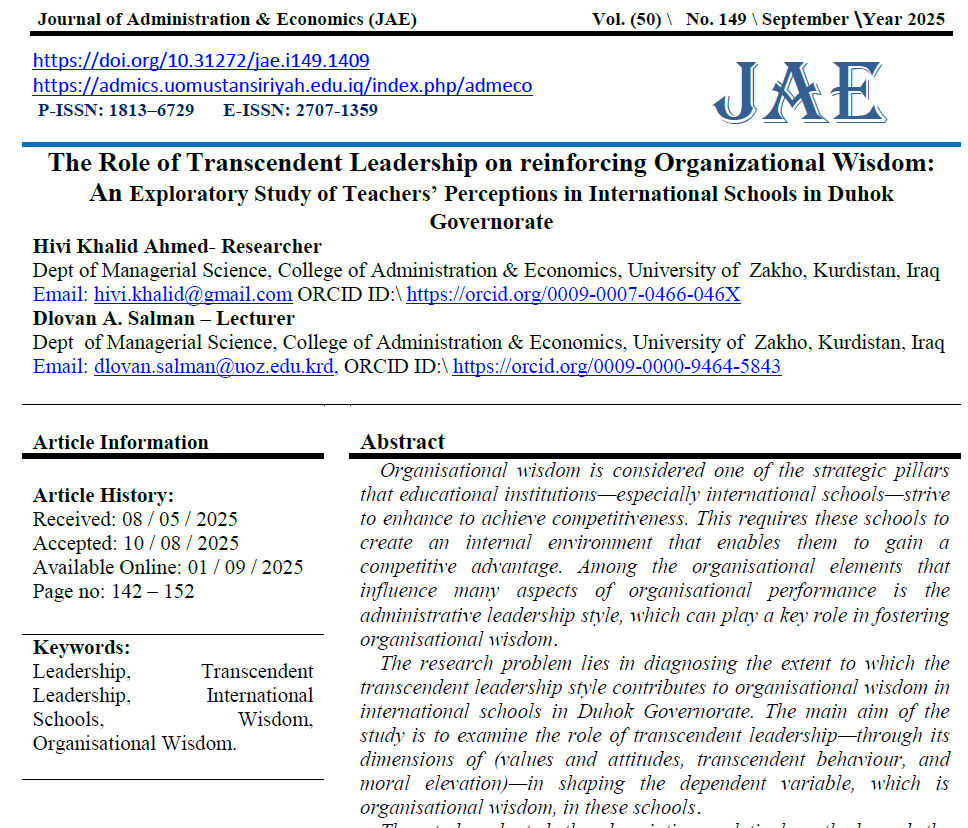
Organizational wisdom is considered as one of the strategic pillars that educational institutions—especially international schools—strive to enhance to achieve competitiveness. This requires these schools to create an internal environment that enables them to gain a competitive advantage. Among the organizational elements that influence many aspects of organizational performance is the administrative leadership style, which can play a key role in fostering organizational wisdom.
The research problem lies in diagnosing the extent to which the transcendent leadership style contributes to organizational wisdom in international schools in Duhok Governorate. The main aim of the study is to examine the role of transcendent leadership—through its dimensions of (values and attitudes, transcendent behavior, and moral elevation)—in shaping the dependent variable, which is organizational wisdom, in these schools.
The study adopted the descriptive-analytical method, and the primary tool for data collection was a questionnaire. A total of 120 questionnaires were distributed, of which 102 were retrieved and deemed valid for analysis, forming the study sample. Using SPSS software, the research yielded several findings, foremost among them being that transcendent leadership has a significant impact on organizational wisdom. In particular, the dimensions of transcendent behavior and moral elevation were found to contribute significantly to enhancing organizational wisdom among teaching staff in international schools in Duhok.
The study recommends the adoption of transcendent behaviors and moral elevation among future administrative leaders to strengthen organizational wisdom in these schools. It also calls for future studies to explore other leadership styles that may contribute to enhancing organizational wisdom among educators in educational institutions
Downloads
References
[1] Abdul Wahab, M. O., & Mahmoud, S. M. (2024). The impact of emotional labor on achieving strategic alignment: An exploratory analytical study in the colleges and centers of Al-Mustansiriya University. Journal of Administration and Economics, 48(138), 13-26. https://doi.org/10.31272/jae.i138.1105 DOI: https://doi.org/10.31272/jae.i138.1105
[2] Al-Haj, M. (2023, November 30). Kurdish professors present (8) recommendations for developing education in the Kurdistan Region. Shafaq News. https://shafaq.com
[3] Alnifie, S., (2023) System Thinking in a Global Context to Foster Transcendent Leadership , The Paris Conference on Education 2023: Official Conference Proceedings (pp. 509-519) https:// doi.org/10.22492/issn.2758-0962.2023.43 DOI: https://doi.org/10.22492/issn.2758-0962.2023.43
[4] Al-Lassasmeh,W., (2023),The Degree of Transcendental Leadership Practice Among School Principals in The Directorate of Education, Al- Qasr/ Karak district Journal of Educational and Psychological Sciences (JEPS), Vol 7, Issue 8, P:22-43, https:// doi.org/10.26389/AJSRP.L210822. DOI: https://doi.org/10.26389/AJSRP.L210822
[5] Al- Qaisi, K. A., (2019). Ethical climate and its relationship to psychological combustion and organizational commitment, Dar Al Yazouri for Publishing and Distribution, Amman, Jordon, I (1).
[6] Ardelt, M. (2024) Wisdom predicts emotional intelligence and wise reasoning. The Journal of Positive Psychology, Volume 20, Issue :1, pp: 123-135, doi.org/10.1080/17439760.2024.2322448 DOI: https://doi.org/10.1080/17439760.2024.2322448
[7] Asrar, R., & Lounis, M. (2021). The role of organizational wisdom in knowledge management practices for enhancing organizational competitiveness. Journal of Knowledge Management, 22(3), 144-156. https://doi.org/10.1108/JKM-06-2020-0434
[8] Azevedo, M. A, Gonçalves, C. M., & Costa, P. (2024). Spirituality in organizational leaders–Ways to inner, ways to wisdom. Journal of Organizational Change Management, 37(4), 778–801. https://doi.org/10.1108/JOCM-06-2023-0248 DOI: https://doi.org/10.1108/JOCM-06-2023-0248
[9] Brown, S. and Greene, J. (2006), The wisdom development scale, Journal of College student development, 47, 1-19, DOI:10.1353/csd.2006.0002 DOI: https://doi.org/10.1353/csd.2006.0002
[10] Clayton, V. (1982)., “Wisdom and intelligence: the nature and function of knowledge in later years”, International Journal of Aging and Human Development, 15(4), 315-321,doi:10.2190/17tq-bw3y-p8j4-tg40 DOI: https://doi.org/10.2190/17TQ-BW3Y-P8J4-TG40
[11] Dawoda, R. M. N. (2005). The sequential effect of charismatic leadership and organizational trust on cognitive work: An exploratory study of a sample of department heads in universities in the Kurdistan Region. (Master's thesis). College of Administration and Economics, University of Duhok.
[12] Gibson, A. (2011). Spirituality in principal leadership and its influence on teachers and teaching. Doctor of Philosophy in Education, The University of Waikato, New Zealand.
[13] Grossmann, I., & Johnson, S. (2025). Cultivating wisdom through metacognition: A new frontier in decision-making under radical uncertainty. https://doi.org/10.31234/osf.io/hcnkx_v2 DOI: https://doi.org/10.31234/osf.io/hcnkx_v5
[14] Hameed, A. H., & Saeed, H. K. (2023). The impact of organizational wisdom on strategic foresight. Journal of Namibian Studies: History Politics Culture, 33(S1), 424–447. https:// doi.org/10.59670/jns.v33i.443 DOI: https://doi.org/10.59670/jns.v33i.443
[15] Hamzah, Z. I., & Al-Kilabi, N. A. (2024). The impact of strategic leadership on human resource job performance. Journal of Administration and Economics, 49(144), 25-35. https://doi.org/10.31272/jae.i144.1234 DOI: https://doi.org/10.31272/jae.i144.1234
[16] Isebor, J. (2018). Transcendental Leadership for the 21st Century: A Narrative Inquiry on Effective Leadership and Workplace Spirituality, PhD. Dissertation, University of Phoenix, United states. DOI: https://doi.org/10.2139/ssrn.3206297
[17] Issa, M. R., & Abbas, Y. K. (2024). Factor analysis and its use in media research. Journal of Administration and Economics, 49(144), 25-35. https://doi.org/10.31272/jae.i144.1235 DOI: https://doi.org/10.31272/jae.i144.1235
[18] Jaddah, A. N. Y. (2020). Transcendent leadership among secondary school leaders in the Kingdom of Saudi Arabia and its relationship to developing organizational culture: A proposed vision. (Master's thesis). Department of Educational Administration and Supervision, College of Education, King Khalid University.
[19] Khudair, L. A., & Al-Ameri, F. M. I. (2020). Transcendent leadership in enhancing university performance: A field study. Journal of Economic and Administrative Sciences, 26(121), 156-175. University of Baghdad, College of Administration and Economics, Iraq.
[20] Kramer, D. A., (1990), “Conceptualizing wisdom: affect-cognition. In R. J. Sternberg (Ed.), Wisdom: Its nature, origins, and development”, pp. 977-363, Cambridge: Cambridge University Press.
[21] Kunzmann, Ute. (2022). The Wisdom in Emotions. Foundations of Wisdom in the Individual and in the World, part:2, Published online by Cambridge University Press, https://doi.org/10.1017/9781009085724.013 DOI: https://doi.org/10.1017/9781009085724.013
[22] Meng, Y. (2016). Spiritual Leadership at the Workplace: Perspective and theories (Review). Biomedical Report, (5): 408-412. https://doi.org/10.3892/br.2016.748 DOI: https://doi.org/10.3892/br.2016.748
[23] Miao, Q., Newman, A., Schwarz, G. and Xu, L. (2014), “Servant leadership, trust, and the organizational commitment of public sector employees in China”, Public Administration, Vol. 92, pp. 727-743, https:// doi.org/10.1111/padm.12091 DOI: https://doi.org/10.1111/padm.12091
[24] Obeidat, B. F., Al-Khaza’leh, M. S., Abdel Hadi, S., Elyat, M. N., & Mustafa, M. B. (2024). Examining transcendent leadership practices: Perspectives of public-school principals in Amman as perceived by teachers. Journal of Educational and Social Research, 14(3), E-ISSN 2240-0524. https://doi.org/10.36941/jesr-2024-0051 DOI: https://doi.org/10.36941/jesr-2024-0051
[25] Odeh, M. K. M. (2023). Transcendent leadership of faculty members and its relationship to creative thinking and innovation in scientific research among postgraduate students in Palestinian universities: A proposed model. (Doctoral dissertation). Arab American University, Palestine.
[26] Ortiz, G.M, Ariza-M. and Molina. (2017). Servant Leadership in a Social Religious Organization: An Analysis of Work Engagement, Authenticity, and Spirituality at Working. J. Environ. Res. Public Health 17, 8542; http://doi:10.3390/ijerph17228542 DOI: https://doi.org/10.3390/ijerph17228542
[27] Racelis, A (2017). Exploring leader motives and motivations: towards the creation of a transcendental leadership scale. International Journal of Management Decisions, 1 (3) pp.1-& 2, pp 1-22, ISSN:2454-7425, http://orcid.org/0000-0003-1850-1527
[28] Shahrokhi, F, Navidi, A. Shoghi, B. (2015).The Effect of Organizational Wisdom on the Effectiveness of Education Staff in Markaz Province, Educational Management Innovations, Vol. 11,No. 1, p. 61-77. , https://sanad.iau.ir/en/Article/1110521?FullText=FullText&utm
[29] Sternberg, R. J. (1998). A balance theory of wisdom. Review of General Psychology, 2(4), 347–365. https:// doi.org/10.1037/1089-2680.2.4.347 DOI: https://doi.org/10.1037//1089-2680.2.4.347
[30] Theissen, Hubertus, Maximilian H. and Ali A. Gümüsay. (2024), Self-transcendent leadership: A meta-perspective, European Management Review, (21):4, pp:1-17, DOI: 10.1111/emre.12640 DOI: https://doi.org/10.1111/emre.12640
[31] Thomas, M. L., Bangen, K. J., Ardelt, M., & Jeste, D. V. (2017). Development of a 12-itemitem abbreviated three-dimensional wisdom scale (3D-WS-12): Item selection and psychometric properties assessment. Assessment, 24(1):71-82. Doi :10.1177/1073191115595714 . DOI: https://doi.org/10.1177/1073191115595714
Downloads
Published
Issue
Section
License
Copyright (c) 2025 Hivi Khalid Ahmed- Researcher , Dlovan A. Salman – Lecturer

This work is licensed under a Creative Commons Attribution 4.0 International License.
The journal of Administration and Economics is an open- access journal that all contents are free of charge. Articles of this journal are licensed under the terms of the Creative Commons Attribution International Public License CC-BY 4.0 (https://creativecommons.org/licenses/by/4.0/legalcode) that licensees are unrestrictly allowedto search, download, share, distribute, print, or link to the full text of the articles, crawl them for indexing and reproduce any medium of the articles provided that they give the author(s) proper credits (citation). The journal allows the author(s) to retain the copyright of their published article.
Creative Commons-Attribution (BY)