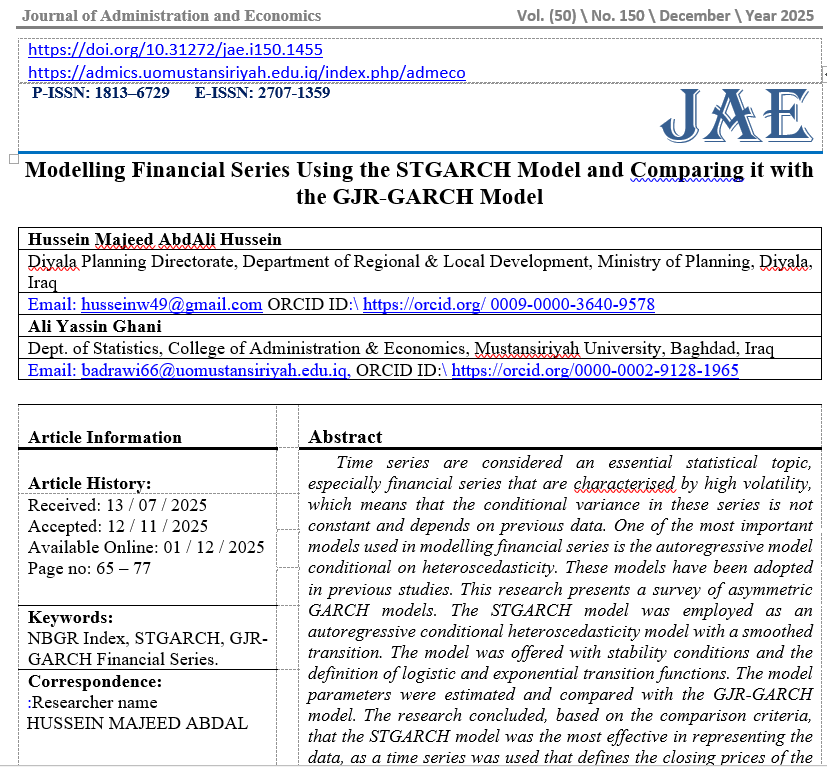
Modelling Financial Series Using the STGARCH Model and Comparing it with the GJR-GARCH Model
DOI:
https://doi.org/10.31272/jae.i150.1455Keywords:
NBGR Index, STGARCH, GJR-GARCH Financial SeriesAbstract
Time series are considered an essential statistical topic, especially financial series that are characterised by high volatility, which means that the conditional variance in these series is not constant and depends on previous data. One of the most important models used in modelling financial series is the autoregressive model conditional on heteroscedasticity. These models have been adopted in previous studies. This research presents a survey of asymmetric GARCH models. The STGARCH model was employed as an autoregressive conditional heteroscedasticity model with a smoothed transition. The model was offered with stability conditions and the definition of logistic and exponential transition functions. The model parameters were estimated and compared with the GJR-GARCH model. The research concluded, based on the comparison criteria, that the STGARCH model was the most effective in representing the data, as a time series was used that defines the closing prices of the shares in the National Bank of Greece index.
Downloads
References
[1] Al-Moussawi, J. K., & Ghani, A. Y. (2016). Study of the ARMA-GARCH model when the error follows the Laplace distribution and its comparison with the normal distribution. Journal of Administration and Economics,
[2] Abd-Ali, H. M., & Ghani, A. Y. (2020). Estimating parameters of the GARCH model with hyperbolic cutoff distribution: An application. Journal of Administration and Economics, (123). 422-433.
[3] Engle, R. F. (1982). Autoregressive conditional heteroscedasticity with estimates of the variance of United Kingdom inflation. Econometrica: Journal of the econometric society, 987-1007.https://doi.org/10.2307/1912773 DOI: https://doi.org/10.2307/1912773
[4] Bollerslev, T. (1986) Generalized Autoregressive Conditional Heteroskedasticity “Journal of Econometrics , Vol.31, pp . 307-327. DOI:1 0.1016/0304-4076(86)90063-1. DOI: https://doi.org/10.1016/0304-4076(86)90063-1
[5] Glosten, L. R., Jagannathan, R., & Runkle, D. E. (1993). On the relation between the expected value and the volatility of the nominal excess return on stocks. The Journal of Finance, 48(5), 1779-1801. https://doi.org/10.1111/j.1540-6261.1993.tb05128.x DOI: https://doi.org/10.1111/j.1540-6261.1993.tb05128.x
[6] Hagerud, G. E. (1997). A smooth transition GARCH model. Research Report, Department of Economic Statistics, Stockholm School of Economics.
[7] M.A Abdul Rahim, S.M Zahari, SSR Shariff, 2018, Variance Targeting Estimator for GJR-GARCH under Model's Misspecification, Sains Malaysiana 47 (9), 2195-2204 . 10.17576/JSM-2018-4709-30 DOI: https://doi.org/10.17576/jsm-2018-4709-30
[8] Gonzalez-Rivera, G. (1998). "Smooth-Transition GARCH Models." Studies in Nonlinear Dynamics & Econometrics, 3(2), 1-20. 10.2202/1558-3708.1041 DOI: https://doi.org/10.2202/1558-3708.1041
[9] Tsay,R., (2002), " Analysis of Financial Time Series, " John Wiley & Sons, Canada. doi/pdf/10.1002/0471264105. DOI: https://doi.org/10.1002/0471264105
[10] Nidhaleddine Ben Cheikha, Younes Ben Zaiedb, Julien Chevallierc ,2020 ,Asymmetric volatility in cryptocurrency markets: New evidence from smooth transition GARCH models ,Finance Research LettersVolume 35, July 2020, 101293. https://doi.org/10.1016/j.frl.2019.09.008 DOI: https://doi.org/10.1016/j.frl.2019.09.008
[11] Zivot, E. (2009). Practical issues in the analysis of univariate GARCH models. In Handbook of financial time series (pp. 113-155). Berlin, Heidelberg: Springer Berlin Heidelberg. 10.1007/978-3-540-71297-8_5 DOI: https://doi.org/10.1007/978-3-540-71297-8_5
[12] Chu, J., Chan, S., Nadarajah, S., & Osterrieder, J. (2017). GARCH modelling of cryptocurrencies. Journal of Risk and Financial Management, 10(4), 17.,10.3390/jrfm10040017 DOI: https://doi.org/10.3390/jrfm10040017
Downloads
Published
Issue
Section
License
Copyright (c) 2025 Hussein Majeed AbdAli Hussein, Ali Yassin Ghani

This work is licensed under a Creative Commons Attribution 4.0 International License.
The journal of Administration and Economics is an open- access journal that all contents are free of charge. Articles of this journal are licensed under the terms of the Creative Commons Attribution International Public License CC-BY 4.0 (https://creativecommons.org/licenses/by/4.0/legalcode) that licensees are unrestrictly allowedto search, download, share, distribute, print, or link to the full text of the articles, crawl them for indexing and reproduce any medium of the articles provided that they give the author(s) proper credits (citation). The journal allows the author(s) to retain the copyright of their published article.
Creative Commons-Attribution (BY)