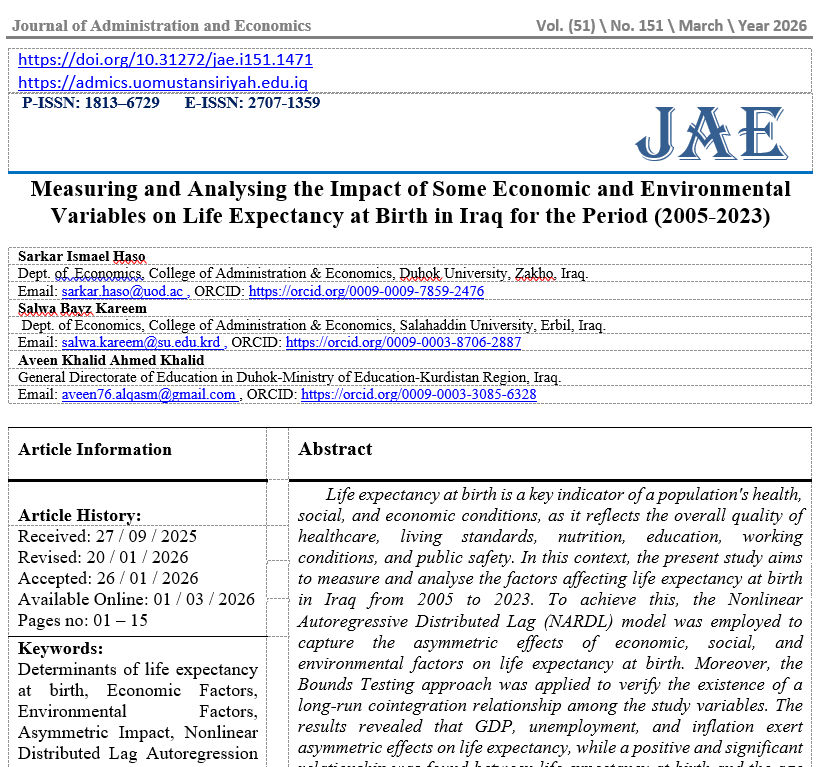
Measuring and analyzing the impact of some economic and environmental variables on life expectancy at birth in Iraq during the period (2005-2023)
DOI:
https://doi.org/10.31272/jae.i151.1471Keywords:
Determinants of life expectancy at birth, time series data, nonlinear distributed lag autoregression.Abstract
Life expectancy at birth is a basic indicator for assessing the health, social and economic status of a population, as it expresses the level of quality of health care, living, nutrition, education, working conditions, and general safety in society. In this context, this research aims to measure and analyze the factors affecting life expectancy at birth in Iraq during the period (2005-2023). To achieve this, a nonlinear autoregressive distributed lag (NARDL) model was used, where life expectancy at birth as the dependent variable was regressed on seven explanatory variables that influence it.
The analysis results showed a direct and significant relationship between life expectancy at birth and GDP growth, health spending, and the age dependency ratio. Meanwhile, a significant inverse relationship was found between life expectancy and unemployment and inflation rates. As for carbon dioxide emissions and average temperatures, their effect on the dependent variable was found to be insignificant.
The adjusted coefficient of determination (R̅2) value indicates that approximately 99% of the changes occurring in the dependent variable are explained by the independent variables included in the model, and the remainder is due to variables not included in the model.
Downloads
References
[1] Kadhim, J. (2024). Analysis of the variables affecting the variation in life expectancy at birth and its relationship to population characteristics in Iraq for the period 1967 - 2022. Thi Qar Arts Journal, 12(48). https://doi.org/10.32792/tqartj.v12i48.718 DOI: https://doi.org/10.32792/tqartj.v12i48.718
[2] Țarcă, V., Țarcă, E., & Moscalu, M. (2024). Social and Economic Determinants of Life Expectancy at Birth in Eastern Europe. Healthcare, 12(11), 1148. https://doi.org/10.3390/healthcare12111148 DOI: https://doi.org/10.3390/healthcare12111148
[3] Chen, Z., Ma, Y., Hua, J., Wang, Y., & Guo, H. (2021). Impacts from economic development and environmental factors on life expectancy: A comparative study based on data from both developed and developing countries from 2004 to 2016. International Journal of Environmental Research and Public Health, 18(16), 8559. https://doi.org/10.3390/ijerph18168559 DOI: https://doi.org/10.3390/ijerph18168559
[4] Martín Cervantes, P. A., Rueda López, N., & Cruz Rambaud, S. (2020). Life Expectancy at Birth in Europe: An Econometric Approach Based on Random Forests Methodology. Sustainability, 12(1), 413. https://doi.org/10.3390/su12010413 DOI: https://doi.org/10.3390/su12010413
[5] Hashem, A. A. K. (2021). Factors affecting life expectancy at birth in the Middle East and North Africa during the period 2000–2016. Arab Journal of Management, 41(3), 115–128. https://doi.org/10.21608/aja.2021.187440 DOI: https://doi.org/10.21608/aja.2021.187440
[6] Barro, R. (1996). Health and economic growth. World Health Organization, 1-47. http://down.aefweb.net/AefArticles/aef140202Barro.pdf
[7] World Bank. (2023). World Development Indicators: Life Expectancy and GDP.
[8] Chang, K., Bunevicius, A., Bunevicius, R., & Chang, S. (2017). Life expectancy and years of potential life lost in people with mental disorders: a systematic review and meta-analysis. The Lancet Psychiatry, 4(10), 840-851. https://doi.org/10.1016/S2215-0366(17)30383-7
[9] Preston, S. H. (1975). The Changing Relation between Mortality and Level of Economic Development. Population Studies, 29(2), 231–248. https://doi.org/10.1080/00324728.1975.10412852 DOI: https://doi.org/10.1080/00324728.1975.10410201
[10] Deaton, A. (2003). Health, Inequality, and Economic Development. Journal of Economic Literature, 41(1), 113–158. https://doi.org/10.1257/002205103321544710 DOI: https://doi.org/10.1257/jel.41.1.113
[11] Bartley M. (1994). Unemployment and ill health: understanding the relationship. Journal of epidemiology and community health, 48(4), 333–337. https://doi.org/10.1136/jech.48.4.333 DOI: https://doi.org/10.1136/jech.48.4.333
[12] Cylus, J., Glymour, M., & Avendano, M. (2014). Health effects of unemployment benefit program generosity. American Journal of Public Health, 104(3), 97–103. https://doi.org/10.2105/AJPH.2013.301548 DOI: https://doi.org/10.2105/AJPH.2013.301548
[13] Suhaila, A. A. M. A., Mustafa, K. R., & Aliya, H. K. A. (2024). Private investment: A path towards economic reform, addressing unemployment, and achieving sustainable development in Iraq. Journal of Administration and Economics, 49(146), 105–110. https://doi.org/10.31272/jae.i146.1325 DOI: https://doi.org/10.31272/jae.i146.1325
[14] Cutler, D., Deaton, A., & Lleras-Muney, A. (2006). The determinants of mortality. Journal of Economic Perspectives, 20(3), 97–120. https://doi.org/10.1257/jep.20.3.97 DOI: https://doi.org/10.1257/jep.20.3.97
[15] Bloom, D., & Canning, D. (2003). The health and wealth of nations. Science, 301(5632), 1207–1209. https://doi.org/10.1126/science.1082914 DOI: https://doi.org/10.1126/science.287.5456.1207
[16] Al-Dhubawi, F., & Atshan, H. (2025). Inflation and its impact on indicators of sustainable development. Journal of Kufa Studies Center, 1(76(c), 221-259. https://doi.org/10.36322/jksc.176(c).19701 DOI: https://doi.org/10.36322/jksc.176(c).19701
[17] United Nations. (2022). World Population Prospects 2022: Summary of Results. Department of Economic and Social Affairs, Population Division. https://population.un.org/wpp/
[18] World Bank. (2023). Life expectancy at birth, total (years) – Iraq. World Development Indicators. https://data.albankaldawli.org/indicator/SP.DYN.LE00.IN?locations=IQ
[19] Gupta, S., Verhoeven, M., & Tiongson, E. (2002). The effectiveness of government spending on education and health care in developing and transition economies. European Journal of Political Economy, 18(4), 717–739. https://doi.org/10.1016/S0176-2680(02)00115-9 DOI: https://doi.org/10.1016/S0176-2680(02)00116-7
[20] Ali, A. J., & Issam, A. A. S. (2024). The impact of government consumption expenditure on the trade balance in Iraq for the period 2005–2020 using the VECM model. Journal of Administration and Economics, 49(142), 92–105. https://doi.org/10.3390/healthcare10091608 DOI: https://doi.org/10.31272/jae.i142.1031
[21] Pope, C. A., Ezzati, M., & Dockery, D. W. (2009). Fine-particulate air pollution and life expectancy in the United States. New England Journal of Medicine, 360(4), 376–386. https://doi.org/10.1056/NEJMsa0805646 DOI: https://doi.org/10.1056/NEJMsa0805646
[22] World Health Organization (WHO). (2021). Air pollution and child health: Prescribing clean air.
[23] Anwar, A., Hyder, S., Bennett, R., & Younis, M. (2022). Impact of environmental quality on healthcare expenditures in developing countries: a panel data approach. In Healthcare (Vol. 10, No. 9, p. 1608). MDPI. https://doi.org/10.3390/healthcare10091608 DOI: https://doi.org/10.3390/healthcare10091608
[24] Intergovernmental Panel on Climate Change (IPCC). (2023). Climate Change 2023: Synthesis Report. Contribution of Working Groups I, II and III to the Sixth Assessment Report of the Intergovernmental Panel on Climate Change [Core Writing Team, H. Lee and J. Romero (eds.)]. IPCC. https://doi.org/10.59327/IPCC/AR6-9789291691647 DOI: https://doi.org/10.59327/IPCC/AR6-9789291691647
[25] Gasparrini, A., Guo, Y., Hashizume, M., Lavigne, E., Zanobetti, A., Schwartz, J., Tobias, A., Mackenbach, J., Pan, X., Nitschke, M., & Armstrong, B. (2015). Mortality risk attributable to high and low ambient temperature: a multicountry observational study.The Lancet,386(9991),369–375. https://doi.org/10.1016/S0140-6736(14)62114-0 DOI: https://doi.org/10.1016/S0140-6736(14)62114-0
[26] Haines, A., Kovats, R. S., Campbell-Lendrum, D., & Corvalan, C. (2006). Climate change and human health: impacts, vulnerability and public health. Public Health, 120(7), 585–596. https://doi.org/10.1016/j.puhe.2006.01.002 DOI: https://doi.org/10.1016/j.puhe.2006.01.002
[27] Korançe, F. (2021). The growing relationship between environment and public health. Science Medicine Journal, 3(2), 102–103. https://doi.org/10.28991/SciMedJ-2021-0302-3 DOI: https://doi.org/10.28991/SciMedJ-2021-0302-3
[28] Myers, S. S., Smith, M. R., Guth, S., Golden, C. D., Vaitla, J., Mueller, N. D., Dangour, A. D., & Huybers, P. (2017). Climate change and global food systems: potential impacts on food security and undernutrition. Annual Review of Public Health, 38, 259–277. https://doi.org/10.1146/annurev-publhealth-031816-044359 DOI: https://doi.org/10.1146/annurev-publhealth-031816-044356
Downloads
Published
Issue
Section
License
Copyright (c) 2026 Sirkar Ismail Hasso, Salwa Bayez Kareem, & Evin Khalid Ahmed Khalid

This work is licensed under a Creative Commons Attribution 4.0 International License.
The journal of Administration and Economics is an open- access journal that all contents are free of charge. Articles of this journal are licensed under the terms of the Creative Commons Attribution International Public License CC-BY 4.0 (https://creativecommons.org/licenses/by/4.0/legalcode) that licensees are unrestrictly allowedto search, download, share, distribute, print, or link to the full text of the articles, crawl them for indexing and reproduce any medium of the articles provided that they give the author(s) proper credits (citation). The journal allows the author(s) to retain the copyright of their published article.
Creative Commons-Attribution (BY)