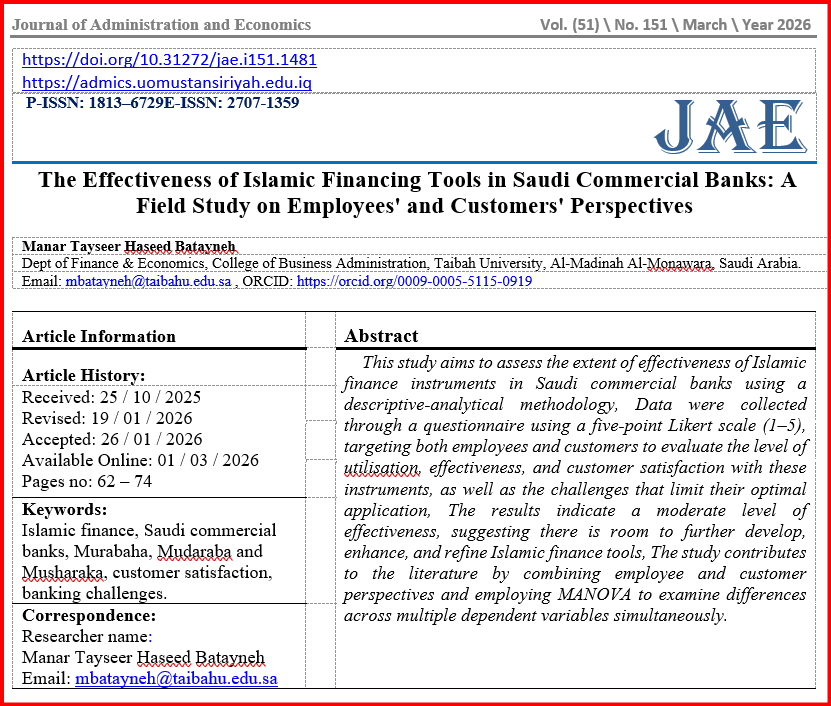
The Effectiveness of Islamic Financing Tools in Saudi Commercial Banks: A Field Study on Employees' and Customers' Perspectives
DOI:
https://doi.org/10.31272/jae.i151.1481Keywords:
Saudi commercial banks, Islamic finance, Murabaha, Mudaraba and Musharaka, customer satisfaction, banking challengesAbstract
This study aims to assess the extent of effectiveness of Islamic finance instruments in Saudi commercial banks using a descriptive-analytical methodology, Data were collected through a questionnaire using a five-point Likert scale (1–5), targeting both employees and customers to evaluate the level of utilisation, effectiveness, and customer satisfaction with these instruments, as well as the challenges that limit their optimal application, The results indicate a moderate level of effectiveness, suggesting there is room to further develop, enhance, and refine Islamic finance tools, The study contributes to the literature by combining employee and customer perspectives and employing MANOVA to examine differences across multiple dependent variables simultaneously.
Downloads
References
[1] Hossain, M. I., Rahman, M. M., & Karim, M. A. (2024). Operational efficiency and productivity dynamics: A comparative analysis of Islamic and conventional banks in Bangladesh. Journal of Islamic Accounting and Business Research, 15(4), 567–585. https://doi.org/10.1108/JIABR-05-2023-0167
[2] Ahmad, F. (2024). A comparative analysis of profitability in state-owned commercial banks: Islamic profit-loss sharing vs. conventional interest models in Bangladesh. International Journal of Islamic and Middle Eastern Finance and Management, 17(3), 450–467. https://doi.org/10.1108/IMEFM-08-2023-0280
[3] Chebru, S., & Mahawat, T. (2024). The role of Islamic banking finance in achieving economic growth: An econometric study of the Saudi Arabia case for the period (2014–2021). Journal of Financial and Commercial Research, 25(3), 120–145. DOI: 10.21608/jsst.2024.254321.1711
[4] Ben Atallah, S., & Zaghdar, A. (2023). The impact of Islamic finance modes on credit risk: A case study of the Arab Islamic International Bank (2007–2022). Journal of Economic and Financial Studies, 14(2), 211–233. https://asjp.cerist.dz/en/article/235358(asjp:235358)
[5] Abed, F. B. A. (2022). The impact of Islamic banking credit on gross domestic product in the Kingdom of Saudi Arabia (2014–2022). Journal of Sharia Sciences and Islamic Studies, 50(1), 125–148.
[6] Malik, A., Ullah, K., & Ullah, S. (2021). Integrating Shari’ah knowledge and governance principles in Islamic banking: A framework for enhanced performance. Journal of Risk and Financial Management, 14(7), 295. https://doi.org/10.3390/jrfm14070295 DOI: https://doi.org/10.1108/IMEFM-07-2020-0325
[7] Jahan, N. (2022). Determinants of profitability in Islamic banks: Evidence from Bangladesh. ISRA International Journal of Islamic Finance, 14(1), 26–42. https://doi.org/10.55188/ijif.v14i1.189
[8] Muhiuddin, G., Hossain, M., & Hasan, M. (2023). Efficiency analysis of Islamic banking in OIC countries: An application of stochastic frontier approach. Global Finance Journal, 55, 100794. https://doi.org/10.1016/j.gfj.2022.100794 DOI: https://doi.org/10.1016/j.gfj.2022.100794
[9] Iqbal, Z., & Mirakhor, A. (2011). An introduction to Islamic finance: Theory and practice (Vol. 687). John Wiley & Sons.(DOI):https://doi.org/10.1002/978111839044 DOI: https://doi.org/10.1002/9781118390474
[10] Alqahtani, F., & Mayes, D. G. (2018). Financial stability of Islamic banking and the global financial crisis: Evidence from the Gulf Cooperation Council. Economic Systems, 42(2), 346–360. https://doi.org/10.1016/j.ecosys.2017.09.001 DOI: https://doi.org/10.1016/j.ecosys.2017.09.001
[11] Al-Khalifi, A. B. M. (2023). Islamic financing instruments in Saudi banks: Reality and challenges. Journal of Imam Muhammad bin Saud Islamic University (Islamic Sciences), 64(2), 145–165.
[12] Ben Ata Allah, S., & Zaghina, Z. (2023). The impact of Islamic financing instruments on the financing of economic institutions: A case study of Al Baraka Bank of Algeria. Journal of Mohammed Boudiaf University of M'Sila for Economic, Commercial and Management Sciences, 15, 456–475.
[13] Saudi Arabian Monetary Authority. (2024). Annual reports of Saudi commercial banks. Retrieved from ahttps://www.sama.gov.sa/
[14] Saudi Arabian Monetary Authority. (2023-2024). Financial reports of Saudi banks. Retrieved from https://www.sama.gov.sa/
Downloads
Published
Issue
Section
License
Copyright (c) 2026 Manar Tayseer Hasid Batayneh

This work is licensed under a Creative Commons Attribution 4.0 International License.
The journal of Administration and Economics is an open- access journal that all contents are free of charge. Articles of this journal are licensed under the terms of the Creative Commons Attribution International Public License CC-BY 4.0 (https://creativecommons.org/licenses/by/4.0/legalcode) that licensees are unrestrictly allowedto search, download, share, distribute, print, or link to the full text of the articles, crawl them for indexing and reproduce any medium of the articles provided that they give the author(s) proper credits (citation). The journal allows the author(s) to retain the copyright of their published article.
Creative Commons-Attribution (BY)