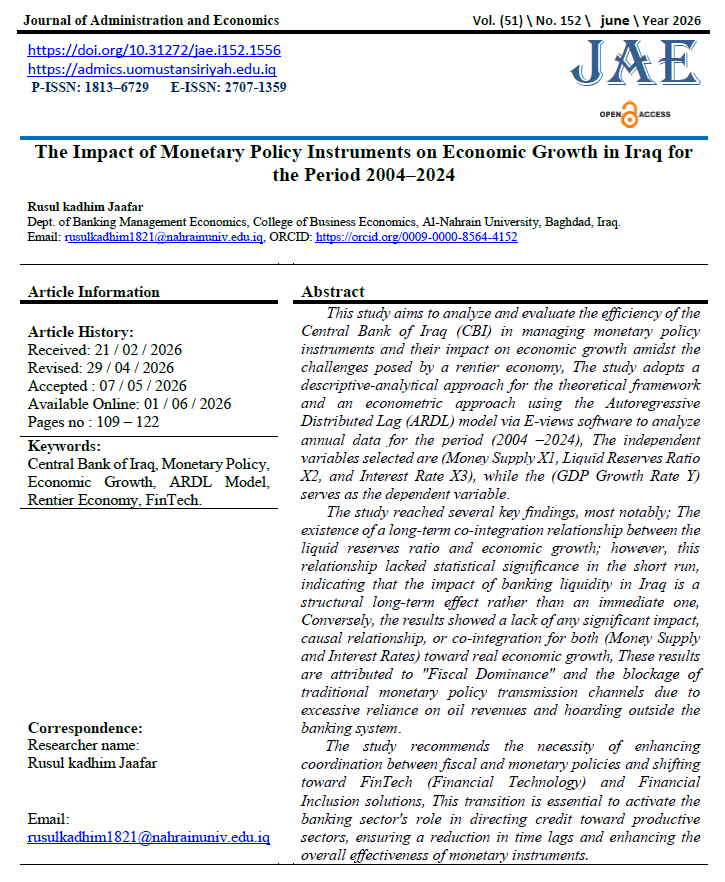
The Impact of Monetary Policy Instruments on Economic Growth in Iraq for the Period 2004–2024
DOI:
https://doi.org/10.31272/jae.i152.1556Keywords:
Central Bank of Iraq, Monetary Policy, Economic Growth, ARDL Model, Rentier Economy, FinTechAbstract
This study aims to analyze and evaluate the efficiency of the Central Bank of Iraq (CBI) in managing monetary policy instruments and their impact on economic growth amidst the challenges posed by a rentier economy, The study adopts a descriptive-analytical approach for the theoretical framework and an econometric approach using the Autoregressive Distributed Lag (ARDL) model via E-views software to analyze annual data for the period (2004 –2024), The independent variables selected are (Money Supply X1, Liquid Reserves Ratio X2, and Interest Rate X3), while the (GDP Growth Rate Y) serves as the dependent variable.
The study reached several key findings, most notably; The existence of a long-term co-integration relationship between the liquid reserves ratio and economic growth; however, this relationship lacked statistical significance in the short run, indicating that the impact of banking liquidity in Iraq is a structural long-term effect rather than an immediate one, Conversely, the results showed a lack of any significant impact, causal relationship, or co-integration for both (Money Supply and Interest Rates) toward real economic growth, These results are attributed to "Fiscal Dominance" and the blockage of traditional monetary policy transmission channels due to excessive reliance on oil revenues and hoarding outside the banking system.
The study recommends the necessity of enhancing coordination between fiscal and monetary policies and shifting toward FinTech (Financial Technology) and Financial Inclusion solutions, This transition is essential to activate the banking sector's role in directing credit toward productive sectors, ensuring a reduction in time lags and enhancing the overall effectiveness of monetary instruments.
Downloads
References
[1] Abbas, M. A. (2018). Money supply and its impact on economic growth: An analytical and econometric study in Iraq for the period (2004-2017) [Unpublished master's thesis]. College of Administration and Economics, Mustansiriyah University, Baghdad, Iraq. Mustansiriyah University Digital Repository
[2] Al-Zubaidi, H. Y., et al. (2021). Monetary policy and the Central Bank of Iraq: Challenges and opportunities. University Press, Baghdad. ISBN: 978-9922-635-12-5
[3] Hussein, A. A. (2022). Management of banking liquidity and reserves and their impact on financial stability in Iraq. Journal of Economic and Administrative Sciences, University of Baghdad, 28(130). DOI: 10.33095/jeas.v28i130.2248
[4] Shahin, A. H. (2025). Challenges of Sustainable Development in Rentier Economies. Yazouri Scientific Publishing, Amman. ISBN: 978-9957-35-512-8 Link: https://yazouri.com
[5] Hashad, N. (1994). Dictionary of Economic and Banking Terms. Dar Al-Nahda Al-Arabiya, Cairo. ID: (Old Edition - Publisher Archive) Link: http://www.dar-alnahda.com
[6] Abdullah, K. S. (2019). Banking Operations: Scientific and Practical Aspects. Dar Wael for Publishing, Amman. ISBN: 978-9957-91-454-7 Link: https://darwael.com
[7] Ibrahim, M. A. (2021). Monetary Policy and Central Bank Independence. Dar Al-Kotob Al-Ilmiyah, Baghdad. ISBN: 978-2-7451-9452-1 Link: https://al-ilmiyah.com
[2] Al-Zubaidi, et al. (2021). Monetary Policy and the Central Bank of Iraq: Challenges and Opportunities. University Press, Baghdad. ISBN: 978-9922-635-12-5 Link: https://www.iraqnla.gov.iq
[8] Al-Talbanani, A. (2019). Central Banks and Contemporary Monetary Policies. The Academic Library, Cairo. ISBN: 978-977-281-546-4 Link: https://theacademiclibrary.com
[9] Al-Nusayri, S. (2022). Crisis Management and the Developmental Role of the Central Bank of Iraq. Research Paper, Iraqi Private Banks League. ID: (Private Paper ID: IPBI-2022) Link: https://kapitaliraq.com
[10] Al-Sahlani, M. A. (2008). Monetary Stability in Light of Economic Fluctuations. Journal of Economic Sciences, University of Baghdad. DOI: 10.33899/mjeps.2008.163421 (Digitally Archived) Link: https://www.iasj.net/iasj/journal/42
[11] Rustam, et al. (2023). The Efficiency of Monetary Policy Tools in Achieving Economic Stability. Journal of Administration and Economics, University of Kerbala. DOI: 10.32894/kjae.2023.142516 Link: https://www.iasj.net/iasj/journal/90
[12] Mishkin, F. S. (2019). The Economics of Money, Banking and Financial Markets (12th ed.). Pearson Education. ISBN: 978-0134733821 Link: https://www.pearson.com
[13] Blanchard, O. (2017). Macroeconomics (7th ed.). Pearson Education. ISBN: 978-0133780581 Link: https://www.pearson.com
[14] Frankel, J. A. (2011). A Solution to Fiscal Dominance and High Inflation. NBER Working Paper No. 17438. DOI: 10.3386/w17438 Link: https://www.nber.org/papers/w17438 DOI: https://doi.org/10.3386/w17438
[15] Central Bank of Iraq. (2024). Annual Statistical Bulletins and Economic Reports (2004-2024). Statistics and Research Directorate, Baghdad. ID: General Government (CBI-Reports) Link: https://cbi.iq/page/22
Downloads
Published
Issue
Section
License
Copyright (c) 2026 Rusul kadhim Jaafar

This work is licensed under a Creative Commons Attribution 4.0 International License.
The journal of Administration and Economics is an open- access journal that all contents are free of charge. Articles of this journal are licensed under the terms of the Creative Commons Attribution International Public License CC-BY 4.0 (https://creativecommons.org/licenses/by/4.0/legalcode) that licensees are unrestrictly allowedto search, download, share, distribute, print, or link to the full text of the articles, crawl them for indexing and reproduce any medium of the articles provided that they give the author(s) proper credits (citation). The journal allows the author(s) to retain the copyright of their published article.
Creative Commons-Attribution (BY)