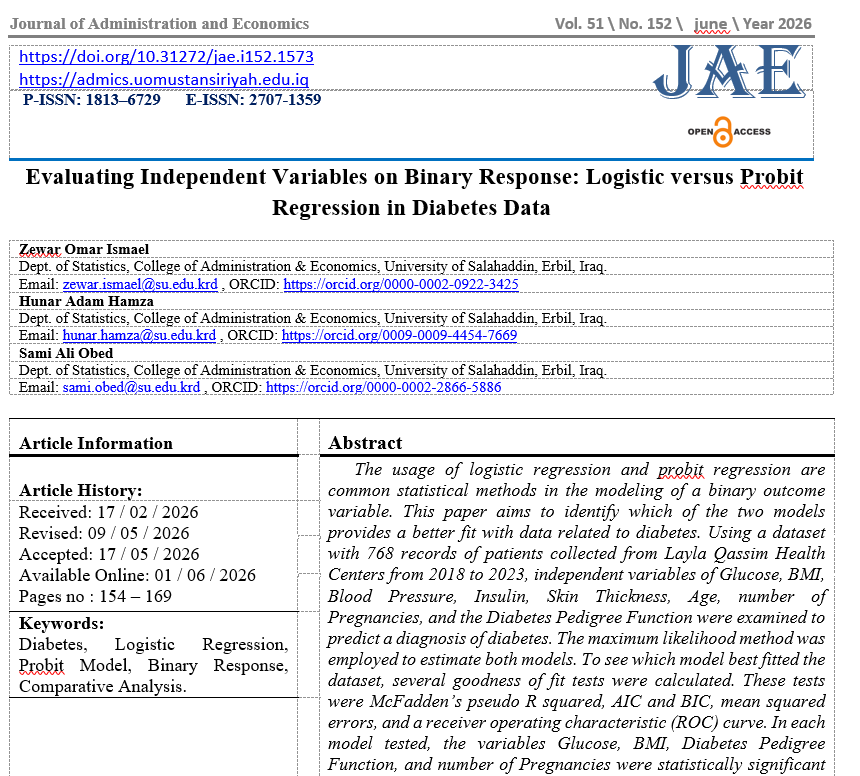
Evaluating Independent Variables on Binary Response: Logistic versus Probit Regression in Diabetes Data
DOI:
https://doi.org/10.31272/jae.i152.1573Keywords:
Diabetes, Logistic Regression, Probit Model, Binary Response, Comparative AnalysisAbstract
This research investigates how various demographic and physiological variables influence diabetes outcomes through binary response modeling, comparing two widely used statistical approaches: logistic and probit regression. The analysis draws on data from 768 patients who visited Layla Qassim Health Centers over a five-year period spanning 2018 to 2023. Eight predictor variables were examined: glucose levels, body mass index, blood pressure readings, insulin measurements, skin thickness, age, number of pregnancies, and the diabetes pedigree function—a metric capturing hereditary risk. Both regression models were fitted using maximum likelihood estimation. To assess how well each model performed, several diagnostic tools were applied, including McFadden's pseudo-R², the Akaike and Bayesian Information Criteria, mean squared error calculations, and ROC-AUC analysis. Across both modeling frameworks, the same variables emerged as meaningful predictors: elevated glucose concentrations, higher BMI values, a family history of diabetes, and pregnancy count all showed strong statistical associations with diabetes status. In contrast, insulin levels and skin thickness contributed little explanatory value to either model. When comparing the two approaches directly, the probit model demonstrated a slight edge in overall fit and classification accuracy, though the practical difference between them was negligible. These results reinforce that logistic and probit methods yield comparable conclusions when applied to binary health outcomes, while also drawing attention to the metabolic and genetic factors that clinicians and policymakers should prioritize in diabetes screening programs and public health planning
Downloads
References
[1] Washington, S., Karlaftis, M. G., & Mannering, F. L. (2003). Statistical and econometric methods for transportation data analysis. Chapman & Hall/CRC. DOI: https://doi.org/10.1201/9780203497111
[2] Rajendra, P., & Latifi, S. (2021). Prediction of diabetes using logistic regression and ensemble techniques. Computer Methods and Programs in Biomedicine Update, 1, 100032. https://doi.org/10.1016/j.cmpbup.2021.100032 DOI: https://doi.org/10.1016/j.cmpbup.2021.100032
[3] Aliman, G., Faye Nivera, T. S., Charmille Olazo, J. A., Jane Ramos, D. P., Danielle Sanchez, C. B., Amado, T. M., Arago, N. M., Jorda Jr., R. L., Virrey, G. C., & Valenzuela, I. C. (2022). Sentiment analysis using logistic regression.
[4] Han, S., & Lee, S. (2018). Estimation in a generalisation of bivariate probit models with dummy endogenous regressors. arXiv preprint arXiv:1808.05792. https://doi.org/10.48550/arXiv.1808.05792 DOI: https://doi.org/10.2139/ssrn.3233422
[5] Strzelecka, A., Kurdyś-Kujawska, A., & Zawadzka, D. (2020). Application of logistic regression models to assess household financial decisions regarding debt. Procedia Computer Science, 176, 3418–3427. https://doi.org/10.1016/j.procs.2020.09.055 DOI: https://doi.org/10.1016/j.procs.2020.09.055
[6] Jawa, T. M. (2022). Logistic regression analysis for studying the impact of home quarantine on psychological health during COVID-19 in Saudi Arabia. Alexandria Engineering Journal, 61(10), 7995–8005. https://doi.org/10.1016/j.aej.2022.01.047 DOI: https://doi.org/10.1016/j.aej.2022.01.047
[7] Abonazel, M. R., Dawoud, I., Awwad, F. A., & Tag-Eldin, E. (2023). New biased estimators for the probit regression model. Scientific Reports, 13(1), 5851. https://doi.org/10.1038/s41598-023-32452-4 DOI: https://doi.org/10.1016/j.sciaf.2023.e01565
[8] Srisathan, W. A., Ketkaew, C., Phonthanukitithaworn, C., & Naruetharadhol, P. (2023). Driving policy support for open eco-innovation enterprises in Thailand: A probit regression model. Journal of Open Innovation: Technology, Market, and Complexity, 9(3), 100084. https://doi.org/10.1016/j.joitmc.2023.100084 ( DOI: https://doi.org/10.1016/j.joitmc.2023.100084
[9] Bhattacharyya, K. (1997). Key issues in polychotomous logit regression. Statistics in Medicine, 16(12), 1391–1397. https://doi.org/10.1002/(SICI)1097-0258(19970630)16:12<1391::AID-SIM540>3.0.CO;2-Y DOI: https://doi.org/10.1002/(SICI)1097-0258(19970630)16:12<1391::AID-SIM636>3.0.CO;2-1
[10] Bishai, D. (1996). Quality efficiency of health care providers: Inferences from a latent variable model. Health Economics, 5(2), 143–155. https://doi.org/10.1002/(SICI)1099-1050(199603)5:2<143::AID
[11] Alhemoud, A. M. (2011). An ordered probit regression model for estimating the effects of demographic factors on rice consumption in Saudi Arabia. International Journal of Business and Globalisation, 6(1), 1–17. https://doi.org/10.1504/IJBG.2011.037416 DOI: https://doi.org/10.1504/IJBG.2011.037322
[12] Obed, S. A., Mohammed, P. A., & Kadir, D. H. (2021). The estimation of (Covid-19) cases in Kurdistan region using Nelson Aalen estimator. Cihan University-Erbil Scientific Journal, 5(2), 24–31. https://doi.org/10.24086/cuesj.v5n2y2021.pp24-31 DOI: https://doi.org/10.24086/cuesj.v5n2y2021.pp24-31
[13] Kadir, D. H., & Amin, K. A. (2022). Comparing between Probit and Logit regression models to predict the factors affecting inflation in Iraq. Tikrit Journal of Administrative and Economic Sciences, 18(58, 2), 438–455. https://doi.org/10.25130/tjaes.18.58.2.25 DOI: https://doi.org/10.25130/tjaes.18.58.2.25
[14] Golam Kibria, B. M., & Saleh, A. K. M. E. (2012). Improving the estimators of the parameters of a probit regression model: A ridge regression approach. Journal of Statistical Planning and Inference, 142(6), 1421–1435. https://doi.org/10.1016/j.jspi.2011.12.023 DOI: https://doi.org/10.1016/j.jspi.2011.12.023
[15] Khaleel, Z. J., & Al-Jamil, S. K. (2021). The impact of some public finance variables on the gross national savings in Iraq. Tikrit Journal of Administrative and Economic Sciences, 17(54, 3), 430–443. https://doi.org/10.25130/tjaes.17.54.3.27 DOI: https://doi.org/10.25130/tjaes.17.54.3.27
[16] Salh, S. M., Abdalla, H. T., & Omer, Z. M. (2021). Using multinomial logistic regression model to study factors that affect chest pain. Tikrit Journal of Administrative and Economic Sciences, 17(53, 2), 534–555. https://doi.org/10.25130/tjaes.17.53.2.31 DOI: https://doi.org/10.25130/tjaes.17.53.2.31
[17] Sule, B. O., & Saporu, F. W. O. (2015). Mathematical theory and modeling. Journal of Mathematical Theory and Modeling, 5(10), 45-53.
[18] Hua, Y., Stead, T. S., George, A., & Ganti, L. (2025). Clinical risk prediction with logistic regression: Best practices, validation techniques, and applications in medical research. Academic Medicine & Surgery, 4(1), e131964. https://doi.org/10.62186/ams.v4i1.131964 DOI: https://doi.org/10.62186/001c.131964
[19] Dey, D., Haque, M. S., Islam, M. M., Aishi, U. I., Shammy, S. S., Mayen, M. S. A., Noor, S. T. A., & Uddin, M. J. (2025). The proper application of logistic regression model in complex survey data: A systematic review. BMC Medical Research Methodology, 25(1), 1–15. https://doi.org/10.1186/s12874-024-02454-5 DOI: https://doi.org/10.1186/s12874-024-02454-5
[20] Bewick, V., Cheek, L., & Ball, J. (2005). Statistics review 14: Logistic regression. Critical Care, 9(1), 112–118. https://doi.org/10.1186/cc3045 DOI: https://doi.org/10.1186/cc3045
[21] Gibbons, R. D., Hedeker, D., & Lab, B. (1994). Application of random-effects probit regression models. Journal of DOI: https://doi.org/10.1037/0022-006X.62.2.285
Consulting and Clinical Psychology, 62(2), 285–296. https://doi.org/10.1037/0022-006X.62.2.285 DOI: https://doi.org/10.1037/0022-006X.62.2.285
Downloads
Published
Issue
Section
License
Copyright (c) 2026 Zewar Omar Ismael Ismael, Hunar Adam Hamza, Sami Ali Obed

This work is licensed under a Creative Commons Attribution 4.0 International License.
The journal of Administration and Economics is an open- access journal that all contents are free of charge. Articles of this journal are licensed under the terms of the Creative Commons Attribution International Public License CC-BY 4.0 (https://creativecommons.org/licenses/by/4.0/legalcode) that licensees are unrestrictly allowedto search, download, share, distribute, print, or link to the full text of the articles, crawl them for indexing and reproduce any medium of the articles provided that they give the author(s) proper credits (citation). The journal allows the author(s) to retain the copyright of their published article.
Creative Commons-Attribution (BY)