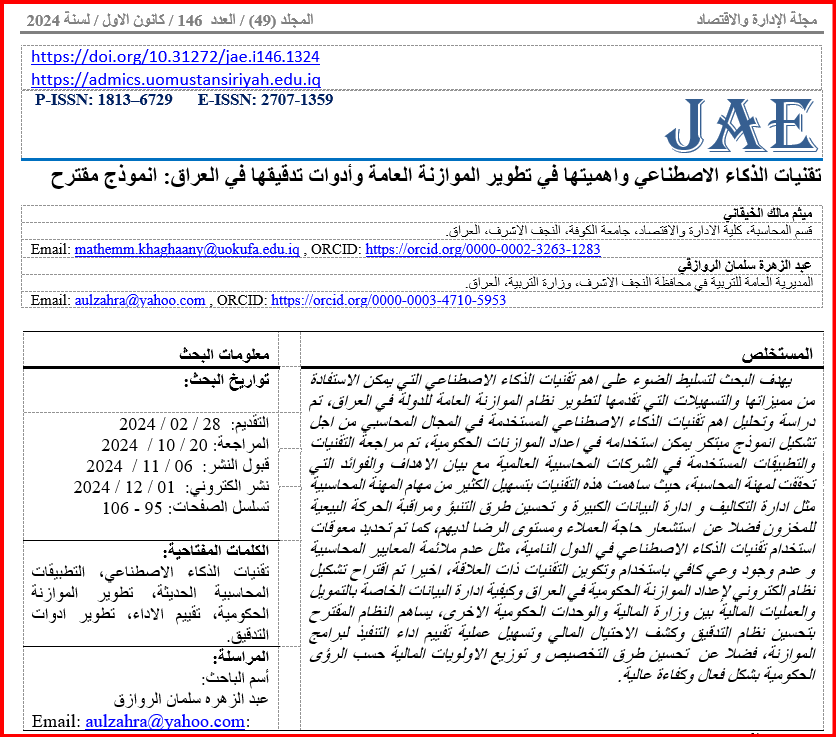
تقنيات الذكاء الاصطناعي واهميتها في تطوير الموازنة العامة وأدوات تدقيقها في العراق: انموذج مقترح
DOI:
https://doi.org/10.31272/jae.i146.1324الكلمات المفتاحية:
تقنيات الذكاء الاصطناعي، التطبيقات المحاسبية الحديثة، تطوير الموازنة الحكومية, تقييم الاداء، تطوير ادوات التدقيق.الملخص
يهدف البحث لتسليط الضوء على اهم تقنيات الذكاء الاصطناعي التي يمكن الاستفادة من مميزاتها والتسهيلات التي تقدمها لتطوير نظام الموازنة العامة للدولة في العراق. تم دراسة وتحليل اهم تقنيات الذكاء الاصطناعي المستخدمة في المجال المحاسبي من اجل تشكيل انموذج مبتكر يمكن استخدامه في اعداد الموازنات الحكومية. تم مراجعة التقنيات والتطبيقات المستخدمة في الشركات المحاسبية العالمية مع بيان الاهداف والفوائد التي تحققت لمهنة المحاسبة. حيث ساهمت هذه التقنيات بتسهيل الكثير من مهام المهنة المحاسبية مثل ادارة التكاليف و ادارة البيانات الكبيرة و تحسين طرق التنبؤ ومراقبة الحركة البيعية للمخزون اضافة الى استشعار حاجة العملاء ومستوى الرضا لديهم. كما تم تحديد معوقات استخدام تقنيات الذكاء الاصطناعي في الدول النامية, مثل عدم ملائمة المعايير المحاسبية و عدم وجود وعي كافي باستخدام وتكوين التقنيات ذات العلاقة. اخيرا تم اقتراح تشكيل نظام الكتروني لإعداد الموازنة الحكومية في العراق وكيفية ادارة البيانات الخاصة بالتمويل والعمليات المالية بين وزارة المالية والوحدات الحكومية الاخرى. يساهم النظام المقترح بتحسين نظام التدقيق وكشف الاحتيال المالي وتسهيل عملية تقييم اداء التنفيذ لبرامج الموازنة. اضافة الى تحسين طرق التخصيص و توزيع الاولويات المالية حسب الرؤى الحكومية بشكل فعال وكفاءة عالية.
التنزيلات
المراجع
[1] Abd A. Sh. (2023). The Reality of Accounting in Light of Artificial Intelligence in Iraq. Tikrit Journal of Administrative and Economic Sciences, 1, 1–21. https://doi.org/10.25130/tjaes.19.63.1.
[2] Abdul Halim, Abeer (2022). Artificial Intelligence in Management Accounting and its Impact on Accounting Performance and Decision Support: An Analytical Study. Journal of Financial and Commercial Research, Vol. 23 (2).
[3] Abdul Mottaleb, Shaimaa (2022). Benefiting from International Accounting Education Standards in Achieving Quality of Life in Faculties of Commerce in Egypt. Alexandria Journal of Accounting Research, Alexandria University, Vol. 13 (1).
[4] Ahmed, Said (2023). The Impact of Cloud Artificial Intelligence Techniques on Improving Audit Evidence in Light of Related Auditing Standards. Scientific Journal of Financial and Commercial Studies and Research, Damietta University, Vol. 4 (1).
[5] Al-Jaber, Ghadeer (2020). The Impact of Artificial Intelligence on the Efficiency of Accounting Systems in Jordanian Banks. Master's Thesis, Middle East University, Jordan.
[6] Al-Rawazqi, Abdul Zahra. & Tsatakhlanova, Tamara (2022). Implementation of Smart Budgeting in Iraq: Opportunities and Challenges. In Proceedings of: The Digital Transformation of Industry Conference: Trends, Management and Strategies - pp. 18-33.
[7] Al-Sayed, Karima Ahmed (2020). Improving the Accuracy of Profit Forecasting Using Artificial Neural Networks: A Field Study. Master's Thesis, Faculty of Commerce, Al-Azhar University.
[8] Amer Qasim, F., & Kharbat, F. F. (2020). Blockchain Technology, Business Data Analytics, and Artificial Intelligence: Use in the Accounting Profession and Ideas for Inclusion into the Accounting Curriculum. Journal of Emerging Technologies in Accounting. 17, (1), 107–117. https://doi.org/10.2308/jeta-52649 DOI: https://doi.org/10.2308/jeta-52649
[9] Coyne, J. G., & McMickle, P. L. (2017). Can Blockchains serve an accounting purpose? Journal of Emerging Technologies in Accounting, 14 (2), 101–111. https://doi.org/10.2308/jeta-51910 DOI: https://doi.org/10.2308/jeta-51910
[10] Desouki, Hamad Ahmed (2020). Using Neural Network Analysis Method in Criteria for Determining Labor Cost Elements in Industrial Companies. Journal of Financial and Commercial Studies, Faculty of Commerce, Issue (3).
[11] Digalaki, E. (2019). AI in banking business insider. Business Insider.
[12] Djevojić, C., Brajak, M., & Mihajlovic, I. (2021). Digital Transformation, Sharing Economy and Effects on Society. In B. Katalinic (Ed.), Proceedings of the 32nd DAAAM International Symposium (pp. 0732-0739). DOI: https://doi.org/10.2507/32nd.daaam.proceedings.102
[13] El-Mousawi, H., Jaber, A., & Fakih, I. (2023). Impact of Using Artificial Intelligence Applications on the Accounting and Auditing Profession: An Exploratory Study from the LCPAs’ Perspective. Journal of Business Theory and Practice, 11 (4), 1–16. https://doi.org/10.22158/jbtp.v11n4p1. DOI: https://doi.org/10.22158/jbtp.v11n4p1
[14] EY. (2018). Data Governance: Securing the Future of Financial Services.
[15] He, X., Chu, L. R., Qiu, C., Ai, Q., & Ling, Z. (2018). A novel data-driven situation awareness approach for future grids-using large random matrices for big data modeling. IEEE Access, 6, 13855–13865. DOI: https://doi.org/10.1109/ACCESS.2018.2805815
[16] Hoelscher, J., & Mortimer, A. (2018). Using tableau to visualize data and drive decision-making. Journal of Accounting Education, 44, 49–59. https://doi.org/10.1016/j.jaccedu.2018.05.002 DOI: https://doi.org/10.1016/j.jaccedu.2018.05.002
[17] Kroon, N., Alves, M. C., & Martins, I. (2021). The Impacts of Emerging Technologies on Accountants’ Role and Skills: Connecting to Open Innovation—A Systematic Literature Review. Journal of Open Innovation: Technology, Market, and Complexity, 7 (3), 163. https://doi.org/10.3390/joitmc7030163 DOI: https://doi.org/10.3390/joitmc7030163
[18] Negnevitsky, M. (2005). Artificial Intelligence: A guide to intelligent systems (2nd ed.). Pearson Education.
[19] OECD. (2019). Measuring the Digital Transformation: A Roadmap for the Future. OECD Publishing. https://doi.org/10.1787/9789264311992-en DOI: https://doi.org/10.1787/9789264311992-en
[20] Oloyede, A. A., Faruk, N., Noma, N., Tebepah, E., & Nwaulune, A. A. (2023). Measuring the impact of the digital economy in developing countries: A systematic review and meta-analysis. Heliyon, 9 (7), e17654. https://doi.org/10.1016/j.heliyon.2023.e17654 DOI: https://doi.org/10.1016/j.heliyon.2023.e17654
[21] Parry, D. (2020). Corporate reporting in the era of artificial intelligence. A free monthly publication, (12).
[22] Qin, Y., Xu, Z., Wang, X., & Skare, M. (2023). Artificial Intelligence and Economic Development: An Evolutionary Investigation and Systematic Review. Journal of the Knowledge Economy. https://doi.org/10.1007/s13132-023-01183-2 DOI: https://doi.org/10.1007/s13132-023-01183-2
[23] Quinto II, E. J. (2022). How Technology Has Changed the Field of Accounting. (BSU Honors Program Theses and Projects, Item 558). https://vc.bridgew.edu/honors_proj/558
[24] Rashwan, A. R. M. S., & Alhelou, E. M. S. (2020). The Impact of Using Artificial Intelligence on the Accounting and Auditing Profession in Light of the Corona Pandemic. Journal of Advance Research in Business, Management and Accounting. DOI: https://doi.org/10.53555/nnbma.v6i9.890
[25] Rizk, Alaa Ahmed (2020). The Extent of the Contribution of Artificial Intelligence Techniques in Supporting Performance Quality for Accounting and Auditing Offices in Egypt. Islamic Thought Journal, Vol. 24 (2).
[26] Rout, J. K., Choo, K. K. R., Dash, A. K., et al. (2018). A model for sentiment and emotion analysis of unstructured social media text. Electronic Commerce Research, 18, 181–199. https://doi.org/10.1007/s10660-017-9257-8 DOI: https://doi.org/10.1007/s10660-017-9257-8
[27] Shanan, Ali Abbas (2024). A Proposed Approach to Activating the Use of Artificial Intelligence Technology in the Accounting Field and its Impact on Supporting and Developing the Accounting Profession: A Field Study in the Contemporary Business Environment. Scientific Journal of Financial and Commercial Studies and Research, (1) 2, 631–666.
[28] Sheng, H., Fan, W. Hu, W., Liu, X., & Zhang, K. (2018). Economic incentive structure for blockchain network. In M. Qiu (Ed.), Smart Blockchain (Lecture Notes in Computer Science) (pp. 120–128). Springer. DOI: https://doi.org/10.1007/978-3-030-05764-0_13
[29] Valle-Cruz, D., Fernandez-Cortez, V., & Gil-Garcia, J. R. (2022). From E-budgeting to smart budgeting: Exploring the potential of artificial intelligence in government decision-making for resource allocation. Government Information Quarterly 39 (2), 101644. https://doi.org/10.1016/j.giq.2021.101644 DOI: https://doi.org/10.1016/j.giq.2021.101644
[30] Waly, Mohamed Zeidan, Ibrahim, Nossair, & Mabrouk, Mohamed Elsayed (2022). The Impact of the Effectiveness of Artificial Intelligence Technology on Accounting Inference in Financial Reports. Journal of Accounting Thought, Vol. 26 (1).
[31] Weckman, G., Paschold, H., Dowler, J., Whiting, H., & Young, W. (2020). Using Neural Networks with Limited Data to Estimate Manufacturing Cost. Journal of Industrial and Systems Engineering, 3 (4), 257–274.
[32] Yu, Y., Yin, G., Wang, T., et al. (2016). Determinants of pull-based development in the context of continuous integration. Science China Information Sciences, 59 (8), 080104. https://doi.org/10.1007/s11432-016-5595-8 DOI: https://doi.org/10.1007/s11432-016-5595-8
التنزيلات
منشور
إصدار
القسم
الرخصة
الحقوق الفكرية (c) 2024 ميثم مالك الخيقاني، عبد الزهرة سلمان الروازقي

هذا العمل مرخص بموجب Creative Commons Attribution 4.0 International License.
مجلة الإدارة والاقتصاد هي مجلة مفتوحة المصدر حيث تكون جميع محتوياتها مجانية. تخضع مقالات هذه المجلة لشروط ترخيص المشاع الإبداعي المنسوب إلى المؤلف (CC-BY 4.0) (https://creativecommons.org/licenses/by/4.0/legalcode) الذي يسمح للمرخص لهم دون قيود بالبحث عن النص الكامل للمقالات أو تنزيله أو مشاركته أو توزيعه أو طباعته أو ربطه به، وفحصه للفهرسة وإعادة إنتاج أي وسيلة للمقالات بشرط أن ينسبوا إلى المؤلفين الفضل في ذلك (الاستشهاد). تسمح المجلة للمؤلفين بالاحتفاظ بحقوق الطبع والنشر لمقالهم المنشور.
. Creative Commons-Attribution (BY)