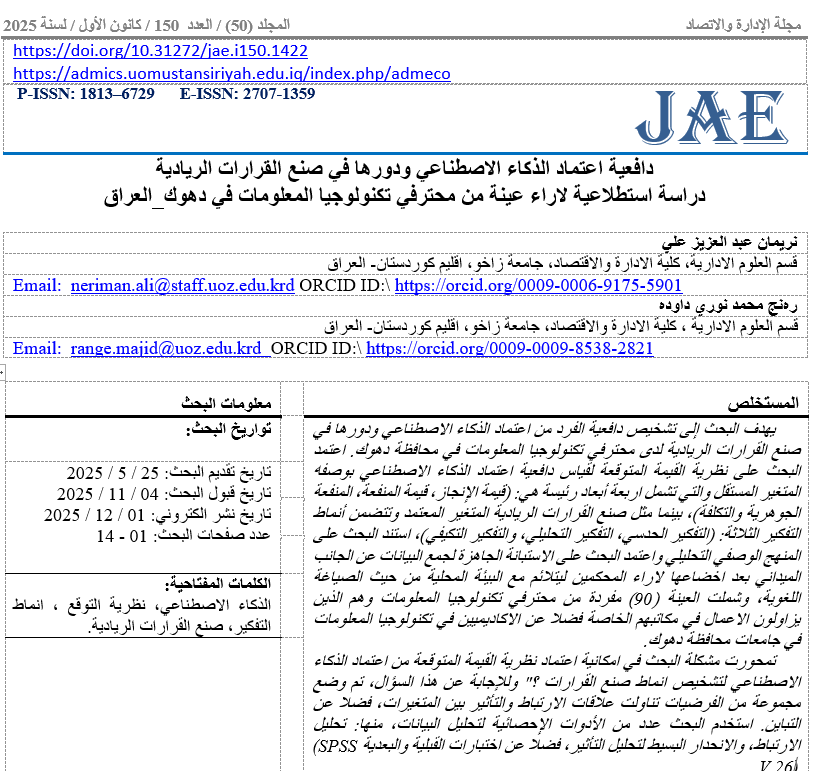
دافعية اعتماد الذكاء الاصطناعي ودورها في صنع القرارات الرياديةدراسة استطلاعية لاراء عينة من محترفي تكنولوجيا المعلومات في دهوك_العراق
DOI:
https://doi.org/10.31272/jae.i150.1422الكلمات المفتاحية:
الذكاء الاصطناعي ، نظرية التوقع ، انماط التفكير ، صنع القرارات الرياديةالملخص
هدفت هذه الدراسة إلى تشخيص دافعية الفرد من اعتماد الذكاء الاصطناعي ودورها في صنع القرارات الريادية لدى محترفي تكنولوجيا المعلومات في محافظة دهوك. اعتمدت الدراسة على نظرية القيمة المتوقعة لقياس الدافعية اعتماد الذكاء الاصطناعي بوصفه المتغير المستقل والتي تشمل اربعة أبعاد رئيسة هي: (قيمة الإنجاز، قيمة المنفعة، المنفعة الجوهرية، والتكلفة)، بينما مثل صنع القرارات الريادية المتغير المعتمد وتتضمن أنماط التفكير الثلاثة: (التفكير الحدسي، التفكير التحليلي، والتفكير التكيفي)، استندت الدراسة على المنهج الوصفي التحليلي واعتمدت الدراسة على الاستبانة الجاهزة لجمع البيانات عن الجانب الميداني، وشملت العينة (90) مفردة من محترفي تكنولوجيا المعلومات وهم الذين يزاولون الاعمال في مكاتبهم الخاصة فضلا عن المتخصصين في تكنولوجيا المعلومات في جامعات محافظة دهوك.
تمحورت مشكلة الدراسة في امكانية اعتماد نظرية القيمة المتوقعة من اعتماد الذكاء الاصطناعي تشخيص انماط صنع القرارات ؟" وللإجابة عن هذا السؤال، تم وضع مجموعة من الفرضيات تناولت علاقات الارتباط والتأثير بين المتغيرات، فضلا عن تصميم انموذج فرضي يعكس تلك العلاقات. واستخدمت الدراسة عدد من الأدوات الإحصائية لتحليل البيانات، منها: تحليل الارتباط، والانحدار البسيط لتحليل التأثير، فضلا عن اختبارات القبلية والبعدية(SPSS V.26)
توصلت الدراسة إلى عدد من النتائج المهمة، من أبرزها وجود علاقة ارتباط معنوية موجبة بين أبعاد القيمة المتوقعة من اعتماد في مجال الذكاء الاصطناعي وانماط صنع القرارات الريادية. وان ابعاد التكلفة المتوقعة من تبني الذكاء الاصطناعي، جاءت في مقدمة من حيث التأثير في صنع القرارات الريادية وتلتها كل من وقيمة المنفعة والمنفعة الجوهرية وقد خلصت الدراسة بمجموعة من التوصيات، أبرزها ضرورة تعزيز استخدام الذكاء الاصطناعي في البيئات الريادية، مع تقديم عدد من مقترحات للدراسات مستقبلية تتناول العلاقة بين المتغيرات وضمن قطاعات مختلفة.
التنزيلات
المراجع
[1] Abdulah, d. m., zaman, b. a., mustafa, z. r., & hassan, l. h. (2024). Artificial intelligence integration in academic writing. The scientific journal of Koya University, 12(2), 194-200., https://doi.org/10.14500/aro.11794 DOI: https://doi.org/10.14500/aro.11794
[2] Abdul-Azeez, O., Ihechere, A. O., and Idemudia, C. (2024). Enhancing business performance: The role of data-driven analytics in strategic decision-making. International Journal of Management and Entrepreneurship Research, 2066–2081, https://doi.org/10.51594/ijmer.v6i7.1257 DOI: https://doi.org/10.51594/ijmer.v6i7.1257
[3] Ahmed, R. A. W. (2024). The role of artificial intelligence technologies in improving the quality of hotel services: A theoretical study. Journal of Administration and Economics, Mustansiriyah University, Vol: (49), No.144, 154–160. https://doi.org/10.31272/jae.i144 DOI: https://doi.org/10.31272/jae.i144.1249
[4] Ahmed, R. M. S. (2022). Applications of artificial intelligence management in administrative decision-making (Master’s thesis, College of Law, Middle East University, Amman, Jordan).
[5] Al-Juhani, N. B. S. H. (2020). A proposed program based on artificial intelligence to identify teachers’ training needs and develop their professional capabilities. Journal of Human and Literary Studies, 19(2), 1–28. https://doi.org/10.21608/shak.2020.195895 DOI: https://doi.org/10.21608/shak.2020.195895
[6] Allison, C., Chell, E., and Hayes, J. (2010). Intuition and Entrepreneurial Behavior. European Journal of Entrepreneurial Behavior, 9(1), 31-43., https://doi.org/10.1080/135943200398049 DOI: https://doi.org/10.1080/135943200398049
[7] Barron, K. E., and Hulleman, C. S. (2015). The expectancy-value-cost model of motivation. In J. D. Wright (Ed.), International encyclopedia of the social and behavioral sciences (2nd ed., Vol. 8, pp. 503-509). Elsevier, https://doi.org/10.1016/B978-0-08-097086-8.26099-6 DOI: https://doi.org/10.1016/B978-0-08-097086-8.26099-6
[8] Certo, S. T., Connelly, B. L., and Tihanyi, L. (2008). Managers and they’re not-so rational decisions. Business Horizons, 51(2), 113-119., DOI: https://doi.org/10.1016/j.bushor.2007.11.002 DOI: https://doi.org/10.1016/j.bushor.2007.11.002
[9] Clemen, R. T., and Reilly, T. (2001). Making Hard Decisions with Decision Tools. South-Western College Publishing. ISBN: 9781285950983
[10] Darabos, K. (2022). Intuitive decision: When to begin the succession process. Corvinus Journal of Sociology and Social Policy, 13(2), 79–105. DOI: https://doi.org/10.14267/CJSSP.2022.2.4
DOI: https://doi.org/10.14267/cjssp.2022.2.4 DOI: https://doi.org/10.14267/CJSSP.2022.2.4
[11] Dawoda, R. M. N. (2011). Entrepreneurial leadership and business ethics in entrepreneurial organizations (Phd. Doctorate dissertation, College of Administration and Economics, University of Duhok, Kurdistan Region, Iraq.
[12] Fairlie, Robert W., and Frank M. Fossen.( 2018). Opportunity versus Necessity Entrepreneurship: Two Components of Business Creation. In IZA (Institute of Labor Economics) Discussion Paper (IZA Discussion Paper No. 11258, 49 pages).. Munich: CESifo GmbH, https://doi.org/10.2139/ssrn.3140340 DOI: https://doi.org/10.2139/ssrn.3132357
[13] Global Entrepreneurship Monitor. (2018). Global report 2017/18. Global Entrepreneurship Research Association (GERA). https://www.gemconsortium.org/report/gem-2017-2018-global-report
[14] Groves, K., Vance, C., & Choi, D. (2011). Examining Entrepreneurial Cognition: An Occupational Analysis of Balanced Linear and Nonlinear Thinking and Entrepreneurship Success. Journal of Small Business Management. 49(3), 438–466. https://doi.org/10.1111/j.1540-627X.2011.00329.x DOI: https://doi.org/10.1111/j.1540-627X.2011.00329.x
[15] Gugliemo. G, Massimiliano Matteo P., (2023). Artificial Intelligence as an enabler for Entrepreneurs: a Systematic Literature review and an agenda for future research, international journal of entrepreneurial behavior and research,816-837, https://doi.org/10.1108/IJEBR-05-2021-0426 DOI: https://doi.org/10.1108/IJEBR-05-2021-0426
[16] Hamilton, K., Shih, S., and Mohammed, S. (2016). The development and validation of the rational and intuitive decision styles scale. Journal of Personality Assessment. DOI: 10.1080/00223891.2015.1132426 DOI: https://doi.org/10.1080/00223891.2015.1132426
[17] Hilal, G. M. I., Chabaan, Y. M. M., and Njehi, A. M. M. (2022). The Governance of Artificial Intelligence in Line with the International Human Rights Law. Dirasat: Shari’a and Law Sciences, 49(4), 126–138. https://doi.org/10.35516/law.v49i4.1173 DOI: https://doi.org/10.35516/law.v49i4.1173
[18] IBM Cloud Education (2020). Artificial Intelligence. International Telecommunication Union (ITU). (2018)23. United Nations Activities on Artificial Intelligence (AI). Geneva: ITU.
[19] Kashmiri, I. A., Al-Zughaibi, I., Alam, R. M., Barayan, A. M., & Al-Harbi, H. (2024). The use of artificial intelligence in education in the Arab world: A systematic review. Journal of Arts, Literature, Humanities and Sociology, 109, 223–245. https://safwacenter.net/blogs/scientific_articles
[20] Khalil, M. A. M. H. (2019), The Effectiveness of MIS effectiveness in Improving The Efficiency of management decision-making process: An exploratory study in commercial banks in Iraq. Journal of Administration and Economics, Al-Mustansiriyah University, Vol:(42), No.121, 239–254. https://doi.org/10.31272/jae.i121 DOI: https://doi.org/10.31272/jae.i121
[21] Khan, A. (2024). Effective decision making using data analytics. Indian Scientific Journal Of Research In Engineering And Management., 8(4), https://doi.org/10.55041/ijsrem32598 DOI: https://doi.org/10.55041/IJSREM32598
[22] Maani, K. E., and Maharaj, V. (2016)25. Links between systems thinking and complex decision making. System Dynamics Review: The Journal of the System Dynamics Society, 20(1), 21–48., https://doi.org/10.1002/sdr.281 DOI: https://doi.org/10.1002/sdr.281
[23] Makridakis, S., and Polemitis, A. (2023). Human Intelligence (HI) Versus Artificial Intelligence (AI) and Intelligence Augmentation (IA). In Forecasting with Arthificial Intelligence: Theory and Applications (pp. 3-29). Cham: Springer Nature Switzerland.Manufacturing workflow to empower Industry 4.0. International Conference on Smart Systems and Advanced Computing (Syscom-2021), December 25-26, 2021, https://doi.org/10.48550/arXiv.2201.11271 DOI: https://doi.org/10.1007/978-3-031-35879-1_1
[24] Mohamed, A. (2023). Artificial intelligence: The future partner in managing your business. Aljazeera.net, May 22, 2023. https://www.aljazeeera.net (Link not fully provided – assumed source.)
[25] Mohammadi, Golshan and Sajadi, Seyed Mojtaba and Sakhdari, Kamal (2019). "An Entrepreneurial Decision-Making Model: A case study of the Electronic Business of Tehran", Iranian Journal of Management studies, Vol.12, No.1 pp.25-44, https://doi.org/10.22059/ijms.2018.263188.673244
[26] Mosyjowski, E. A., Daly, S. R., Peters, D. L., Skerlos, S. J., and Baker, A. B.31 (2017). JEE Selects Research in Practice: Reality Check. Asee Prism, 27(3), 39-42., https://doi.org/10.18260/1-2--30412 DOI: https://doi.org/10.18260/1-2--30412
[27] Mousa, A., & Bilal, A. H. (2019). Artificial intelligence: A revolution in contemporary technologies (1st ed.). Arab Group for Training and Publishing – Cairo, 978-977-722-152-8، (https://www.arabgroup.net.eg/fronts/book/1436 ) , p. 20.
[28] Muften, H. I., &, Aradin. H. (2021). The role of entrepreneurship in achieving sustainable banking development: An exploratory study of a sample of the Iraqi banks. Journal of Administration and Economics, Mustansiriyah University, Vol: 46, No. (129), 1–21. https://doi.org/10.31272/jae.i129.40 DOI: https://doi.org/10.31272/jae.i129.40
[29] Okyireh, M. A. A., and Okyireh, R. O. (2020). Entrepreneurial Cognitions and Decision-Making: A Study of Community Participants in The La-Nkwantanang Municipality, Ghana. International Journal of Academic Research in Business and Social Sciences. 10(10), 1-21., https://doi.org/10.6007/IJARBSS/v10-i10/7894 DOI: https://doi.org/10.6007/IJARBSS/v10-i10/7894
[30] Sadler-Smith, E. (2019). Intuition in Management. https://doi.org/10.1093/ACREFORE/9780190224851.013.177 DOI: https://doi.org/10.1093/acrefore/9780190224851.013.177
[31] Sassetti ,Sara , Vinceoknzo Cavaliere & Sara Lombardi, (2022)32 ,The rhythm of effective entrepreneurs’ decision making process. The pathways of alertness scanning and search and cognitive style. A mediation model, International Entrepreneurship and Management Journal , 18:555–578 https://doi.org/10.1007/s11365-021-00759-1 DOI: https://doi.org/10.1007/s11365-021-00759-1
[32] Wei, Y., Long, D., and Fu, L. (2024). The Influence of Intuitive-Analytical Cognitive Styles on Entrepreneurial Decision-Making Logic: Moderated by Environmental Uncertainty. SAGE Open, 14(3), https://doi.org/10.1177/21582440241273297 DOI: https://doi.org/10.1177/21582440241273297
[33] Yurt,E. and Kasarci, I. (2024). A Questionnaire of Artificial Intelligence Use Motives: A contribution to investigating the connection between AI and motivation. International Journal of Technology in Education (IJTE), 7(2), 308-325. https://doi.org/10.46328/ijte.725 DOI: https://doi.org/10.46328/ijte.725
[34] Zaki, W. R. (2023). Artificial intelligence in facing crises and disasters: Opportunities and challenges. International Journal of Human Studies, 11(67). https://www.researchgate.net/publication/375058991_aldhka_alastnay DOI: https://doi.org/10.4103/IJHS_20230411_67
[35] Zhang, J., Yang, S., and Wang, Y. (2024). How does the level of enterprise digitalization affect value creation and realization? Testing of the dual path of" based on breakthrough" and" tending to compliance". Plos one, 19(6), https://doi.org/10.1371/journal.pone.0305078. DOI: https://doi.org/10.1371/journal.pone.0305078
التنزيلات
منشور
إصدار
القسم
الرخصة
الحقوق الفكرية (c) 2025 Neriman AbdulAzeez Ali, Range M. Nori Dawoda

هذا العمل مرخص بموجب Creative Commons Attribution 4.0 International License.
مجلة الإدارة والاقتصاد هي مجلة مفتوحة المصدر حيث تكون جميع محتوياتها مجانية. تخضع مقالات هذه المجلة لشروط ترخيص المشاع الإبداعي المنسوب إلى المؤلف (CC-BY 4.0) (https://creativecommons.org/licenses/by/4.0/legalcode) الذي يسمح للمرخص لهم دون قيود بالبحث عن النص الكامل للمقالات أو تنزيله أو مشاركته أو توزيعه أو طباعته أو ربطه به، وفحصه للفهرسة وإعادة إنتاج أي وسيلة للمقالات بشرط أن ينسبوا إلى المؤلفين الفضل في ذلك (الاستشهاد). تسمح المجلة للمؤلفين بالاحتفاظ بحقوق الطبع والنشر لمقالهم المنشور.
. Creative Commons-Attribution (BY)