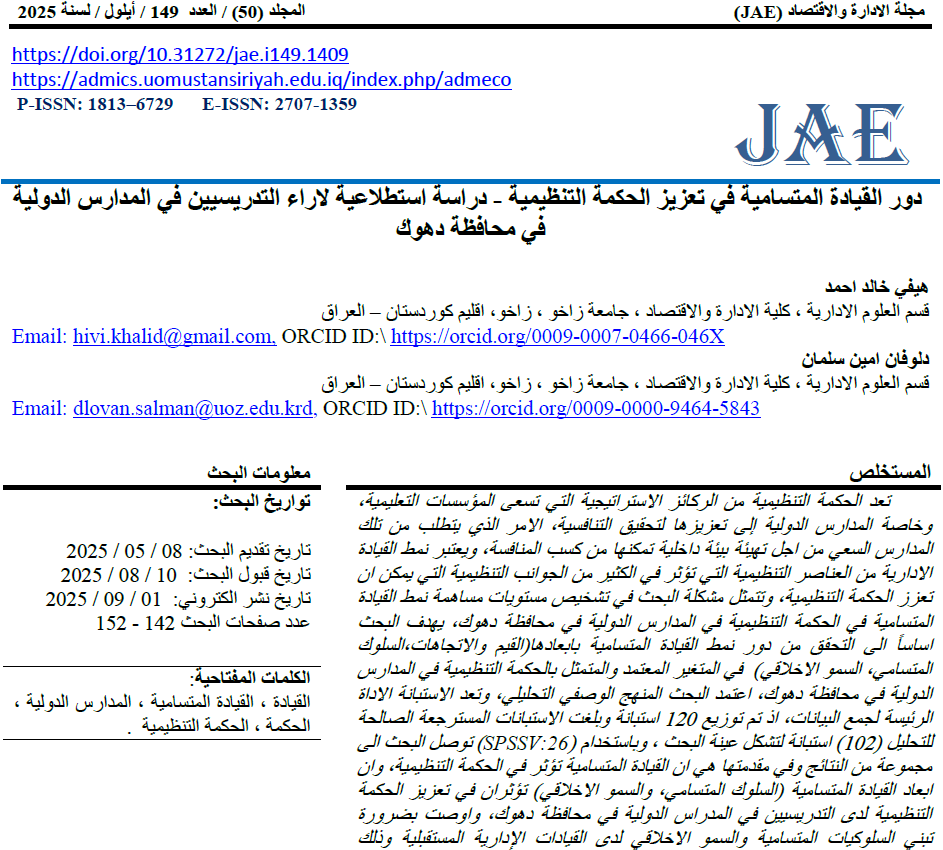
دور القيادة المتسامية في تعزيز الحكمة التنظيمية - دراسة استطلاعية لاراء التدريسيين في المدارس الدولية في محافظة دهوك
DOI:
https://doi.org/10.31272/jae.i149.1409الكلمات المفتاحية:
القيادة ، القيادة المتسامية ، المدارس الدولية ، الحكمة، الحكمة التنظيميةالملخص
تعد الحكمة التنظيمية احدى اهم الموجودات الاستراتيجية التي تسعى المنظمات الى توظيفها وخاصة لدى المؤسسات التعليمية، وتعد المدارس الدولية من المؤسسات التعليمية التي تساهم في بناء الطاقات المستقبلية وتنافس نظيراتها، الامر الي يتطلب من تلك المدارس السعي من اجل تهيئة بيئة داخلية تمكنها من كسب المنافسة، وتعد القيادة الادارية من العناصر التنظيمية التي تؤثر في الكثير من الجوانب التنظيمية اعتمادا على القوة التي تمتلكها والمستندة على النمط القيادي التي من شأنه ان تعزز الحكمة التنظيمية، يهدف البحث الى التحقق من دور نمط القيادة المتسامية بابعادها(القيم والاتجاهات،السلوك المتسامي، السمو الاخلاقي) في المتغير المعتمد والمتمثل بالحكمة التنظيمية في المدارس الدولية في محافظة دهوك، اعتمد البحث المنهج الوصفي التحليلي، وتعد الاستبانة الاداة الرئيسة لجمع البيانات، اذ تم توزيع 120 استمارة وبلغت الاستمارات المسترجعة الصالحة (102) استمارة لتشكل عينة البجث ، وتتمثل مشكلة البحث في تشخيص مساهمة نمط القيادة المتسامية في الحكمة التنظيمية في المدارس الدولية في محافظة دهوك، استخدم العديد من الادوات الاحصائية، وتوصل البحث الى مجموعة من الاستنتاجات منها ان القيادة المتسامية تؤثر في الحكمة التنظيمية وان ابعاد القيادة المتسامية (السلوك المتسامي، والسمو الاخلاقي) تؤثران في تعزيز الحكمة التنظيمية لدى التدريسيين في المدراس الدولية واوصت بضرورة تبني السلوكيات المتسامية والسمو الاخلاقي لدى القيادات المستقبلية وذلك لضمان تعزيز الحكمة التنظيمية فضلا عن التوصية بضرورة اجراء دراسات مستقبلية واختبار انماط قيادية اخرى التي من شانها ان تعزز الحكمة التنظيمية لدى التدريسيين في المؤسسات التربوية.
*مستل من رسالة الماجستير للباحث الاول
التنزيلات
المراجع
[1] Abdul Wahab, M. O., & Mahmoud, S. M. (2024). The impact of emotional labor on achieving strategic alignment: An exploratory analytical study in the colleges and centers of Al-Mustansiriya University. Journal of Administration and Economics, 48(138), 13-26. https://doi.org/10.31272/jae.i138.1105 DOI: https://doi.org/10.31272/jae.i138.1105
[2] Al-Haj, M. (2023, November 30). Kurdish professors present (8) recommendations for developing education in the Kurdistan Region. Shafaq News. https://shafaq.com
[3] Alnifie, S., (2023) System Thinking in a Global Context to Foster Transcendent Leadership , The Paris Conference on Education 2023: Official Conference Proceedings (pp. 509-519) https:// doi.org/10.22492/issn.2758-0962.2023.43 DOI: https://doi.org/10.22492/issn.2758-0962.2023.43
[4] Al-Lassasmeh,W., (2023),The Degree of Transcendental Leadership Practice Among School Principals in The Directorate of Education, Al- Qasr/ Karak district Journal of Educational and Psychological Sciences (JEPS), Vol 7, Issue 8, P:22-43, https:// doi.org/10.26389/AJSRP.L210822. DOI: https://doi.org/10.26389/AJSRP.L210822
[5] Al- Qaisi, K. A., (2019). Ethical climate and its relationship to psychological combustion and organizational commitment, Dar Al Yazouri for Publishing and Distribution, Amman, Jordon, I (1).
[6] Ardelt, M. (2024) Wisdom predicts emotional intelligence and wise reasoning. The Journal of Positive Psychology, Volume 20, Issue :1, pp: 123-135, doi.org/10.1080/17439760.2024.2322448 DOI: https://doi.org/10.1080/17439760.2024.2322448
[7] Asrar, R., & Lounis, M. (2021). The role of organizational wisdom in knowledge management practices for enhancing organizational competitiveness. Journal of Knowledge Management, 22(3), 144-156. https://doi.org/10.1108/JKM-06-2020-0434
[8] Azevedo, M. A, Gonçalves, C. M., & Costa, P. (2024). Spirituality in organizational leaders–Ways to inner, ways to wisdom. Journal of Organizational Change Management, 37(4), 778–801. https://doi.org/10.1108/JOCM-06-2023-0248 DOI: https://doi.org/10.1108/JOCM-06-2023-0248
[9] Brown, S. and Greene, J. (2006), The wisdom development scale, Journal of College student development, 47, 1-19, DOI:10.1353/csd.2006.0002 DOI: https://doi.org/10.1353/csd.2006.0002
[10] Clayton, V. (1982)., “Wisdom and intelligence: the nature and function of knowledge in later years”, International Journal of Aging and Human Development, 15(4), 315-321,doi:10.2190/17tq-bw3y-p8j4-tg40 DOI: https://doi.org/10.2190/17TQ-BW3Y-P8J4-TG40
[11] Dawoda, R. M. N. (2005). The sequential effect of charismatic leadership and organizational trust on cognitive work: An exploratory study of a sample of department heads in universities in the Kurdistan Region. (Master's thesis). College of Administration and Economics, University of Duhok.
[12] Gibson, A. (2011). Spirituality in principal leadership and its influence on teachers and teaching. Doctor of Philosophy in Education, The University of Waikato, New Zealand.
[13] Grossmann, I., & Johnson, S. (2025). Cultivating wisdom through metacognition: A new frontier in decision-making under radical uncertainty. https://doi.org/10.31234/osf.io/hcnkx_v2 DOI: https://doi.org/10.31234/osf.io/hcnkx_v5
[14] Hameed, A. H., & Saeed, H. K. (2023). The impact of organizational wisdom on strategic foresight. Journal of Namibian Studies: History Politics Culture, 33(S1), 424–447. https:// doi.org/10.59670/jns.v33i.443 DOI: https://doi.org/10.59670/jns.v33i.443
[15] Hamzah, Z. I., & Al-Kilabi, N. A. (2024). The impact of strategic leadership on human resource job performance. Journal of Administration and Economics, 49(144), 25-35. https://doi.org/10.31272/jae.i144.1234 DOI: https://doi.org/10.31272/jae.i144.1234
[16] Isebor, J. (2018). Transcendental Leadership for the 21st Century: A Narrative Inquiry on Effective Leadership and Workplace Spirituality, PhD. Dissertation, University of Phoenix, United states. DOI: https://doi.org/10.2139/ssrn.3206297
[17] Issa, M. R., & Abbas, Y. K. (2024). Factor analysis and its use in media research. Journal of Administration and Economics, 49(144), 25-35. https://doi.org/10.31272/jae.i144.1235 DOI: https://doi.org/10.31272/jae.i144.1235
[18] Jaddah, A. N. Y. (2020). Transcendent leadership among secondary school leaders in the Kingdom of Saudi Arabia and its relationship to developing organizational culture: A proposed vision. (Master's thesis). Department of Educational Administration and Supervision, College of Education, King Khalid University.
[19] Khudair, L. A., & Al-Ameri, F. M. I. (2020). Transcendent leadership in enhancing university performance: A field study. Journal of Economic and Administrative Sciences, 26(121), 156-175. University of Baghdad, College of Administration and Economics, Iraq.
[20] Kramer, D. A., (1990), “Conceptualizing wisdom: affect-cognition. In R. J. Sternberg (Ed.), Wisdom: Its nature, origins, and development”, pp. 977-363, Cambridge: Cambridge University Press.
[21] Kunzmann, Ute. (2022). The Wisdom in Emotions. Foundations of Wisdom in the Individual and in the World, part:2, Published online by Cambridge University Press, https://doi.org/10.1017/9781009085724.013 DOI: https://doi.org/10.1017/9781009085724.013
[22] Meng, Y. (2016). Spiritual Leadership at the Workplace: Perspective and theories (Review). Biomedical Report, (5): 408-412. https://doi.org/10.3892/br.2016.748 DOI: https://doi.org/10.3892/br.2016.748
[23] Miao, Q., Newman, A., Schwarz, G. and Xu, L. (2014), “Servant leadership, trust, and the organizational commitment of public sector employees in China”, Public Administration, Vol. 92, pp. 727-743, https:// doi.org/10.1111/padm.12091 DOI: https://doi.org/10.1111/padm.12091
[24] Obeidat, B. F., Al-Khaza’leh, M. S., Abdel Hadi, S., Elyat, M. N., & Mustafa, M. B. (2024). Examining transcendent leadership practices: Perspectives of public-school principals in Amman as perceived by teachers. Journal of Educational and Social Research, 14(3), E-ISSN 2240-0524. https://doi.org/10.36941/jesr-2024-0051 DOI: https://doi.org/10.36941/jesr-2024-0051
[25] Odeh, M. K. M. (2023). Transcendent leadership of faculty members and its relationship to creative thinking and innovation in scientific research among postgraduate students in Palestinian universities: A proposed model. (Doctoral dissertation). Arab American University, Palestine.
[26] Ortiz, G.M, Ariza-M. and Molina. (2017). Servant Leadership in a Social Religious Organization: An Analysis of Work Engagement, Authenticity, and Spirituality at Working. J. Environ. Res. Public Health 17, 8542; http://doi:10.3390/ijerph17228542 DOI: https://doi.org/10.3390/ijerph17228542
[27] Racelis, A (2017). Exploring leader motives and motivations: towards the creation of a transcendental leadership scale. International Journal of Management Decisions, 1 (3) pp.1-& 2, pp 1-22, ISSN:2454-7425, http://orcid.org/0000-0003-1850-1527
[28] Shahrokhi, F, Navidi, A. Shoghi, B. (2015).The Effect of Organizational Wisdom on the Effectiveness of Education Staff in Markaz Province, Educational Management Innovations, Vol. 11,No. 1, p. 61-77. , https://sanad.iau.ir/en/Article/1110521?FullText=FullText&utm
[29] Sternberg, R. J. (1998). A balance theory of wisdom. Review of General Psychology, 2(4), 347–365. https:// doi.org/10.1037/1089-2680.2.4.347 DOI: https://doi.org/10.1037//1089-2680.2.4.347
[30] Theissen, Hubertus, Maximilian H. and Ali A. Gümüsay. (2024), Self-transcendent leadership: A meta-perspective, European Management Review, (21):4, pp:1-17, DOI: 10.1111/emre.12640 DOI: https://doi.org/10.1111/emre.12640
[31] Thomas, M. L., Bangen, K. J., Ardelt, M., & Jeste, D. V. (2017). Development of a 12-itemitem abbreviated three-dimensional wisdom scale (3D-WS-12): Item selection and psychometric properties assessment. Assessment, 24(1):71-82. Doi :10.1177/1073191115595714 . DOI: https://doi.org/10.1177/1073191115595714
التنزيلات
منشور
إصدار
القسم
الرخصة
الحقوق الفكرية (c) 2025 Hivi Khalid Ahmed- Researcher , Dlovan A. Salman – Lecturer

هذا العمل مرخص بموجب Creative Commons Attribution 4.0 International License.
مجلة الإدارة والاقتصاد هي مجلة مفتوحة المصدر حيث تكون جميع محتوياتها مجانية. تخضع مقالات هذه المجلة لشروط ترخيص المشاع الإبداعي المنسوب إلى المؤلف (CC-BY 4.0) (https://creativecommons.org/licenses/by/4.0/legalcode) الذي يسمح للمرخص لهم دون قيود بالبحث عن النص الكامل للمقالات أو تنزيله أو مشاركته أو توزيعه أو طباعته أو ربطه به، وفحصه للفهرسة وإعادة إنتاج أي وسيلة للمقالات بشرط أن ينسبوا إلى المؤلفين الفضل في ذلك (الاستشهاد). تسمح المجلة للمؤلفين بالاحتفاظ بحقوق الطبع والنشر لمقالهم المنشور.
. Creative Commons-Attribution (BY)