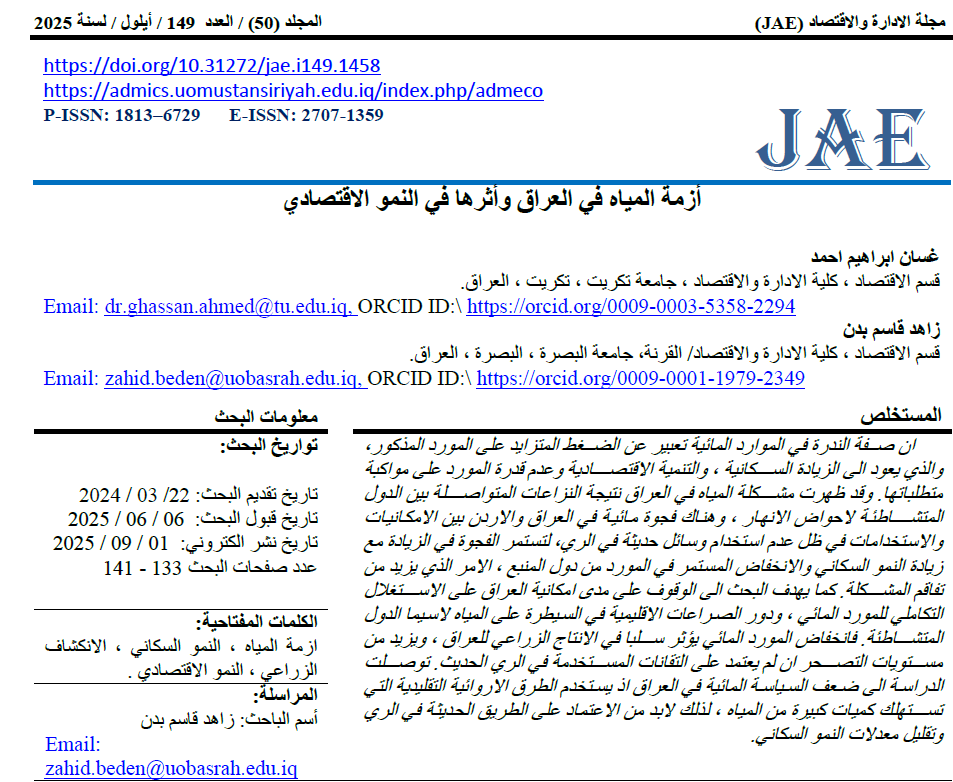
أزمة المياه في العراق وأثرها في النمو الاقتصادي
DOI:
https://doi.org/10.31272/jae.i149.1458الكلمات المفتاحية:
ازمة المياه ، النمو السكاني، الانكشاف الزراعي ، النمو الاقتصاديالملخص
ان صفة الندرة في الموارد المائية تعبير عن الضغط المتزايد على المورد المذكور، والذي يعود الى الزيادة السكانية ، والتنمية الاقتصادية وعدم قدرة المورد على مواكبة متطلباتها. وقد ظهرت مشكلة المياه في العراق نتيجة النزاعات المتواصلة بين الدول المتشاطئة لاحواض الانهار ، وهناك فجوة مائية في العراق والاردن بين الامكانيات والاستخدامات في ظل عدم استخدام وسائل حديثة في الري، لتستمر الفجوة في الزيادة مع زيادة النمو السكاني والانخفاض المستمر في المورد من دول المنبع ، الامر الذي يزيد من تفاقم المشكلة. كما يهدف البحث الى الوقوف على مدى امكانية العراق على الاستغلال التكاملي للمورد المائي ، ودور الصراعات الاقليمية في السيطرة على المياه لاسيما الدول المتشاطئة. فانخفاض المورد المائي يؤثر سلبا في الانتاج الزراعي للعراق ، ويزيد من مستويات التصحر ان لم يعتمد على التقانات المستخدمة في الري الحديث. توصلت الدراسة الى ضعف السياسة المائية في العراق اذ يستخدم الطرق الاروائية التقليدية التي تستهلك كميات كبيرة من المياه ، لذلك لابد من الاعتماد على الطريق الحديثة في الري وتقليل معدلات النمو السكاني.
التنزيلات
المراجع
[1]- Al Ansari, N., Adamo, N., & Sissakian, V. (2018). Water Resources of the Euphrates River Catchment. Journal of Earth Sciences and Geotechnical Engineering, 8(3), 187–222. https://doi.org/10.1792/1792-9040.2018.08.3.187
[2]- Al-Ansari, N. (2013). Management of water resources in Iraq: Perspectives and prognoses. Engineering, 5(8), 667–684. https://doi.org/10.4236/eng.2013.58080 DOI: https://doi.org/10.4236/eng.2013.58080
[3]- Al Ansari, N., Adamo, N., Sissakian, V. K., Knutsson, S., & Laue, J. (2018). Water resources of the Tigris River catchment. Journal of Earth Sciences and Geotechnical Engineering, 8(3), 21–42.
[4]- Al Muqdadi, S. W., Omer, M. F., Abo, R., & Naghshineh, A. (2016). Dispute over Water Resource Management—Iraq and Turkey. Journal of Environmental Protection, 7(8), 1096–1103. https://doi.org/10.4236/jep.2016.78098 DOI: https://doi.org/10.4236/jep.2016.78098
[5]- Kaya, Y., & Michel, C. (2016). Hydrologic impacts of engineering projects on the Tigris Euphrates systems and its marshlands. Journal of Hydrology, 540, 452–464. https://doi.org/10.1016/j.jhydrol.2016.06.024 DOI: https://doi.org/10.1016/j.jhydrol.2016.06.024
[6]- Kibaroglu, A., & Scheumann, W. (2013). Transforming transboundary rivers: Turkey’s participation in international river politics. Water Policy, 15(S2), 8–25. https://doi.org/10.2166/wp.2013.125 DOI: https://doi.org/10.2166/wp.2013.125
[7]- Kibaroglu, A., & Scheumann, W. (2013). Turkey, Syria and Iraq: Conflict over the Euphrates–Tigris river system. In A. Kibaroglu, W. Scheumann, & A. Kramer (Eds.), Turkey's Water Policy: National Frameworks and International Cooperation (pp. 279–309). Springer. https://doi.org/10.1007/978-94-007-5911-9_16
[8]- Kibaroglu, A., & Scheumann, W. (2013). Turkey, Syria and Iraq: Conflict over the Euphrates–Tigris river system. In Turkey’s Water Policy: National Frameworks and International Cooperation (pp. 277–301). Springer. https://doi.org/10.1007/978-94-007-5842-6_16
[9]- Kliot, N. (1994). Water Resources and Conflict in the Middle East. Routledge,P301. https://doi.org/10.4324/9781315036464
[10]- Kramer, A., & Kibaroglu, A. (2011). Turkey’s position towards international water law. In Turkey’s Water Policy: National Frameworks and International Cooperation (pp. 215–228). Springer. https://doi.org/10.1007/978-3-642-19636-2_12 DOI: https://doi.org/10.1007/978-3-642-19636-2_12
[11]- Potter, L. G. (1994). The Evolution of the Iran–Iraq Boundary: Water, Territory, and Conflict. Middle East Journal, 48(4), 609–624. https://doi.org/10.2307/4329353
[12]- Saleh, D. K. (2010). Stream gage descriptions and streamflow statistics for sites in the Tigris River and Euphrates River Basins, Iraq (USGS Data Series 540). U.S. Geological Survey. https://doi.org/10.3133/ds540 DOI: https://doi.org/10.3133/ds540
[13]- Sharqi, N. J. (2022). The Impact of Joint Management of Water Resources of the Tigris and Euphrates Basins on the Security and Stability of Iraq. Journal of Law and Political Science, 46(3), 1–18. https://doi.org/10.61279/g46n3c18 DOI: https://doi.org/10.61279/g46n3c18
[14]- Voss, K. A., Famiglietti, J. S., Lo, M., de Linage, C., Rodell, M., & Swenson, S. C. (2013). Groundwater depletion in the Middle East from GRACE with implications for transboundary water management in the Tigris Euphrates Western Iran region. Water Resources Research, 49(2), 904–914. https://doi.org/10.1002/wrcr.20078 DOI: https://doi.org/10.1002/wrcr.20078
[15]- Özdoğan, M. (2011). Climate change impacts on snow water availability in the Euphrates–Tigris basin. Hydrology and Earth System Sciences, 15(9), 2789–2803. https://doi.org/10.5194/hess-15-2789-2011 DOI: https://doi.org/10.5194/hess-15-2789-2011
[16]- Özçimen, S., & Günalp, N. (2019). Temporal variability and trends of streamflow in the Tigris River Basin: implications for water resources management. Journal of Hydrology: Regional Studies, 22, 100591. https://doi.org/10.1016/j.ejrh.2019.100591
التنزيلات
منشور
إصدار
القسم
الرخصة
الحقوق الفكرية (c) 2025 Ghassan Ibrahim Ahmed, Zahid Qassim Beden

هذا العمل مرخص بموجب Creative Commons Attribution 4.0 International License.
مجلة الإدارة والاقتصاد هي مجلة مفتوحة المصدر حيث تكون جميع محتوياتها مجانية. تخضع مقالات هذه المجلة لشروط ترخيص المشاع الإبداعي المنسوب إلى المؤلف (CC-BY 4.0) (https://creativecommons.org/licenses/by/4.0/legalcode) الذي يسمح للمرخص لهم دون قيود بالبحث عن النص الكامل للمقالات أو تنزيله أو مشاركته أو توزيعه أو طباعته أو ربطه به، وفحصه للفهرسة وإعادة إنتاج أي وسيلة للمقالات بشرط أن ينسبوا إلى المؤلفين الفضل في ذلك (الاستشهاد). تسمح المجلة للمؤلفين بالاحتفاظ بحقوق الطبع والنشر لمقالهم المنشور.
. Creative Commons-Attribution (BY)