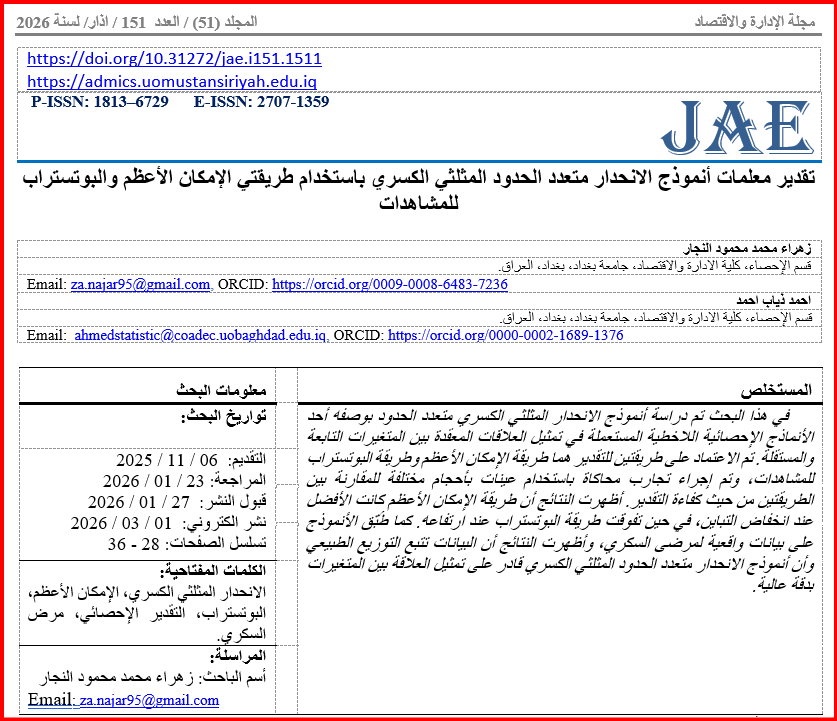
تقدير معلمات أنموذج الانحدار متعدد الحدود المثلثي الكسري باستخدام طريقتي الإمكان الأعظم والبوتستراب للمشاهدات
DOI:
https://doi.org/10.31272/jae.i151.1511الكلمات المفتاحية:
الانحدار المثلثي الكسري، الإمكان الأعظم، البوتستراب، التقدير الإحصائي، مرض السكريالملخص
في هذا البحث تم دراسة أنموذج الانحدار المثلثي الكسري متعدد الحدود بوصفه أحد النماذج الإحصائية اللاخطية المستخدمة في تمثيل العلاقات المعقدة بين المتغيرات التابعة والمستقلة. تم الاعتماد على طريقتين للتقدير هما طريقة الإمكان الأعظم وطريقة البوتستراب للمشاهدات، وتم إجراء تجارب محاكاة باستخدام عينات بأحجام مختلفة للمقارنة بين الطريقتين من حيث كفاءة التقدير. أظهرت النتائج أن طريقة الإمكان الأعظم كانت الأفضل عند انخفاض التباين، في حين تفوقت طريقة البوتستراب عند ارتفاعه. كما طُبّق الأنموذج على بيانات واقعية لمرضى السكري، وأظهرت النتائج أن البيانات تتبع التوزيع الطبيعي وأن الأنموذج المقترح قادر على تمثيل العلاقة بين المتغيرات بدقة عالية.
التنزيلات
المراجع
[1] Royston, P., & Altman, D. G. (1994). Regression using fractional polynomials of continuous covariates: Parsimonious parametric modelling. Journal of the Royal Statistical Society: Series C (Applied Statistics), 43(3), 429–467. DOI: https://doi.org/10.2307/2986270 DOI: https://doi.org/10.2307/2986270
[2] Ishola, T. A., Olatayo, O. T., & Adesanya, K. K. (2019). Parameter estimation of fractional trigonometric polynomial regression model. International Journal of Computers, 5, 19-25. Link: https://www.iaras.org/iaras/journals/ijc .
[3] Duong, H., & Volding, D. (2014). Modelling continuous risk variables: Introduction to fractional polynomial regression. Vietnam Journal of Science (VJS), 1(2). Link: https://vietnamresearch.com/vjs/
[4] Ullah, E., & Shah, T. (2014). Trigonometric polynomial rings and their factorization properties. Matematički Vesnik, 66(3), 301–314. DOI: https://doi.org/10.2298/MEV1403301U
[5] Ahmed, A. D., & Kazem, G. A. S. (2017). Estimation of parameters of the second-degree multivariate polynomial regression model with a practical application. Al-Qadisiyah Journal of Administrative and Economic Sciences, 19(3), 376–398. Link (IASJ): https://www.iasj.net/iasj/article/133719
[6] Baneshi, M. R., Nakhaee, F., & Law, M. (2013). On the use of fractional polynomial models to assess preventive aspect of variables: An example in prevention of mortality following HIV infection. International Journal of Preventive Medicine, 4(4), 414–419. DOI: https://doi.org/10.4103/2008-7802.111820
[7] Royston, P., Ambler, G., & Sauerbrei, W. (1999). The use of fractional polynomials to model continuous risk variables in epidemiology. International Journal of Epidemiology, 28(5), 964–974. DOI: https://doi.org/10.1093/ije/28.5.964 DOI: https://doi.org/10.1093/ije/28.5.964
[8] Morris, T. P., White, I. R., Carpenter, J. R., Stanworth, S. J., & Royston, P. (2015). Combining fractional polynomial model building with multiple imputation. Statistics in Medicine, 34(21), 3298–3317. DOI: https://doi.org/10.1002/sim.6549 DOI: https://doi.org/10.1002/sim.6553
[9] Eubank, R.L, & Speckman, P. (1987). Data Smoothing by polynomial-trigonometric regression. Technical Report No. SWI/DS/TR/212, Southern Methodist University.
[10] Ali, O. A., & Kazem, K. J. (2019). Using the maximum likelihood method with a proposed weight to estimate the effect of some pollutants in the Tigris River – Kut city. Journal of Administration and Economics, 42(120). Link (IASJ): https://www.iasj.net/iasj/article/171549
[11] Barrios, E. B. (2011). Bootstrap methods. The Philippine Statistician, 60(1), 129–132. Link: https://psa.gov.ph/sites/default/files/ThePhilippineStatistician_2011_60_1_11.pdf DOI: https://doi.org/10.59139/ws.2011.11.6
[12] Ahmed, S. A. (2018). Estimation of simple linear regression model parameters using the bootstrap method under heteroscedasticity. Scientific Journal of Faculty of Commerce, Alexandria University, 55(2), 184–511. Link: https://acj.journals.ekb.eg/
[13] Ahmed, A. D., & Rahman, M. A. R. (2019). Comparison of modified maximum likelihood methods for estimating autoregressive model parameters. Journal of Administration and Economics, University of Baghdad, 42(120), 305–318. Link (IASJ): https://www.iasj.net/iasj/article/171561
[14] Das, K. R., & Imon, A. H. M. R. (2016). A brief review of tests for normality. American Journal of Theoretical and Applied Statistics, 5(1), 5–12. DOI: https://doi.org/10.11648/j.ajtas.20160501.12 DOI: https://doi.org/10.11648/j.ajtas.20160501.12
التنزيلات
منشور
إصدار
القسم
الرخصة
الحقوق الفكرية (c) 2026 زهراء محمد محمود النجار، احمد ذياب احمد

هذا العمل مرخص بموجب Creative Commons Attribution 4.0 International License.
مجلة الإدارة والاقتصاد هي مجلة مفتوحة المصدر حيث تكون جميع محتوياتها مجانية. تخضع مقالات هذه المجلة لشروط ترخيص المشاع الإبداعي المنسوب إلى المؤلف (CC-BY 4.0) (https://creativecommons.org/licenses/by/4.0/legalcode) الذي يسمح للمرخص لهم دون قيود بالبحث عن النص الكامل للمقالات أو تنزيله أو مشاركته أو توزيعه أو طباعته أو ربطه به، وفحصه للفهرسة وإعادة إنتاج أي وسيلة للمقالات بشرط أن ينسبوا إلى المؤلفين الفضل في ذلك (الاستشهاد). تسمح المجلة للمؤلفين بالاحتفاظ بحقوق الطبع والنشر لمقالهم المنشور.
. Creative Commons-Attribution (BY)