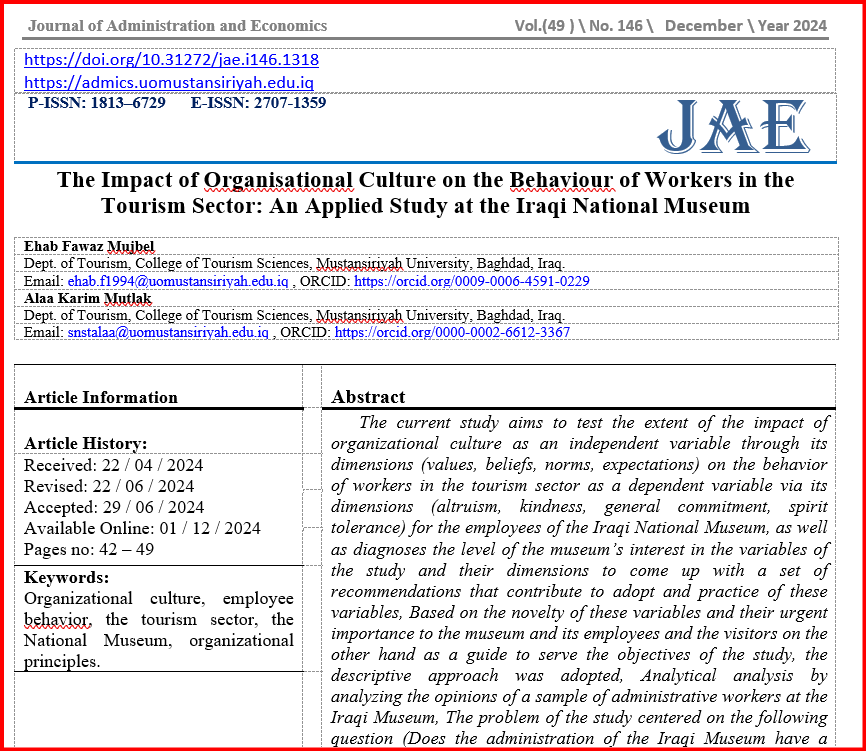
The Impact of Organisational Culture on the Behaviour of Workers in the Tourism Sector: An Applied Study at the Iraqi National Museum
DOI:
https://doi.org/10.31272/jae.i146.1318Keywords:
Organisational culture, Employee behaviour, Tourism sector, National Museum, ValuesAbstract
The current study aims to test the extent of the impact of organizational culture as an independent variable through its dimensions (values, beliefs, norms, expectations) on the behavior of workers in the tourism sector as a dependent variable via its dimensions (altruism, kindness, general commitment, spirit tolerance) for the employees of the Iraqi National Museum, as well as diagnoses the level of the museum’s interest in the variables of the study and their dimensions to come up with a set of recommendations that contribute to adopt and practice of these variables, Based on the novelty of these variables and their urgent importance to the museum and its employees and the visitors on the other hand as a guide to serve the objectives of the study, the descriptive approach was adopted, Analytical analysis by analyzing the opinions of a sample of administrative workers at the Iraqi Museum, The problem of the study centered on the following question (Does the administration of the Iraqi Museum have a clear perception of the concept and dimensions of the organizational culture?), While a set of advanced statistical methods and programs used to analyse the statistically represented (Amos V.29 SPSS V.29) used to analyse initial data as well as Use simple linear slope and multiple linear slopes, statistical analysis showed some conclusions are the most prominent of which is the excellent attention by the management of the Iraqi National Museum in motivating the worlds to do more activity and creativity and to address their existing weaknesses.
Downloads
References
[1] Abbas, N. K. (2023). The role of organizational culture in improving organizational performance [Higher Diploma research, University of Baghdad].
[2] Alhajj Ali, L. A. I. (2020). Organizational behavior of workers in public administration [Master's thesis, Zawiya University, Libya].
[3] Ando, N., & Matsuda, S. (2010). How employees see their roles: The effect of interactional justice and gender. Journal of Service Science and Management, 3(2), 281–286. DOI: https://doi.org/10.4236/jssm.2010.32035
[4] Awadeh, R. (2023). The role of organizational culture in implementing an electronic educational space from the perspective of basic school principals in Jerusalem Governorate. Scientific Journal of the Faculty of Education, Assiut University, 39(2), 284–307.
[5] Hallak, B. (2020). Organizational behavior [Monograph]. Publications of the Syrian Virtual University. Retrieved from (Published under Creative Commons License).
[6] Jallab, I. D. (2011). Managing organizational behavior in the age of change (1st ed.). Dar Safaa for Publishing and Distribution.
[7] Karnilev, S. S. (2002). Multiple regression (1st ed.). Statistical Science Library Publishing House.
[8] Musa'deh, M. A. M. (2013). Organization management: A holistic perspective (1st ed.). Dar Al Masirah for Publishing and Distribution.
[9] Mustafa, D. W., Badr El Din, R. M., & Baher Omar, M. M. (2022). Organizational anomie and its impact on the behavior of workers in the tourism company in Alexandria Governorate. Journal of the Faculty of Tourism and Hotels, (11, Part 6).
[10] Najiya, D. (2013). The role of organizational culture in controlling the behavior of the worker within the organization [Master's thesis, M'sila University, Algeria].
[11] Nasira, B., & Nawal, S. (2020). Organizational behavior and its relationship to the effectiveness of workers' performance in the public enterprise [Master's thesis, Yahia Fares University].
[12] Noura, A. (2016). The impact of applying total quality management in the Algerian enterprise on the behavior of workers [Master's thesis, Ahmed Draia University, Adrar].
[13] Qahwaji, A. (2018). The importance of studying human behavior within organizations. Algerian Journal of Human Resources, 3(2).
[14] Tighza, M. B. (2012). Exploratory and confirmatory factor analysis: Their concepts and methodology (1st ed.). Dar Al Masirah for Printing and Publishing.
[15] Trice, H. M., & Beyer, J. M. (1993). The cultures of work organizations. Prentice Hall.
Downloads
Published
Issue
Section
License
Copyright (c) 2024 Ehab Fawaz Mujbel, Alaa Karim Mutlak

This work is licensed under a Creative Commons Attribution 4.0 International License.
The journal of Administration and Economics is an open- access journal that all contents are free of charge. Articles of this journal are licensed under the terms of the Creative Commons Attribution International Public License CC-BY 4.0 (https://creativecommons.org/licenses/by/4.0/legalcode) that licensees are unrestrictly allowedto search, download, share, distribute, print, or link to the full text of the articles, crawl them for indexing and reproduce any medium of the articles provided that they give the author(s) proper credits (citation). The journal allows the author(s) to retain the copyright of their published article.
Creative Commons-Attribution (BY)