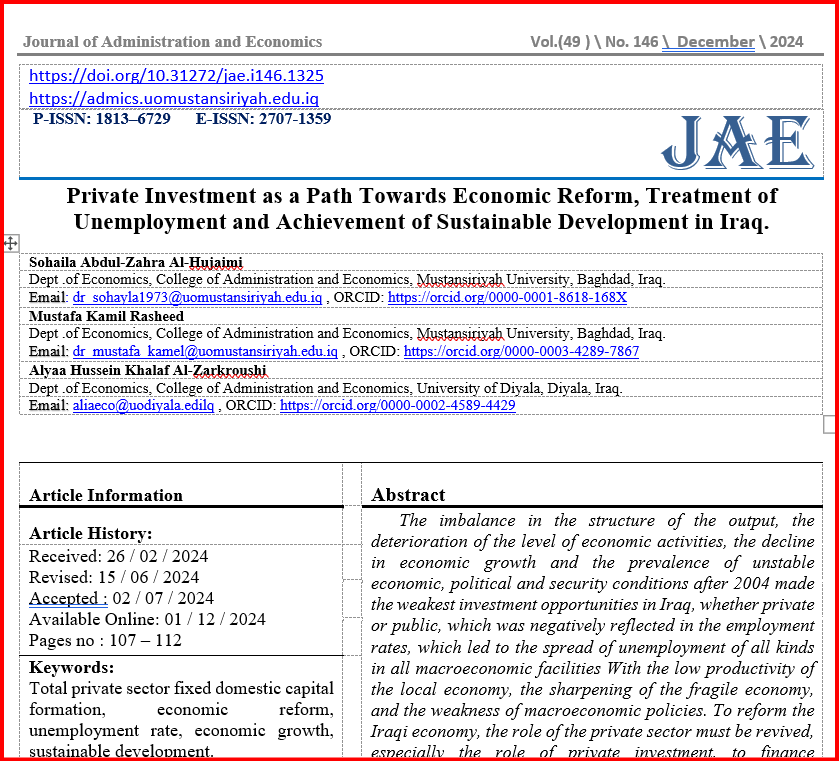
Private Investment as a Path Towards Economic Reform, Treatment of Unemployment and Achievement of Sustainable Development in Iraq.
DOI:
https://doi.org/10.31272/jae.i146.1325Keywords:
Total private sector fixed domestic capital formation, economic reform, unemployment rate, economic growth, sustainable developmentAbstract
The imbalance in the structure of the output, the deterioration of the level of economic activities, the decline in economic growth and the prevalence of unstable economic, political and security conditions after 2004 made the weakest investment opportunities in Iraq, whether private or public, which was negatively reflected in the employment rates, which led to the spread of unemployment of all kinds in all macroeconomic facilities With the low productivity of the local economy, the sharpening of the fragile economy, and the weakness of macroeconomic policies. To reform the Iraqi economy, the role of the private sector must be revived, especially the role of private investment, to finance sustainable development plans and overcome economic obstacles that prevent access to economic stability. The research problem is represented by the weakness of private investment, with the weak role of the private sector in supporting the local economy, which caused the weakness of economic activities and high unemployment rates. To carry out economic reform, private investment must be paid attention to in rebuilding the Iraqi economy. The hypothesis of the research on economic reform begins with supporting private investment and highlighting its role in leading the economy to confront macroeconomic problems, reduce unemployment rates and achieve sustainable development. The research recommends adopting a long-term scientific approach that supports the orientation of the private sector as an essential step in economic reform to strengthen the macroeconomic structure and implement sustainable development plans.
Downloads
References
[1] Alaa, Adel Ali Abdel Aal, 2013, "The Role of Indirect Foreign Investment in Stimulating the Egyptian Stock Exchange," Scientific Economic Research, Issues 63, 64, Egypt.
[2] General Secretariat of the Chambers of Commerce, Industry and Agriculture for Arab Countries, 1997, "Economic Adjustment and Macro-Reform Policies," Economic Papers Journal, Beirut.
[3] Gharib Bouldebah, 2012, "Factors Stimulating the Attraction of Foreign Direct Investment and Methods for their Evaluation - The Case of Algeria," Al-Baheth Journal (The Researcher), Issue 10, University of Ouargla.
[4] Gouda, Abdel Khaleq, 1986, International Economics – From Comparative Advantages to Unequal Exchange, 2nd ed., Dar Al Nahda Al Arabiya, Egypt.
[5] Jameel, Ahmed Hamid, 2000, Structural Imbalances and Economic Reform Policies in Yemen for the Period 1980-1998, Ph.D. Thesis, Al-Mustansiriya University, Iraq.
[6] Keynes, John Maynard, 1951, The General Theory of Employment, Interest and Money, Macmillan and Co., Ltd., London.
[7] Saleh, Mahdi Kuhait, 2011, the Condition of Legislative Stability in the Security Investment Contract, Unpublished Master's Thesis, College of Law, Karbala University.
[8] Tahir, Haidar Hardan, 1997, Principles of Investment, Al-Mustaqbal for Publishing and Distribution, Jordan.
[9] United Nations, 1997, Exploratory Study on Social Impact Approaches to Structural Adjustment Policies, United States of America.
Downloads
Published
Issue
Section
License
Copyright (c) 2024 Sohaila Abdul-Zahra Al-Hujaimi, Mustafa Kamil Rasheed, Alyaa Hussein Khalaf Al-Zarkroushi

This work is licensed under a Creative Commons Attribution 4.0 International License.
The journal of Administration and Economics is an open- access journal that all contents are free of charge. Articles of this journal are licensed under the terms of the Creative Commons Attribution International Public License CC-BY 4.0 (https://creativecommons.org/licenses/by/4.0/legalcode) that licensees are unrestrictly allowedto search, download, share, distribute, print, or link to the full text of the articles, crawl them for indexing and reproduce any medium of the articles provided that they give the author(s) proper credits (citation). The journal allows the author(s) to retain the copyright of their published article.
Creative Commons-Attribution (BY)