Using Newton's divided polynomial to solve multi-choice programming problem
DOI:
https://doi.org/10.31272/jae.i148.1334Keywords:
Newton's Divided Polynomial , Mixed-Integer Programming , Multiple-choice Programming , Nonlinear ProgrammingAbstract
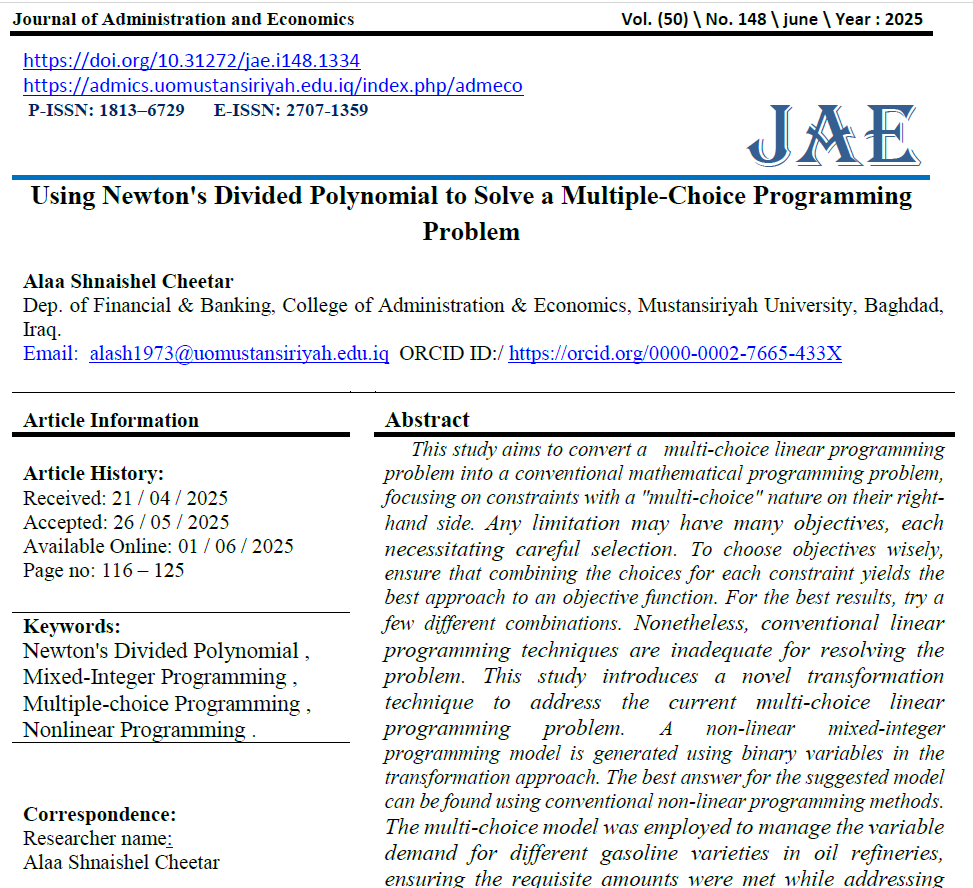
This study aims to convert a multi-choice linear programming problem into a conventional mathematical programming problem, focusing on constraints with a "multi-choice" nature on their right-hand side.Any limitation may have many objectives, each necessitating careful selection. To choose objectives wisely, ensure that combining the choices for each constraint yields the best approach to an objective function. For the best results, try a few different combinations. Nonetheless, conventional linear programming techniques are inadequate for resolving the problem. This study introduces a novel transformation technique to address the current multi-choice linear programming problem. A non-linear mixed-integer programming model is generated using binary variables in the transformation approach. The best answer for the suggested model can be found using conventional non-linear programming methods.The multi-choice model was employed to manage the variable demand for different gasoline varieties in oil refineries, ensuring the requisite amounts were met while addressing uncertainty; the model demonstrated its efficacy in identifying the ideal option.
Downloads
References
[1] Al-Aybi, W. M., & Rahi, A. R. K. (2018). Solve the Transportation Problem with Discount Constraints on The Transported Quantity. Journal of Administration and Economics, Al-Mustansyriah University, 43(116).
[2] Ali, S. S. H. (2024). Sensitivity Analysis for Fuzzy Linear Programming Problem by Mehar Method. Journal of Administration and Economics, Al-Mustansyriah University, 49(143). DOI: https://doi.org/10.31272/jae.i143.1190
[3] Biswal, M. P., & Acharya, S. (2009). Transformation of a multi-choice linear programming problem. Applied Mathematics and Computation, 210(1), 182–188. DOI: https://doi.org/10.1016/j.amc.2008.12.080
[4] Biswal, M. P., & Acharya, S. (2011). Solving multi-choice linear programming problems by interpolating polynomials. Mathematical and Computer Modeling, 54(5–6), 1405–1412. DOI: https://doi.org/10.1016/j.mcm.2011.04.009
[5] Chang, C.-T. (2007). Multi-choice goal programming. Omega, 35(4), 389–396. https://doi.org/10.1016/j.omega.2005.07.009 DOI: https://doi.org/10.1016/j.omega.2005.07.009
[6] Chang, C.-T. (2008). Revised multi-choice goal programming. Applied Mathematical Modeling, 32(12), 2587–2595. DOI: https://doi.org/10.1016/j.apm.2007.09.008
[7] Cheetar, A. (2018). The technique of converting multi-choice mathematical programming into linear mathematical programming to find the optimal solution. Journal of Economics And Administrative Sciences, Baghdad University, 24(102).
[8] Healey. (1964). Operations Research (Vol. 12).
[9] Lee, A. H. I., Kang, H.-Y., & Chang, C.-T. (2009). Fuzzy multiple goal programming applied to TFT-LCD supplier selection by downstream manufacturers. Expert Systems with Applications, 36(3), 6318–6325. DOI: https://doi.org/10.1016/j.eswa.2008.08.044
[10] Liao, C.-N. (2009). Formulating the multi-segment goal programming. Computers & Industrial Engineering, 56(1), 138–141. DOI: https://doi.org/10.1016/j.cie.2008.04.007
[11] Liao, C.-N., & Kao, H.-P. (2010). Supplier selection model using Taguchi loss function, analytical hierarchy process and multi-choice goal programming. Computers & Industrial Engineering, 58(4), 571–577. DOI: https://doi.org/10.1016/j.cie.2009.12.004
[12] Özkan, I., & Türkcsen, I. B. (2014). Uncertainty and fuzzy decisions. Chaos Theory in Politics, 17–27. DOI: https://doi.org/10.1007/978-94-017-8691-1_2
[13] Paksoy, T., & Özceylan, E. (2012). Supply chain optimisation with U-type assembly line balancing. International Journal of Production Research, 50(18), 5085–5105. DOI: https://doi.org/10.1080/00207543.2011.639399
[14] Salman, M. S. (2024). Improving Linear Programming via Artificial Intelligence Techniques: An Experimental Study. Journal of Administration and Economics, Al-Mustansyriah University, 49(143).
[15] Yu-Hsien Lin, E. (1994). Multiple Choice Programming: A State-of-the-Art Review. International Transactions in Operational Research, 1(4), 409–421. DOI: https://doi.org/10.1111/j.1475-3995.1994.00319.x
[16] T. Ganesh and P. Agrawal, (2019)“Solving multi-choice fractional stochastic transportation problem involving newton’s divided difference interpolation,” in Numerical Optimization in Engineering and Sciences: Select Proceedings of NOIEAS 2019, 2020, pp. 289–298. DOI: https://doi.org/10.1007/978-981-15-3215-3_28
[17] T. Ganesh and P. Agrawal, (2021) “Solution of stochastic transportation problem involving multi-choice random parameter using Newton’s divided difference interpolation,” J. Inf. Optim. Sci., vol. 42, no. 1, pp. 77–91.. DOI: https://doi.org/10.1080/02522667.2019.1694741
[18] T. Schrage, (2008) “LINGO Release 11.0,” LINDO Syst. (Inc. 2008). DOI: https://doi.org/10.1145/1455664.1459238
Downloads
Published
Issue
Section
License
Copyright (c) 2025 Alaa Shnaishel Cheetar sh

This work is licensed under a Creative Commons Attribution 4.0 International License.
The journal of Administration and Economics is an open- access journal that all contents are free of charge. Articles of this journal are licensed under the terms of the Creative Commons Attribution International Public License CC-BY 4.0 (https://creativecommons.org/licenses/by/4.0/legalcode) that licensees are unrestrictly allowedto search, download, share, distribute, print, or link to the full text of the articles, crawl them for indexing and reproduce any medium of the articles provided that they give the author(s) proper credits (citation). The journal allows the author(s) to retain the copyright of their published article.
Creative Commons-Attribution (BY)