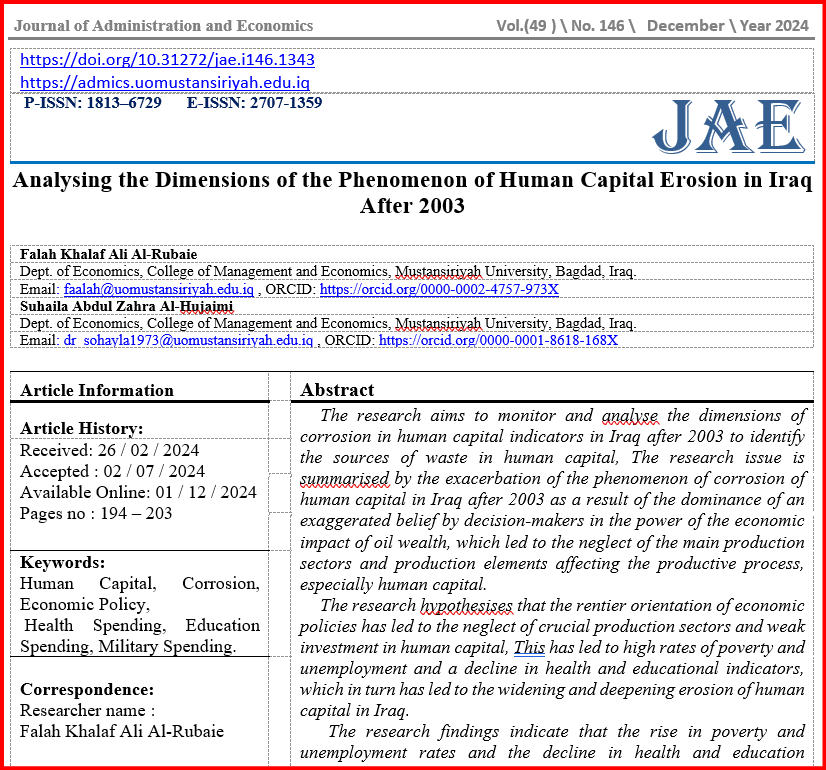
Analysing the Dimensions of the Phenomenon of Human Capital Erosion in Iraq After 2003
DOI:
https://doi.org/10.31272/jae.i146.1343Keywords:
Human Capital, Corrosion, Economic Policy, Health Spending, Education Spending, Military SpendingAbstract
The research aims to monitor and analyse the dimensions of corrosion in human capital indicators in Iraq after 2003 to identify the sources of waste in human capital. The research issue is summarised by the exacerbation of the phenomenon of corrosion of human capital in Iraq after 2003 as a result of the dominance of an exaggerated belief by decision-makers in the power of the economic impact of oil wealth, which led to the neglect of the main production sectors and production elements affecting the productive process, especially human capital.
The research hypothesises that the rentier orientation of economic policies has led to the neglect of crucial production sectors and weak investment in human capital. This has led to high rates of poverty and unemployment and a decline in health and educational indicators, which in turn has led to the widening and deepening erosion of human capital in Iraq.
The research findings indicate that the rise in poverty and unemployment rates and the decline in health and education indicators after 2003 was accompanied by a continued increase in the amount of military spending
Downloads
References
[1] Ali Hussein Mohammed, Nidal Shaker Jawda, "The Impact of Military Spending on the Development Path in Iraq for the Period (1990-2016)."
[2] Ashraf Al-Arabi (2007), "Human Capital in Egypt, The Concept and Measurement," Journal of Arab Economic Research, Issue 39.
[3] Becker, G. S. Human Capital. Chicago: University of Chicago Press, 1993. ISBN (Paper): 978-0-226-04120-9 DOI: 10.7208/chicago/9780226041223.001.0001 DOI: https://doi.org/10.7208/chicago/9780226041223.001.0001
[4] H.G. Johnson, (2004) "Towards a generalized capital accumulation approach to economic development, economics of education."
[5] International Bank for Reconstruction and Development (2021) The Human Capital Index 2020 Update: Human Capital in the Time of COVID-19.
[6] International Labour Organization (ILO) - "Generation 2050 Working Paper: Transforming Iraq’s Demographic Dividend into an Economic Window of Opportunity," Baghdad, 2022.
[7] Iraqi Ministry of Health, Planning and Resource Development Directorate, Statistical Reports for the Years (2003-2021).
[8] Mardin Mahsoum Faraj, Saman Ali Arif, "The Impact of Military Expenditures on Some Macroeconomic Variables in Iraq..." Journal of Business Economics for Applied Research, 2023.
[9] Ministry of Planning, Central Statistical Organization (CSO), "Secondary Education in Iraq for the Academic Year 2010-2021."
[10] Ministry of Planning, "Analysis of Poverty Trends in Iraq - 2021."
[11] Ministry of Planning, Central Statistical Organization (CSO), Environment Statistics Division, "Priority Indicators of Environment and Sustainable Development in Iraq," October 2018.
[12] Ministry of Planning, Central Statistical Organization (CSO), Statistical Abstract, 2020.
[13] Ministry of Planning, Central Statistical and Information Technology Organization, Statistical Abstract for the Years (2003-2021), Baghdad.
[14] Mohammed Thabit Al-Kar'awi, "Investment in Human Capital and the Requirements for Transformation Towards the Digitalization of the Knowledge Economy," Al-Ghari Journal for Economic and Administrative Sciences, 2022.
[15] Nagham Hameed Abdel Khader, Khalid Rokan Awad, Rabab Nadhim Khazzam, "Analysis of the Relationship between Investment in Human Capital and Economic Growth in Iraq..." Journal of Business Economics for Applied Research, 2023.
[16] Suhaira Abdul Zahra Al-Juhaishi, Amira Khalaf Lefta Shahin, Amer Sami, "The Phenomenon of the Demographic Dividend and the Waste of Human Capital in Iraq..." Al-Kunooz Al-Ilmiyya Journal, 2023.
[17] Theodore W. Schultz: "Human Capital: Policy Issues and Research Opportunities," NBER.
[18] The Iraqi Journal of Economic Sciences, 2020, Vol. 18, Issue 65.
[19] Tugce YerlitasIlona, BuciunieneIlona Buciuniene, "Antecedents of Human Capital Erosion," Academy of Management Proceedings, 2022. DOI: 10.5465/AMBPP.2022.12835abstract DOI: https://doi.org/10.5465/AMBPP.2022.12835abstract
[20] UNESCO, "Education for People and Planet," Global Education Monitoring Report, 2021: 978-92-3-100433-9.
[21] United Nations Development Programme (UNDP), "Statistical Report on Sustainable Development Goals – Human Development Statistics Division 2021." : 9789210056083
[22] United Nations Development Programme (UNDP), Human Development Report, 2010 : 978-0-230-28445-6.
[23] United Nations Development Programme (UNDP), Human Development Report, 2005: International Cooperation. 0-19-530511-6 / 978-0195305111
[24] Will Kenton (2023), "Human Capital Definition," Investopedia.
[25] World Health Organization (WHO), "COVID-19 Dynamic Dashboard," 2021.
[26] World Bank Group: (2021a) Addressing the Human Capital Crisis: A Public Expenditure Review for Human Development Sectors in Iraq.
Downloads
Published
Issue
Section
License
Copyright (c) 2024 Falah Khalaf Ali Al-Rubaie, Suhaila Abdul Zahra Al-Huja

This work is licensed under a Creative Commons Attribution 4.0 International License.
The journal of Administration and Economics is an open- access journal that all contents are free of charge. Articles of this journal are licensed under the terms of the Creative Commons Attribution International Public License CC-BY 4.0 (https://creativecommons.org/licenses/by/4.0/legalcode) that licensees are unrestrictly allowedto search, download, share, distribute, print, or link to the full text of the articles, crawl them for indexing and reproduce any medium of the articles provided that they give the author(s) proper credits (citation). The journal allows the author(s) to retain the copyright of their published article.
Creative Commons-Attribution (BY)