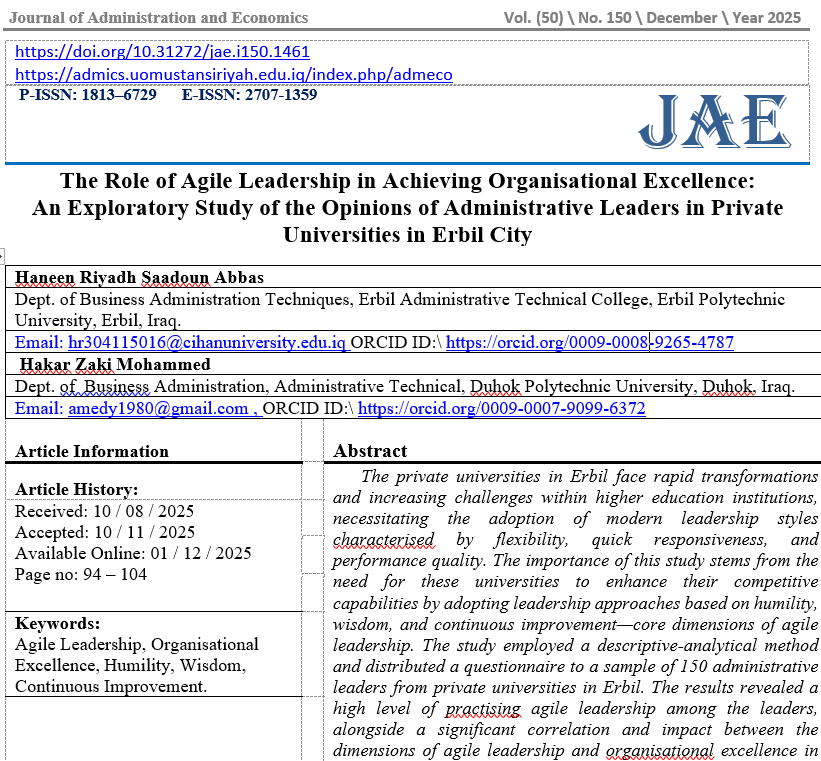
The Role of Agile Leadership in Achieving Organizational Excellence(An Exploratory Study of the Opinions of Administrative Leaders in Private Universities in Erbil City)
DOI:
https://doi.org/10.31272/jae.i150.1461Keywords:
Agile Leadership, Organisational Excellence, Humility, Wisdom, Continuous ImprovementAbstract
This study aims to analyze the role of agile leadership in achieving organizational excellence in private universities in Erbil City, in light of the rapid transformations and increasing challenges facing higher education institutions. These circumstances necessitate the adoption of modern leadership styles that ensure flexibility, prompt responsiveness, and high-quality performance. The significance of this study stems from the need for private universities to enhance their competitive capabilities through leadership approaches characterized by humility, wisdom, and continuous improvement — dimensions that represent the core of agile leadership. The research problem is centered on the main question: To what extent does agile leadership, with its three dimensions, contribute to achieving organizational excellence within private universities? The study sought to achieve several objectives, most notably diagnosing the reality of agile leadership and organizational excellence in private universities, and measuring their relationship and impact. A descriptive-analytical approach was adopted, and a questionnaire was distributed to a sample of (150) administrative leaders in private universities in Erbil City. The results revealed a high level of agile leadership practices, as well as a statistically significant correlation and impact between agile leadership dimensions and organizational excellence. The findings confirm that private universities in Erbil possess a solid foundation of leadership and organizational practices; however, there are clear opportunities to enhance leadership wisdom, involve employees and students in decision-making, and develop knowledge management in order to raise organizational excellence to higher levels. The study concluded that adopting agile leadership styles effectively contributes to promoting organizational excellence in private universities through improving performance, enhancing adaptability, and building a positive organizational culture. It recommended the necessity of embedding agile leadership principles in the environment of private universities, developing training programs aimed at building leadership capacities, and fostering a flexible administrative environment that embraces change and supports sustainable development.
Downloads
References
[1] Abu Bakr Siddiq Abdullah, & Asma. (2020). The degree of practice of agile management dimensions by university leaders and its relationship to the effectiveness of job performance from the perspective of faculty members at New Valley University. The Educational Journal of Sohag Faculty of Education, 80(80), 635-748.
DOI:10.21608/edusohag.2020.120166 DOI: https://doi.org/10.21608/edusohag.2020.120166
[2] Al-Dhabet, O. (2025). Continuous improvement is a necessity, not a luxury. Administrative Development Journal, 219.
[3] Al-Ghazali, A. H. (2005). Ihya' 'Ulum al-Din (The Revival of the Religious Sciences). Beirut: Dar Al-Ma'rifah.
https://doi.org/10.1287/orsc.1120.0795 DOI: https://doi.org/10.1287/orsc.1120.0795
[4] Al-Kaabi, K. M. Y. (2021). Agile leadership and its effect on service quality through employee participation as a mediating variable: An analytical study of the opinions of a sample of employees in private universities and colleges in the holy Karbala province. (Unpublished master's thesis). College of Administration and Economics, University of Karbala, Iraq.
[5] Al-Khazraji, M. B. M. B. A. I. M. A. (1994). Lisan al-Arab (The Tongue of the Arabs). Beirut: Dar Sader.
[6] Al-Muhaimid, B. B. I. (2022). Developing the administrative performance of academic leaders at the Saudi Electronic University in light of the organizational agility approach. Journal of Humanities and Administrative Sciences, 26(1), 150-181. DOI: https://doi.org/10.56760/DCCN1913
[7] Bahash, H. (2020). Agile leadership and its relationship to building the organizational reputation of the institution: A field study at the Electricity and Gas Distribution Company (Sonelgaz) in M'Sila, Algeria. (Master's thesis). Faculty of Humanities and Social Sciences, Mohamed Boudiaf University.
[8] Denning, S. (2018). The Age of Agile: How Smart Companies Are Transforming the Way Work Gets Done. New York: AMACOM. ISBN: 0814439101, 9780814439104
[9] Joiner, W. B., & Josephs, S. A. (2006). Leadership agility: Five levels of mastery for anticipating and initiating change. John Wiley & Sons. ISBN: 9780787979133
[10] Owens, B. P., Johnson, M. D., & Mitchell, T. R. (2013). Expressed humility in organizations: Implications for performance, teams, and leadership. Organization Science, 24(5), 1517-1538. DOI: https://doi.org/10.1287/orsc.1120.0795
[11] Rauch, E., Damian, A., Holzner, P., & Matt, D. T. (2016). Lean hospitality—Application of lean management methods in the hotel sector. Procedia CIRP, 41, 614–619. DOI: 10.1016/j.procir.2016.01.086 DOI: https://doi.org/10.1016/j.procir.2016.01.019
[12] Salmi, L., Yacoub, M., & Brouki, A. (2022). The impact of adopting agile leadership behaviors on the performance of a university professor. (Doctoral dissertation, Ahmed Draia University-Adrar).
[13] Shabath, J. I. A. (2020). The role of agile leadership in motivating employees in health institutions: A case study of the Union of Health Work Committees in the Gaza Strip. Journal of Al-Quds Open University for Administrative & Economic Research, 5(13), 166–167. DOI: 10.33977/1760-005-013-012 DOI: https://doi.org/10.33977/1760-005-013-012
[14] Zainab, B., Fatima, & Ben Ahmed. (2022). The impact of agile leadership on crisis management: A case study of Ghardaia University. (Doctoral dissertation, Ghardaia University).
Downloads
Published
Issue
Section
License
Copyright (c) 2025 Haneen Readh Sadoon, Hakar Zaki Mohammed

This work is licensed under a Creative Commons Attribution 4.0 International License.
The journal of Administration and Economics is an open- access journal that all contents are free of charge. Articles of this journal are licensed under the terms of the Creative Commons Attribution International Public License CC-BY 4.0 (https://creativecommons.org/licenses/by/4.0/legalcode) that licensees are unrestrictly allowedto search, download, share, distribute, print, or link to the full text of the articles, crawl them for indexing and reproduce any medium of the articles provided that they give the author(s) proper credits (citation). The journal allows the author(s) to retain the copyright of their published article.
Creative Commons-Attribution (BY)