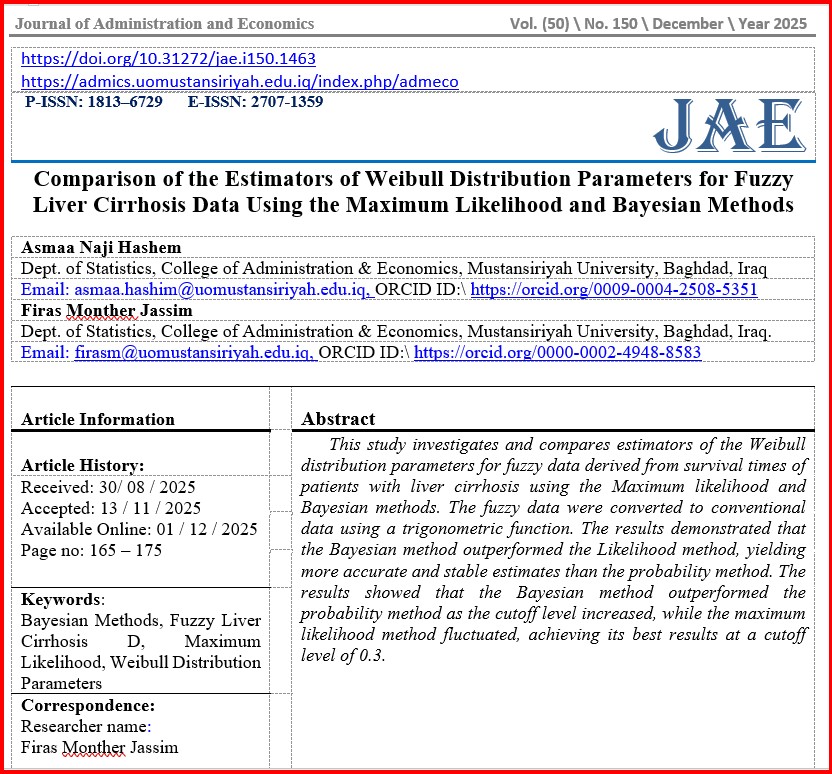
Comparison of the estimators of Weibull distribution parameters for fuzzy Liver Cirrhosis data using the Maximum likelihood and Bayesian methods
DOI:
https://doi.org/10.31272/jae.i150.1463Keywords:
Bayesian Methods, Fuzzy Liver Cirrhosis D, Maximum Likelihood, Weibull Distribution ParametersAbstract
This study investigates and compares the estimators of the Weibull distribution parameters for fuzzy data derived from the survival time of liver cirrhosis patients using the Maximum likelihood and Bayesian methods. The fuzzy data were transformed into conventional data using the trigonometric function. The results demonstrated that the Bayesian method outperformed the Likelihood method in achieving accurate and stable estimates compared to the probability method. The results showed that the Bayesian method outperformed the probability method with increasing cutoff level, while the performance of the maximum likelihood method fluctuated, achieving its best results at a cutoff level of 0.3.
Downloads
References
[1] Al-Majidi, A. J. S., El-Mongi, H. M. R., & Abdel-Atti, F. A. M. (2023). Estimation of the fuzzy reliability of a mixed distribution (Weibull–Rayleigh). International Journal of Intelligent Systems and Applications in Engineering, 11(3), 209-216. https://doi.org/10.46300/91011.2023.17.29
[2] Al-Naqash, A., A., Abdulsahib, S. J. (2019). A Bayes estimator for the Weibull survival function for fuzzy survival time data of kidney failure patients. Journal of Management and Economics - Mustansiriyah University, 1(121), 295–306.
[3] Pak, A., Zolfaghari, S., & Pecht, M. (2013). Parameter estimation for Weibull distribution with fuzzy data using EM algorithm. Reliability Engineering & System Safety, 112, 84–90. https://doi.org/10.1016/j.ress.2012.10.010 DOI: https://doi.org/10.1016/j.ress.2012.10.010
[4] Cox, D. R., & Oakes, D. (1984). Analysis of survival data. CRC Press.
[5] Ross, T. J. (2010). Fuzzy logic with engineering applications (3rd ed.). John Wiley & Sons. DOI: https://doi.org/10.1002/9781119994374
[6] Aje, Z. Y. A. Q. (2015). Estimating the reliability of fuzzy failure times with free distribution and its use in estimating the fuzzy reliability of the Mosul Dam. Journal of Economic and Administrative Sciences, 21(81), 348–362.
[7] Al-Badran, F. M. (2019). Bayes estimation under balanced loss functions. Journal of Administrative and Economic Sciences, 44(119), 108–120. https://doi.org/10.33924/jae.v44i119.539 DOI: https://doi.org/10.31272/JAE.42.2019.119.8
[8] Vishwakarma, G. K., Paul, C., & Singh, N. (2018). Parameters estimation of Weibull distribution based on fuzzy data using neural network. Biostatistics and Biometrics Open Access Journal, 6(5), 1-7. https://doi.org/10.15406/bboaj.2018.06.00223 DOI: https://doi.org/10.19080/BBOAJ.2018.06.555696
[9] Ali, B. K., & Abdullah, A. Y. (2018). A Bayesian approach for estimating the fuzzy reliability of the Fréchet distribution. Karbala University Journal for Administrative and Economic Sciences, 6(26), 55–68.
[10] Gelman, A., Carlin, J. B., Stern, H. S., Dunson, D. B., Vehtari, A., & Rubin, D. B. (2013). Bayesian data analysis (3rd ed.). Chapman and Hall/CRC. DOI: https://doi.org/10.1201/b16018
[11] Jaber, A. K. A., & Ibrahim, W. S. (2021). A study on bladder cancer patients using the survival function for the new extended transformed Weibull distribution. The Iraqi Journal of Administrative Sciences, 139. https://doi.org/10.31272/jae.i139.1090 DOI: https://doi.org/10.31272/jae.i139.1090
[12] Hamza, Z. F., Fadhil, L., & Jassim, F. M. (2023). An extended study to determine the best loss functions for estimating the exponential distribution parameter under Jeffery and Gamma priors. Journal of Mechanics of Continua and Mathematical Sciences, 18(3), 1-13. https://doi.org/10.26782/jmcms.2023.03.00004 DOI: https://doi.org/10.26782/jmcms.2023.03.00001
Downloads
Published
Issue
Section
License
Copyright (c) 2025 Asmaa Naji Hashem, Jassim, Firas Monther

This work is licensed under a Creative Commons Attribution 4.0 International License.
The journal of Administration and Economics is an open- access journal that all contents are free of charge. Articles of this journal are licensed under the terms of the Creative Commons Attribution International Public License CC-BY 4.0 (https://creativecommons.org/licenses/by/4.0/legalcode) that licensees are unrestrictly allowedto search, download, share, distribute, print, or link to the full text of the articles, crawl them for indexing and reproduce any medium of the articles provided that they give the author(s) proper credits (citation). The journal allows the author(s) to retain the copyright of their published article.
Creative Commons-Attribution (BY)