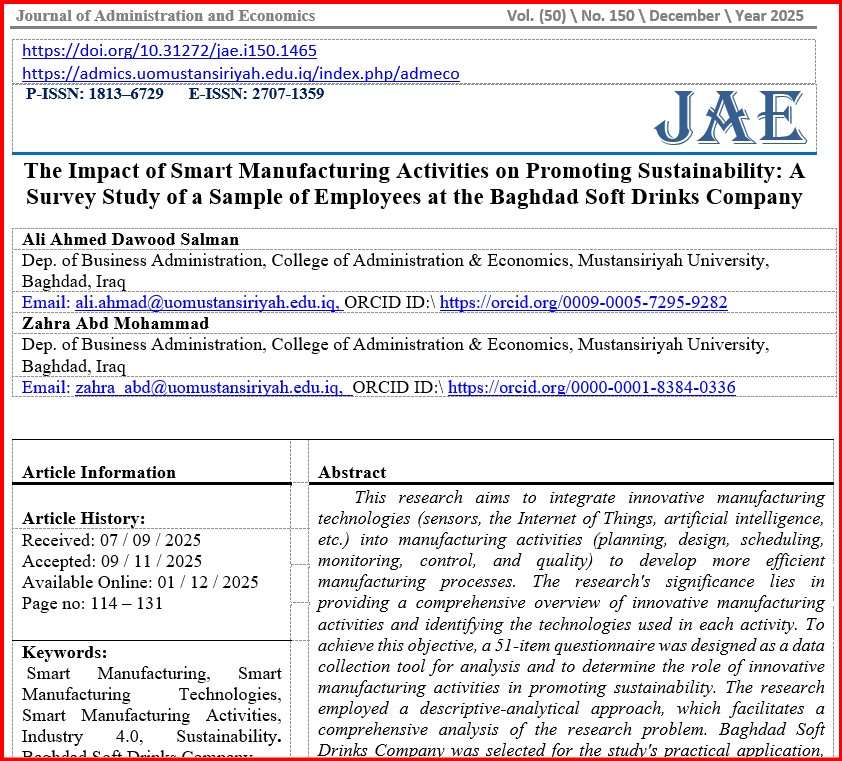
The Impact of Smart Manufacturing Activities on Promoting Sustainability: ASurvey Study of a Sample of Employees at the Baghdad Soft Drinks Company
DOI:
https://doi.org/10.31272/jae.i150.1465Keywords:
Smart Manufacturing, Smart Manufacturing Technologies, Smart Manufacturing Activities, Industry 4.0, Baghdad Soft Drinks CompanyAbstract
Smart manufacturing has received significant attention from major global industrial companies due to its significant role in improving manufacturing activities by achieving optimal use of raw materials and energy, reducing industrial waste, improving process efficiency, reducing gas emissions across all manufacturing processes, and delivering high-quality products. The research problem lies in the still-weak integration of advanced technology into some of the activities of Baghdad Beverages Company. The research aims to employ smart manufacturing technologies (sensors, the Internet of Things, artificial intelligence, big data analysis, cloud computing, etc.) in manufacturing activities (planning, design, scheduling, monitoring, control, and quality) to transform them into smart manufacturing activities. The importance of the research lies in providing a comprehensive view of smart manufacturing
activities, which are the cornerstone of smart manufacturing, and in identifying the technologies used in each smart manufacturing activity. To achieve the research objective, a questionnaire was designed that included (51) items as a tool used to determine the extent to which smart manufacturing activities impact sustainability (environmental, economic, and social). The research relied on the descriptive analytical approach as an approach that assists in the
comprehensive analysis of the researched problem. Baghdad Soft Drinks Company was selected to conduct the applied aspect of the research, and the sample size was (171) employees from senior
management, factory managers, engineers, technicians, and machine operators. The research reached a set of conclusions, the most important of which is that the company's management is weak in the concept of smart manufacturing, its activities, and the technologies applied in its activities, despite the application of some technologies in smart manufacturing activities. Therefore, the
research recommends the necessity of the company's management adopting modern concepts for manufacturing activities supported by Industrial Revolution 4.0 technologies, in addition to adopting the dimensions of sustainability and disseminating these concepts among employees at all levels to achieve maximum benefit from them in the company
Downloads
References
[1] Al-Rumi, Noura Abdul Karim Mahdi, (2018), Evaluating the Application of Environmental Sustainability Requirements Using the Analytical Hierarchy Process, Master’s Thesis, Administrative Technical College/Baghdad, Middle Technical University, Republic of Iraq.
[2] Al-Saeedi, Karar Fadhel Khalaf, (2024), Green operations practices and their role in achieving environmental sustainability through smart quality management: An analytical study of the opinions of a sample of employees in Ur General Company - Dhi Qar, PhD thesis, Technical College / Baghdad, Middle Technical University, Republic of Iraq.
[3] Al-Shammari, Tabarak Fadhel Muhammad, (2023), Evaluating the Reality of Compliance Management According to the Standard (ISO 37301: 2021) and Its Role in Achieving the Dimensions of Sustainability: A Case Study in the General Administration of Rafidain Bank, Master’s Thesis, Administrative Technical College / Baghdad, Middle Technical University, Republic of Iraq.
[4] Nieuwenhuize, G. (2016). Smart manufacturing for Dutch SMEs: Why and how. Rotterdam school of Management–Erasmus University.
Format for journals available online:
[5] Abd al Salam, Alaa Abd al Wahab, Muhammad, Susan Mahmoud, Saleh, Moatasem Hood Muhammad, (2022), The possibility of digitizing the foundations of smart manufacturing: A case study in the General Company for the Manufacture of Cars and Equipment, Journal of Business Economics, Volume 3, Issue 5, pp. 389-405.
[6] Ahmed, Abd al Nasser Mohamed Sayed, (2024), Organizational Sustainability: Definition, Objectives, Importance, Types, Principles, and Dimensions, Arab Journal of Literature and Humanities, Arab Organization for Education, Science, and Culture, Egypt, 8(30), February, pp. 237-248.
[7] Ajor, L., & Alikor, L. O. (2020). Innovative mindset and organizational sustainability of small and medium enterprises in rivers state, Nigeria. British Journal of Management and Marketing Studies, 3(1), p: 20 – 36.
[8] Al-Adhahi, Musa Misfir Abdullah, The Role of Entrepreneurship Projects in Achieving Sustainable Development: A Field Study in the Asir Region. Journal of Economics and Management Research, Volume 3, Issue 2, pp. 31-51.
[9] Ali, Raghad Hussein, (2025), Artificial Intelligence Technology and its Role in Achieving Sustainable Development Goals, Journal of Administration and Economics, Vol. (50), No. 147, pp. 63-70.
[10] Al-Jawzi, Jamila, (2012), The Importance of Transparency in Achieving Sustainable Development, University of Algiers, pp. 105-114.
[11] Arcagök, U. (2023). The sustainability concept and its historical development. In International Research and Reviews in Economics and Administrative Sciences, p: 1 – 17. Serüven Yayınevi.
[12] Arevalo, J. A., Castelló, I., De Colle, S., Lenssen, G., Neumann, K., & Zollo, M. (2011). Introduction to the special issue: integrating sustainability in business models. Journal of Management Development, 30(10), p: 941-954. DOI: https://doi.org/10.1108/02621711111182466
[13] Arowoshegbe, A. O., Emmanuel, U., & Gina, A. (2016). Sustainability and triple bottom line: An overview of two interrelated concepts. Igbinedion University Journal of Accounting, 2(16), p: 88-126.
[14] Besharati-Foumani, H., Lohtander, M., & Varis, J. (2019). Intelligent process planning for smart manufacturing systems: A state-of-the-art review. Procedia Manufacturing, 38, 156-162. DOI: https://doi.org/10.1016/j.promfg.2020.01.021
[15] Cao, Q., Giustozzi, F., Zanni-Merk, C., de Bertrand de Beuvron, F., & Reich, C. (2019). Smart condition monitoring for industry 4.0 manufacturing processes: An ontology-based approach. Cybernetics and Systems, 50(2), 82-96. DOI: https://doi.org/10.1080/01969722.2019.1565118
[16] Correia, M. S. (2019). Sustainability: An overview of the triple bottom line and sustainability implementation. International Journal of Strategic Engineering (IJoSE), 2(1), 29-38. DOI: https://doi.org/10.4018/IJoSE.2019010103
[17] Cunha, B., Madureira, A., Fonseca, B., & Matos, J. (2021). Intelligent scheduling with reinforcement learning. Applied Sciences, 11(8), 3710. DOI: https://doi.org/10.3390/app11083710
[18] Doane, D., & MacGillivray, A. (2001). Economic sustainability: The business of staying in business. New Economics Foundation, 1, 52.
[19] Ebni, M., Bamakan, S. M. H., & Qu, Q. (2023). Digital twin based smart manufacturing; from design to simulation and optimization schema. Procedia Computer Science, 221, 1216-1225. DOI: https://doi.org/10.1016/j.procs.2023.08.109
[20] Egger, J., & Masood, T. (2020). Augmented reality in support of intelligent manufacturing–a systematic literature review. Computers & Industrial Engineering, 140, 106195. DOI: https://doi.org/10.1016/j.cie.2019.106195
[21] Elkington, J. (2004). Enter the triple bottom line. In A. Henriques & J. Richardson (Eds.), The triple bottom line: Does it all add up? (pp. 1–16). Earthscan.
[22] Frederick, W. C. (1960). The growing concern over business responsibility. California Management Review, 2(4), 54–61. DOI: https://doi.org/10.2307/41165405
[23] Galindo-Salcedo, M., Pertúz-Moreno, A., Guzmán-Castillo, S., Gómez-Charris, Y., & Romero-Conrado, A. R. (2022). Smart manufacturing applications for inspection and quality assurance processes. Procedia Computer Science, 198, 536-541. DOI: https://doi.org/10.1016/j.procs.2021.12.282
[24] Ghaithan, A. M., Alshammakhi, Y., Mohammed, A., & Mazher, K. M. (2023). Integrated impact of circular economy, industry 4.0, and lean manufacturing on sustainability performance of manufacturing firms. International journal of environmental research and public health, 20(6), 5119. DOI: https://doi.org/10.3390/ijerph20065119
[25] Hawas, Thamer Akab, (2020), The availability of smart manufacturing pillars: A survey study of the opinions of a sample of employees at Crown Beit Company, Tikrit Journal of Administrative and Economic Sciences, Volume 16, Issue 52, Part 3, pp. 30-49.
[26] Irbite, A., & Strode, A. (2021, May). Artificial intelligence vs designer: The impact of artificial intelligence on design practice. In Society. Integration. education. Proceedings of the international scientific conference (Vol. 4, pp. 539-549). DOI: https://doi.org/10.17770/sie2021vol4.6310
[27] Koul, P. (2025). Green manufacturing in the age of smart technology: A comprehensive review of sustainable practices and digital innovations. Journal of Materials and Manufacturing, 4(1), 1-20.
[28] Kusiak, A., (2018)., Smart manufacturing. International journal of production Research, 56(1-2), p: 508-517. DOI: https://doi.org/10.1080/00207543.2017.1351644
[29] Leutheuser, V., Müller, J. M., & Voigt, K. I. (2024). Weighing sustainability potentials: A DEMATEL analysis of interrelationships in smart manufacturing technologies. DOI: https://doi.org/10.21203/rs.3.rs-4835864/v1
[30] Lin, Y. J., Wei, S. H., & Huang, C. Y. (2019). Intelligent manufacturing control systems: The core of smart factory. Procedia manufacturing, 39, 389-397. DOI: https://doi.org/10.1016/j.promfg.2020.01.382
[31] Meng, Y., Yang, Y., Chung, H., Lee, P. H., & Shao, C. (2018). Enhancing sustainability and energy efficiency in smart factories: A review. Sustainability, 10(12), 4779. DOI: https://doi.org/10.3390/su10124779
[32] Oluyisola, O. E., Bhalla, S., Sgarbossa, F., & Strandhagen, J. O. (2022). Designing and developing smart production planning and control systems in the industry 4.0 era: a methodology and case study. Journal of Intelligent Manufacturing, 33(1), 311-332. DOI: https://doi.org/10.1007/s10845-021-01808-w
[33] Qi, Q., & Tao, F. (2018). Digital twin and big data towards smart manufacturing and industry 4.0: 360 degree comparison. Ieee Access, 6, 3585-3593. DOI: https://doi.org/10.1109/ACCESS.2018.2793265
[34] Rojko, A. (2017). Industry 4.0 concept: Background and overview. International journal of interactive mobile technologies, 11(5). DOI: https://doi.org/10.3991/ijim.v11i5.7072
[35] Rossit, D. A., Tohmé, F., & Frutos, M. (2019), Industry 4.0: smart scheduling. International Journal of Production Research, 57(12), 3802-3813. DOI: https://doi.org/10.1080/00207543.2018.1504248
[36] Salem, Haitham Hamid, Mohsen, Riyadh Malik, and Reda, Nour Naeem, (2024), Smart leadership and its impact on achieving sustainable development/an applied study in the Babylon Business Incubator, Journal of Administration and Economics, Volume (49), Issue 147, pp. 27-34. DOI: https://doi.org/10.31272/jae.i145.1277
[37] Soori, M., Arezoo, B., & Dastres, R. (2023). Digital twin for smart manufacturing, A review. Sustainable Manufacturing and Service Economics, 2, 100017. DOI: https://doi.org/10.1016/j.smse.2023.100017
[38] Spangenberg, J. H. (2005). Economic sustainability of the economy: concepts and indicators. International journal of sustainable development, 8(1-2), 47-64. DOI: https://doi.org/10.1504/IJSD.2005.007374
[39] Subramanian, S. (2024). IoT and edge computing for smart manufacturing, Architecture and future trends. International Journal of Engineering and Computer Science, 13(10), 26504–26522. DOI: https://doi.org/10.18535/ijecs/v13i10.4922
[40] Thoben, K. D., Wiesner, S., & Wuest, T. (2017). “Industrie 4.0” and smart manufacturing-a review of research issues and application examples. International journal of automation technology, 11(1), 4-16. DOI: https://doi.org/10.20965/ijat.2017.p0004
[41] Tooranloo, H. S., Azadi, M. H., & Sayyahpoor, A. (2017). Analyzing factors affecting implementation success of sustainable human resource management (SHRM) using a hybrid approach of FAHP and Type-2 fuzzy DEMATEL. Journal of cleaner production, 162, 1252-1265. DOI: https://doi.org/10.1016/j.jclepro.2017.06.109
[42] Trstenjak, M., & Cosic, P. (2017). Process planning in Industry 4.0 environment. Procedia Manufacturing, 11, 1744-1750. DOI: https://doi.org/10.1016/j.promfg.2017.07.303
[43] Ullah, Z., Al-Turjman, F., Mostarda, L., & Gagliardi, R. (2020). Applications of artificial intelligence and machine learning in smart cities. Computer communications, 154, 313-323. DOI: https://doi.org/10.1016/j.comcom.2020.02.069
[44] Younis, F., & Chaudhary, M. A. (2017). Sustainable development: Economic, social, and environmental sustainability in Asian economies.
[45] Youssef, Rafat Fathi Metwally, 2021), The economic role of standing and the possibility of achieving sustainable development in the Kingdom of Saudi Arabia according to Vision 2030, Journal of Administration and Economics, Volume (46), Issue 128, pp. 119-145.
[46] Zaghbib, Shahrazad, and Omani, Lamia, (2011), Environment and Sustainable Development. Journal of Economics, Management and Business Sciences, Issue (6), pp. 246-263.
[47] Zheng, P., Wang, H., Sang, Z., Zhong, R. Y., Liu, Y., Liu, C., ... & Xu, X. (2018). Smart manufacturing systems for Industry 4.0: Conceptual framework, scenarios, and future perspectives. Frontiers of Mechanical Engineering, 13, 137-150. DOI: https://doi.org/10.1007/s11465-018-0499-5
[48] Zhong, R. Y., Xu, X., Klotz, E., & Newman, S. T. (2017). Intelligent manufacturing in the context of industry 4.0: a review. Engineering, 3(5), 616-630. DOI: https://doi.org/10.1016/J.ENG.2017.05.015
[49] Zwain, A. A., & Abdulkarim, K. Z. (2021). The Impact of Intelligence Quality Management system on Sustainable Manufacturing. Rigeo, 11(12).
Book format:
[50] National Research Council. (2011). Sustainability and the US EPA. Committee on Incorporating Sustainability in the US Environmental Protection Agency
[51] Suresh, P., Poongodi, T., Balamurugan, B., & Sharma, M. (Eds.). (2022). Big Data Analytics in Smart Manufacturing: Principles and Practices. CRC Press. U.S.A. DOI: https://doi.org/10.1201/9781003202776
[52] Tarantino, A. (2022). Smart manufacturing: The Lean Six Sigma way. John Wiley & Sons. New Jersey. DOI: https://doi.org/10.1002/9781119846642
[53] Tran, K. P. (2023). Artificial intelligence for smart manufacturing. Springer. New Jersey. DOI: https://doi.org/10.1007/978-3-031-30510-8
[54] Tyagi, A. K., Tiwari, S., Arumugam, S. K., & Sharma, A. K. (Eds.). (2024). Artificial Intelligence-Enabled Digital Twin for Smart Manufacturing. John Wiley & Sons. U.S.A. DOI: https://doi.org/10.1002/9781394303601
Downloads
Published
Issue
Section
License
Copyright (c) 2025 Ali Ahmed Dawood Salman, Zahra Abd Mohammad

This work is licensed under a Creative Commons Attribution 4.0 International License.
The journal of Administration and Economics is an open- access journal that all contents are free of charge. Articles of this journal are licensed under the terms of the Creative Commons Attribution International Public License CC-BY 4.0 (https://creativecommons.org/licenses/by/4.0/legalcode) that licensees are unrestrictly allowedto search, download, share, distribute, print, or link to the full text of the articles, crawl them for indexing and reproduce any medium of the articles provided that they give the author(s) proper credits (citation). The journal allows the author(s) to retain the copyright of their published article.
Creative Commons-Attribution (BY)