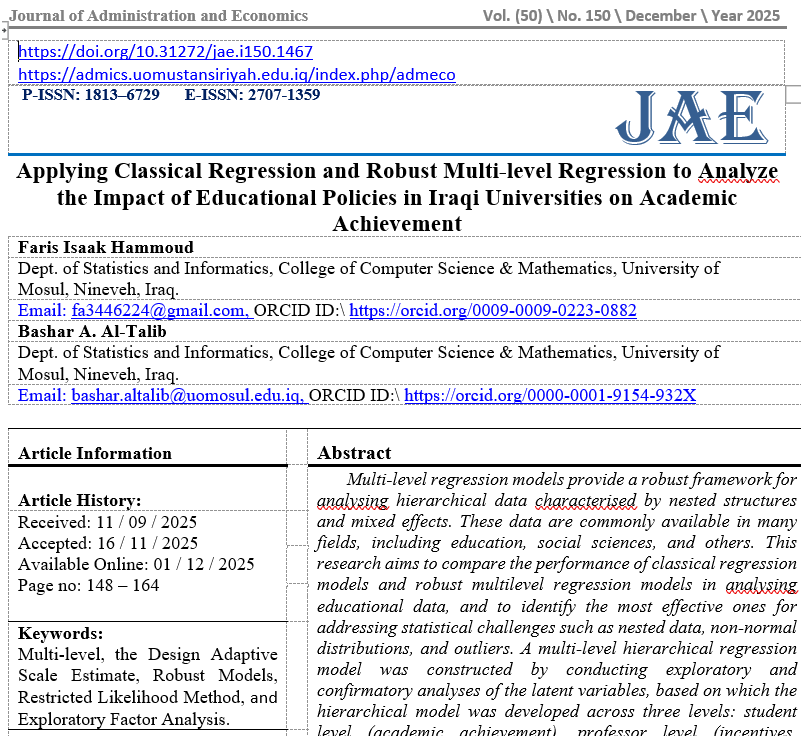
Applying Classical Regression and Robust Multi-level Regression to Analyze the Impact of Educational Policies in Iraqi Universities on Academic Achievement
DOI:
https://doi.org/10.31272/jae.i150.1467Keywords:
Multi-level, the Design Adaptive Scale Estimate, Robust Models, Restricted Likelihood Method, and Exploratory Factor AnalysisAbstract
Multi-level regression models are among the most important statistical methods for analyzing hierarchical or nested data with mixed effects. These data are commonly available in many fields, including education, social sciences, and others. This research aims to compare the performance of traditional regression models and robust multilevel regression models in analyzing educational data, and to identify the most effective ones for addressing statistical challenges such as nested data, non-normal distributions, and outliers. A multilevel hierarchical regression model was constructed using exploratory and confirmatory analyses. The hypothesized model was estimated using two methods: the restricted maximum likelihood method and the robust design adaptive scale method. This study aims to study the impact of incentives, teaching quality, and academic programs on student achievement in Iraqi universities. Both methods were applied to data taken from a sample of Iraqi universities, comprising 540 responses. The results showed that the model estimated using the robust method outperformed the model estimated using the traditional method, as it reduced the impact of outliers on the data and provided more accurate estimates. It was also concluded that developing academic programs and incentives, along with improving the quality of teaching, represents a key driver for raising the level of academic achievement and reducing disparities between universities.
Downloads
References
[1]- Joop J. Hox (2011). "Multilevel analysis: techniques and application", 2nd ed, Utrecht University, The Netherlands. https://doi.org/10.1111/j.1751-5823.2011.0015911.x
[2]- Woltman, H., et al (2012). "An introduction to hierarchical linear modeling." Tutorials in quantitative methods for psychology 8(1): 52-69. https://doi.org/10.20982/tqmp.08.1.p052 DOI: https://doi.org/10.20982/tqmp.08.1.p052
[3]- Eminita, V., et al. (2024). "Analyzing Multilevel Model of Educational Data: Teachers' Ability Effect on Students' Mathematical Learning Motivation." Journal on Mathematics Education 15(2): 431-450. https://doi.org/10.22342/jme.v15i2.pp431-450 DOI: https://doi.org/10.22342/jme.v15i2.pp431-450
[4]- Rameez, R., et al. (2022). "Evaluation of alternative methods for estimating the precision of REML-based estimates of variance components and heritability." Heredity 128(4): 197-208. https://doi.org/10.1038/s41437-022-00509-1 DOI: https://doi.org/10.1038/s41437-022-00509-1
[5]- Maestrini, L., et al. (2024). "Restricted maximum likelihood estimation in generalized linear mixed models". arXiv preprint arXiv:2402.12719. https://doi.org/10.48550/arXiv.2402.12719
[6]-Koller, M. (2013). " Robust estimation of linear mixed models". ETH. https://doi.org/10.32614/cran.package.robustlmm DOI: https://doi.org/10.32614/CRAN.package.robustlmm
[7]- Koller, M. and W. A. Stahel (2022). Robust estimation of general linear mixed effects models. Robust and multivariate statistical methods: Festschrift in honor of David E. Tyler, Springer: 297-322. https://doi.org/10.1007/978-3-031-22687-8_14 DOI: https://doi.org/10.1007/978-3-031-22687-8_14
[8]- Field, A. (2024)." Discovering statistics using IBM SPSS Statistics", Sage Publications Limited.
[9]- Singdahlsen, M. T. (2022). Rotations in Factor Analysis, NTNU. https://hdl.handle.net/11250/3059079
[10]- Brown, T. A. (2015). " Confirmatory factor analysis for applied research", Guilford Publications. https://doi.org/10.1080/08957347.2015.1062763 DOI: https://doi.org/10.1080/08957347.2015.1062763
[11]- Goretzko, D., et al. (2024). "Evaluating model fit of measurement models in confirmatory factor analysis." Educational and Psychological Measurement 84(1): 123-144.Maestrini, L., et al. (2024). "Restricted maximum likelihood estimation in generalized linear mixed models." arXiv preprint arXiv:2402.12719. https://doi.org/10.1177/00131644231163813 DOI: https://doi.org/10.1177/00131644231163813
[12]- Kaplan, D. (2000). " Advanced quantitative techniques in social sciences: Vol. 10. Structural equations modeling: Foundations and extensions ", Thousand Oaks, CA: Sage.
[13]- Amer, A. A. and A. Al-Sayed (2018). “Structural Equation Modeling for Psychological and Social Sciences: Foundations, Applications, and Issues 2”. Naif University Press, Riyadh, Kingdom of Saudi Arabia.
[14]- Azab, F. Y. and A. M. D. T. A. Saleh (2023). "A Comparative Study between GM6. IDRGP (RMVN) and GM6 Methods for Analyzing Multiple Linear Regression Models in the Presence of Outliers Using Simulation Approach." Al Kut Journal of Economics and Administrative Sciences 15(49): 344-363. https://doi.org/10.29124/kjeas.1549.16 DOI: https://doi.org/10.29124/kjeas.1549.16
[15]- Munawar Ahmad Ramadan. (2014). “Factoral Structure of the Cognitive Abilities Test (CogAT) Using Confirmatory and Exploratory Factor Analysis.” Unpublished Master’s Thesis, University of Damascus, Syria.
[16]- Zulkifli, N. R., et al. (2023). "The performance of unweighted least squares and regularized unweighted least squares in estimating factor loadings in structural equation modeling." International Journal of Data & Network Science 7(3). https://doi.org/10.5267/j.ijdns.2023.6.004 DOI: https://doi.org/10.5267/j.ijdns.2023.6.004
[17]- Blunch, N. J. (2012). " Introduction to structural equation modeling using IBM SPSS Statistics and AMOS". https://doi.org/10.4135/9781526402257 DOI: https://doi.org/10.4135/9781526402257
[18]- Sathyanarayana, S. and T. Mohanasundaram (2024). "Fit indices in structural equation modeling and confirmatory factor analysis: reporting guidelines." Asian Journal of Economics, Business and Accounting 24(7): 561-577. https://doi.org/10.9734/ajeba/2024/v24i71430 DOI: https://doi.org/10.9734/ajeba/2024/v24i71430
[19]- Abo El Nasr, M. M., et al. "Performance evaluation of different regression models: application in a breast cancer patient data," Scientific Reports 14(1), (2024): 12986. https://doi.org/10.1038/s41598-024-62627-6 DOI: https://doi.org/10.1038/s41598-024-62627-6
[20]- Kasali, J. and A. A. Adeyemi. (2022). "Model-data fit using Akaike Information Criterion (AIC), Bayesian Information Criterion (BIC), and the sample-size-adjusted BIC." Square: Journal of Mathematics and Mathematics Education 4(1), pp. 43-51. https://doi.org/10.21580/square.2022.4.1.11297 DOI: https://doi.org/10.21580/square.2022.4.1.11297
[21]- Bountziouka, V. and D. B. Panagiotakos (2022). "The role of rotation type used to extract dietary patterns through principal component analysis, on their short-term repeatability." Journal of Data Science 10(1): 19-36. https://doi.org/10.6339/jds.201201_10(1).0002 DOI: https://doi.org/10.6339/JDS.201201_10(1).0002
Downloads
Published
Issue
Section
License
Copyright (c) 2025 Faris Isaak, Bashar A. Al-Talib

This work is licensed under a Creative Commons Attribution 4.0 International License.
The journal of Administration and Economics is an open- access journal that all contents are free of charge. Articles of this journal are licensed under the terms of the Creative Commons Attribution International Public License CC-BY 4.0 (https://creativecommons.org/licenses/by/4.0/legalcode) that licensees are unrestrictly allowedto search, download, share, distribute, print, or link to the full text of the articles, crawl them for indexing and reproduce any medium of the articles provided that they give the author(s) proper credits (citation). The journal allows the author(s) to retain the copyright of their published article.
Creative Commons-Attribution (BY)