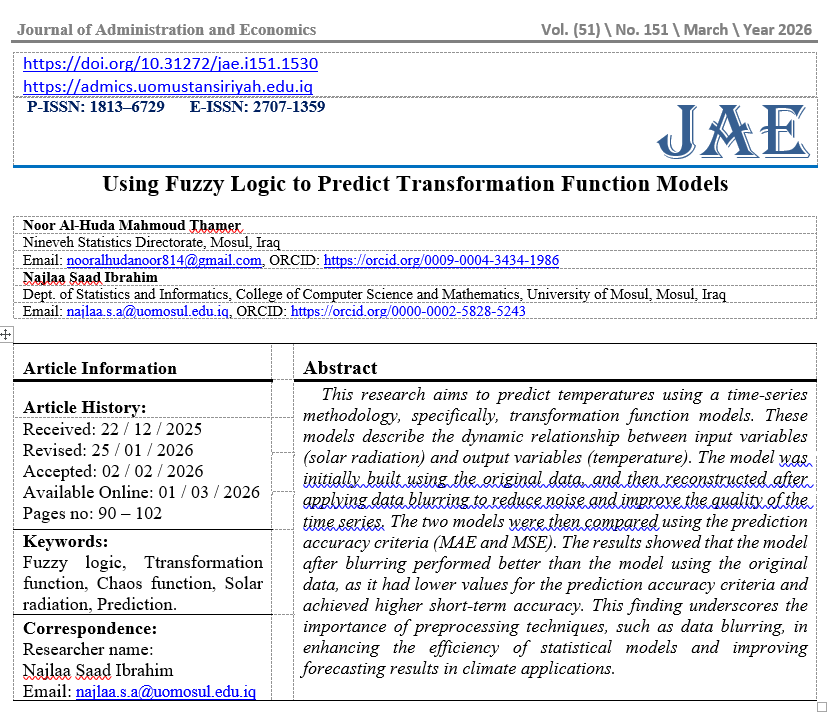
Using Fuzzy Logic to Predict Transformation Function Models
DOI:
https://doi.org/10.31272/jae.i151.1530Keywords:
Proposed Forecasting Model, Time series data, ImprovementAbstract
This research aims to predict temperatures using transformation function models, which are time-based models used to describe the dynamic relationship between input variables (solar radiation) and output variables (temperature). The model was initially built using the original data and then reconstructed after applying data blurring techniques to reduce noise and improve the quality of the time series. The results showed that the model after blurring performed better than the model using the original data, achieving higher accuracy in short-term predictions. This finding underscores the importance of preprocessing techniques, such as data blurring, in enhancing the efficiency of statistical models and improving forecasting results in climate applications.
Downloads
References
[1] Box, G. E. P., Jenkins, G. M., Reinsel, G. C., & Ljung, G. M. (2016). Time Series Analysis: Forecasting and Control (5th ed.). John Wiley & Sons. ISBN-13: DOI: https://doi.org/10.1002/9781118619100
[2] Zadeh, L. A. (1965). Fuzzy Sets. Information and Control, 8(3), 338–353. DOI: https://doi.org/10.1016/S0019-9958(65)90241-X
DOI: https://doi.org/10.1016/S0019-9958(65)90241-X DOI: https://doi.org/10.1016/S0019-9958(65)90241-X
[3] Mendel, J. M. (2017). Uncertain Rule-Based Fuzzy Systems: Introduction and New Directions (2nd ed.). Springer. ISBN-13: 978-3319513690 DOI: https://doi.org/10.1007/978-3-319-51370-6 DOI: https://doi.org/10.1007/978-3-319-51370-6
[4] Korol, T. (2018). The implementation of fuzzy logic in forecasting financial ratios. Contemporary Economics, 12(2), 165–188. DOI: https://doi.org/10.5709/ce.1897-9254.270
[5] Jassam, N. W., & Khudhair, J. K. (2024). Using the Dual-Input Single-Output (DISO) transfer function model in financial time series. Journal of the College of Basic Education, 30(126), 192–212. https://doi.org/10.35950/cbej.v30i126.12216 DOI: https://doi.org/10.35950/cbej.v30i126.12216
[6] Hayawi, H. A. A., Ibrahim, N. S., & Mohammed, L. J. (2021). Using the fuzzy technique to identification stochastic linear dynamic systems. Journal of Statistics and Management Systems, 24(1), 167–181. DOI: https://doi.org/10.1080/09720510.2020.1859808 DOI: https://doi.org/10.1080/09720510.2020.1859808
[7] Ibrahim, N. S., Amin, O. S. and Hayawi, H. A. A.,(2021),” FORECASTING THE FUZZY HYBRID ARIMA-GARCH MODEL OF STOCK PRICES IN THE IRAQI STOCK EXCHANGE”. International Journal of Agricultural and Statistical Sciences, Vol. 17, Supplement 1. DocID: https://connectjournals.com/03899.2021.17.2229
https://doi.org/10.5958/0973-1903.2021.00001.X
[8] Bector, C. R., & Chandra, S. (2005). Fuzzy Mathematical Programming and Fuzzy Matrix Games. Springer (Originally Tata McGraw-Hill). ISBN-13: 978-3540237297 DOI: https://doi.org/10.1007/b138244
[9] Cox, E. (1999). The Fuzzy Systems Handbook: A Practitioner's Guide to Building, Using, and Maintaining Fuzzy Systems (2nd ed.). AP Professional. ISBN-13: 978-0121944551
[10] Reyes ,J. E.M., Ake, S.C. & Llanos , A.I.C.,(2021).” New Hybrid Fuzzy Time Series Model: Forecasting the foreign exchange market”. Contaduría y Administración 66(3):1-24. DOI: https://doi.org/10.22201/fca.24488410e.2021.2623 DOI: https://doi.org/10.22201/fca.24488410e.2021.2623
[11] Klir, G., & Yuan, B. (1995). Fuzzy Sets and Fuzzy Logic: Theory and Applications. Prentice Hall. ISBN-13: 978-0131011717
[12] Chen, K. S., Yao, K. C., Cheng, C. H., Yu, C. M., & Chang, C. H. (2024). Fuzzy Evaluation Model for Critical Components of Machine Tools. Axioms, 13(8), 555. DOI: https://doi.org/10.3390/axioms13080555 DOI: https://doi.org/10.3390/axioms13080555
[13] Liu, L. M. (2006). Time Series Analysis and Forecasting (2nd ed.). Scientific Computing Associates. ISBN-13: 978-0976505686
Downloads
Published
Issue
Section
License
Copyright (c) 2026 Noor Al-Huda Mahmoud Thamer, & Najlaa Saad Ibrahim

This work is licensed under a Creative Commons Attribution 4.0 International License.
The journal of Administration and Economics is an open- access journal that all contents are free of charge. Articles of this journal are licensed under the terms of the Creative Commons Attribution International Public License CC-BY 4.0 (https://creativecommons.org/licenses/by/4.0/legalcode) that licensees are unrestrictly allowedto search, download, share, distribute, print, or link to the full text of the articles, crawl them for indexing and reproduce any medium of the articles provided that they give the author(s) proper credits (citation). The journal allows the author(s) to retain the copyright of their published article.
Creative Commons-Attribution (BY)