Estimating Gamma Regression Model Parameters Using Fire Hawk Optimizer with Practical Application
DOI:
https://doi.org/10.31272/jae.i152.1566Keywords:
Gamma Regression, Fire Hawk Optimizer, Generalized Linear Models, Parameter Estimation, Mean Squared ErrorAbstract
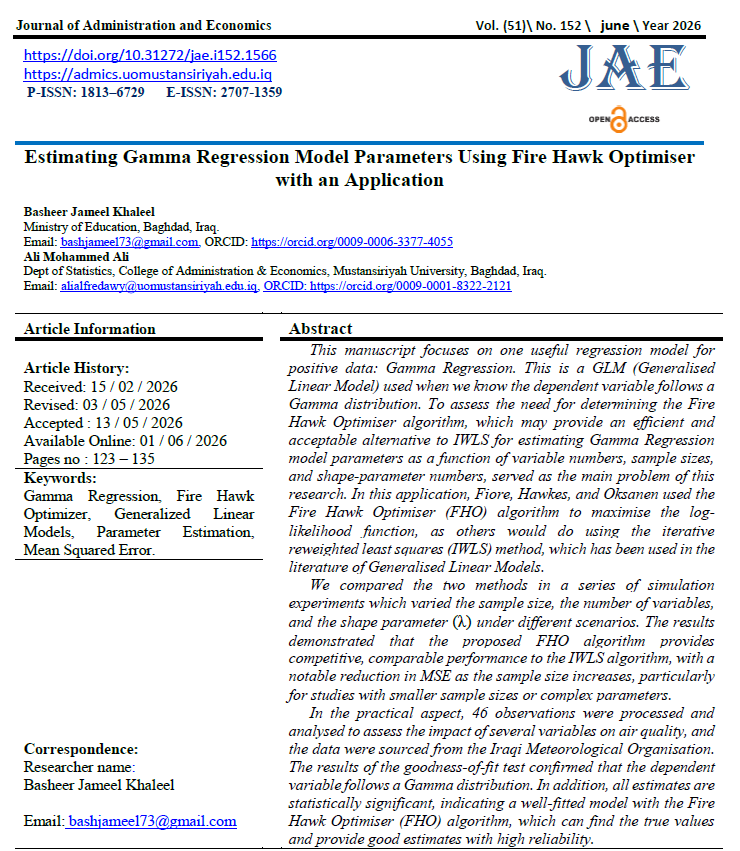
This research addresses one of the most important regression models used in modeling positive data, which is the Gamma Regression model. This model is considered one of the Generalized Linear Models (GLMs) and is utilized when the dependent variable follows a Gamma distribution. The Fire Hawk Optimizer (FHO) algorithm was employed to maximize the log-likelihood function as an alternative to the well-known Iteratively Reweighted Least Squares (IWLS) method in the context of Generalized Linear Models.
A comparison was conducted between the two methods using simulation experiments with different sample sizes and various scenarios for the number of variables and the shape parameter ($\lambda$). The results showed that the FHO algorithm offers a competitive and comparable performance to the IWLS algorithm, especially in cases with small samples or complex parameters, with a clear decrease in the mean squared error (MSE) values as the sample size increases.
In the applied part, the impact of several variables on air quality was analyzed using 46 observations obtained from the Iraqi Meteorological Organization. The goodness-of-fit test results confirmed that the dependent variable follows the Gamma distribution. Furthermore, the estimates showed that all parameters were statistically significant, which reflects the model's adequacy and the efficiency of the FHO algorithm in tracking the true values and providing accurate and reliable estimates.
Downloads
References
[1] Nelder, J.A., and Wedderburn, R.W.M. (1972). Generalized Linear Models. Journal of the Royal Statistical Society: Series A, 135(3), 370–384. https://doi.org/10.2307/2344614 DOI: https://doi.org/10.2307/2344614
[2] Abdaljabbar, L.A. and Nayef, Q.N. (2021). Comparison Between Maximum Likelihood and Bayesian Methods for Estimating the Gamma Regression with Practical Application. Journal of Economics and Administrative Sciences, 27(125), pp. 477–492. https://doi.org/10.33095/jeas.v27i125.2088 DOI: https://doi.org/10.33095/jeas.v27i125.2088
[3] Asar, Y., & Algamal, Z. (2022). A new two-parameter estimator for the gamma regression model. Statistics, Optimization & Information Computing, 10(3), 750-761. https://doi.org/10.19139/soic-2310-5070-822 DOI: https://doi.org/10.19139/soic-2310-5070-822
[4] Ali, T., Al-Saffar, A., & Ismael, S. S. (2023). Using Bayes weights to estimate parameters of a Gamma Regression model. Iraqi Journal of Statistical Sciences, 20(1), 43-54. DOI: 10.33899/IQJOSS.2023.178687 DOI: https://doi.org/10.33899/iqjoss.2023.0178687
[5] Abdullah, M. S., & Abood, S. N. (2024). A Comparison between Methods for Estimating the Restricted Gamma Ridge Regression Model Using the Simulation. Journal of Economics and Administrative Sciences, 30(143), 510-522. https://doi.org/10.33095/jeas.v27i125.2088 DOI: https://doi.org/10.33095/1xrve980
[6] Algamal, Z. Y., Salih, A. M., & Khaleel, M. A. (2024). 0544A New Ridge-Type Estimator for the Gamma regression model. Iraqi Journal for Computer Science and Mathematics, 5(1), 22. https://doi.org/10.52866/ijcsm.2024.05.01.006 DOI: https://doi.org/10.52866/ijcsm.2024.05.01.006
[7] Abed, A. R., & Nayef Al-Qazaz, Q. N. (2025). Comparison of two approaches robust-ridge estimator in restricted additive partially regression model. In AIP Conference Proceedings (Vol. 3264, No. 1, p. 050023). AIP Publishing LLC. https://doi.org/10.1063/5.0259093 DOI: https://doi.org/10.1063/5.0259093
[8] Dawoud, I. (2025). A new improved estimator for the gamma regression model. Communications in Statistics - Simulation and Computation, 1–12. https://doi.org/10.1080/03610918.2025.2450722 DOI: https://doi.org/10.1080/03610918.2025.2450722
[9] Al-Sinjary, A., & Raheem, A. (2022). Gauss-Hermite Cubature Method to estimate parameters of a multivariate GLMM. Journal of Education and Science, 31(2), 29-41. DOI:10.33899/edusj.2022.133041.1216 DOI: https://doi.org/10.33899/edusj.2022.133041.1216
[10] Salinas Ruíz, J., Montesinos López, O. A., Hernández Ramírez, G., & Crossa Hiriart, J. (2023). Generalized linear mixed models with applications in agriculture and biology. Springer Nature. https://doi.org/10.1007/978-3-031-32800-8 DOI: https://doi.org/10.1007/978-3-031-32800-8
[11] Stroup, W. W., Ptukhina, M., & Garai, J. (2024). Generalized linear mixed models: modern concepts, methods and applications. 2nd Edition. Chapman and Hall/CRC. https://doi.org/10.1080/01621459.2025.2506201 DOI: https://doi.org/10.1201/9780429092060
[12] Chattamvelli, R., & Shanmugam, R., (2021). Continuous Distributions in Engineering and the Applied Sciences. Morgan & Claypool. https://doi.org/10.1007/978-3-031-02435-1 DOI: https://doi.org/10.1007/978-3-031-02430-6
[13] Hardin, J. W., & Hilbe, J. M., (2018), “Generalized linear models and extensions”, 4th Edition, Stata press. https://doi.org/10.1007/978-981-96-4726-2 DOI: https://doi.org/10.1007/978-981-96-4726-2
[14] Azizi, M., Talatahari, S., & Gandomi, A. H. (2023). Fire Hawk Optimizer: A novel metaheuristic algorithm. Artificial Intelligence Review, 56(1), 287-363. https://doi.org/10.1007/s10462-022-10173-w DOI: https://doi.org/10.1007/s10462-022-10173-w
[15] Hamza Obeid, R. and J. Sadik, N. (2023) “Selection of variables Affecting Red Blood Cell by Firefly Algorithm”, Journal of Economics and Administrative Sciences, 29(136), pp. 90–100. https://doi.org/10.33095/jeas.v29i136.2610 DOI: https://doi.org/10.33095/jeas.v29i136.2610
[16] R Core Team. (2025). glm: Fitting generalized linear models. In R: A language and environment for statistical computing. https://stat.ethz.ch/R-manual/R-devel/library/stats/html/glm.html DOI: https://doi.org/10.32614/R.manuals
Downloads
Published
Issue
Section
License
Copyright (c) 2026 Basheer Jameel Khaleel, Ali Mohammed Ali

This work is licensed under a Creative Commons Attribution 4.0 International License.
The journal of Administration and Economics is an open- access journal that all contents are free of charge. Articles of this journal are licensed under the terms of the Creative Commons Attribution International Public License CC-BY 4.0 (https://creativecommons.org/licenses/by/4.0/legalcode) that licensees are unrestrictly allowedto search, download, share, distribute, print, or link to the full text of the articles, crawl them for indexing and reproduce any medium of the articles provided that they give the author(s) proper credits (citation). The journal allows the author(s) to retain the copyright of their published article.
Creative Commons-Attribution (BY)