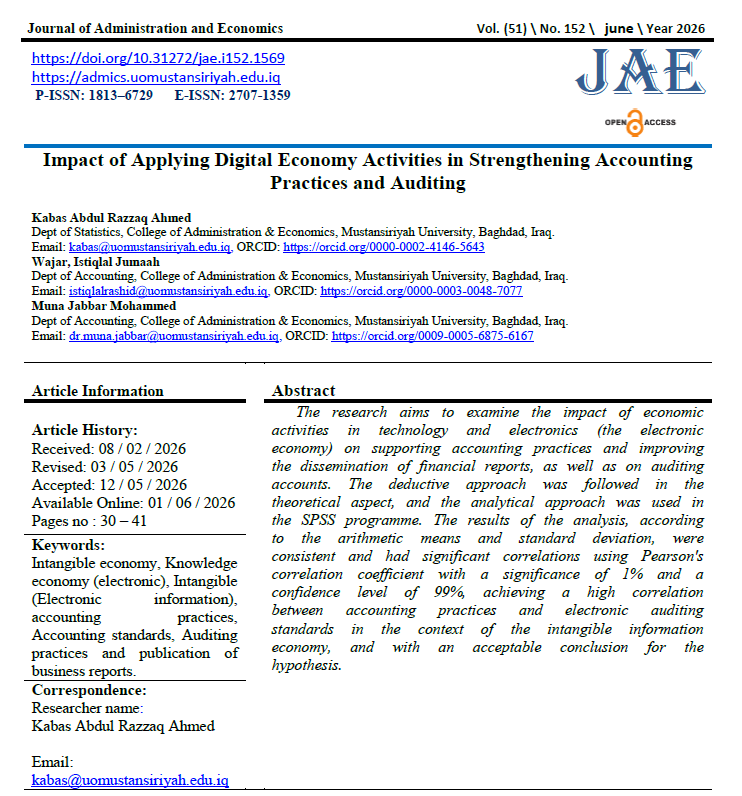
Impact of applying Digital economy activities in strengthening accounting practices and auditing
DOI:
https://doi.org/10.31272/jae.i152.1569Keywords:
Intangible economy, Knowledge economy (electronic), Intangible (Electronic information), accounting practices, accounting standardsAbstract
The research aims to reveal the impact of economic activities related to technology and electronics (electronic economy) in supporting accounting practices and improving the dissemination of financial reports, in addition to auditing accounts. The deductive approach was followed in the theoretical aspect, and the analytical approach was followed based on the SPSS programme.The results of the analysis, according to the arithmetic means and standard deviation, were consistent and had significant correlations using Pearson's correlation coefficient with a significance of 1% and a confidence level of 99%, achieving a high correlation between accounting practices and electronic auditing standards in the context of the intangible information economy, and with an acceptable conclusion for the hypothesis.
Downloads
References
[1] Abu Al-Shamat, M. A. (2012). Trends of intangible (electronic) knowledge economy in Arab countries. Damascus University Journal for Economic and Legal Sciences, 28(1).
[2] Olayan, R. M. (2010). Information economics. Dar Safa for Publishing and Distribution.
[3] Haidoushi, A., & Ayal, M. (2018). Knowledge economy in Algeria: Reality and obstacles. Journal of Scientific Research and Studies.
[4] Al-Ziyadat, M. A. (2000). Contemporary trends in knowledge management (1st ed.). Dar Al-Safaa for Publishing and Distribution.
[5] Yahyaoui, F. (2017). The impact of empowerment leadership on the efficiency of intellectual capital in the light of the knowledge economy [Doctoral dissertation]. University of Médéa, Algeria.
[6] Toutelian, M. (2006). Knowledge economy indicators and the position of women in its development. Arab Institute for Training and Statistical Research.
[7] Al-Samir, A. H. (2015). The role of information specialists in the transition towards the knowledge economy in Syria [Paper presentation]. The 26th Conference of the Arab Federation for Libraries and Information, Amman, Jordan.
[8] Ben Dehiba, K. (2022). The impact of the accounting information system on accounting practices in Algeria [Master's thesis]. Kasdi Merbah University.
[9] Ouadi, N. (2012). Accounting measurement and its impact on the faithful representation of the entity's assets according to international accounting and financial reporting standards and the new financial accounting system (SCF) [Master's thesis]. Badji Mokhtar University.
[10] Sutton, M. H. (2002). Financial reporting at a crossroads. Accounting Horizons, 16(4), 319–328. https://doi.org/10.2308/acch.2002.16.4.319 DOI: https://doi.org/10.2308/acch.2002.16.4.319
[11] Tawfik, M. S. (2002). The need to regulate electronic distribution of business reporting information applied to the banking sector and methods of implementation and accounting for e-commerce operations [Paper presentation]. E-Commerce Conference – Horizons and Challenges, Faculty of Commerce, Alexandria University.
[12] Fitzsimons, A., & Shoaf, V. (2000). FASB studies the electronic reporting of business information. Commercial Lending Review, 15(4), 62-65.
[13] Moreland, K. A. (1997). SAS 80 amends SAS 31 to address information technology. The CPA Journal, 67(7), 44-48.
[14] Helmes, G. I., & Mancino, J. (1999). Information technology issues for the attest – audit and assurance services functions. The CPA Journal, 69(5), 42-45.
[15] Williamson, L. A. (1997). The implications of electronic evidence. Journal of Accountancy, 183(2), 79-80.
Downloads
Published
Issue
Section
License
Copyright (c) 2026 Kabas Abdul razzaq Ahmed Al-Salmani, Istiqlal Jumaah Wajar, Muna Jabbar Mohammed

This work is licensed under a Creative Commons Attribution 4.0 International License.
The journal of Administration and Economics is an open- access journal that all contents are free of charge. Articles of this journal are licensed under the terms of the Creative Commons Attribution International Public License CC-BY 4.0 (https://creativecommons.org/licenses/by/4.0/legalcode) that licensees are unrestrictly allowedto search, download, share, distribute, print, or link to the full text of the articles, crawl them for indexing and reproduce any medium of the articles provided that they give the author(s) proper credits (citation). The journal allows the author(s) to retain the copyright of their published article.
Creative Commons-Attribution (BY)