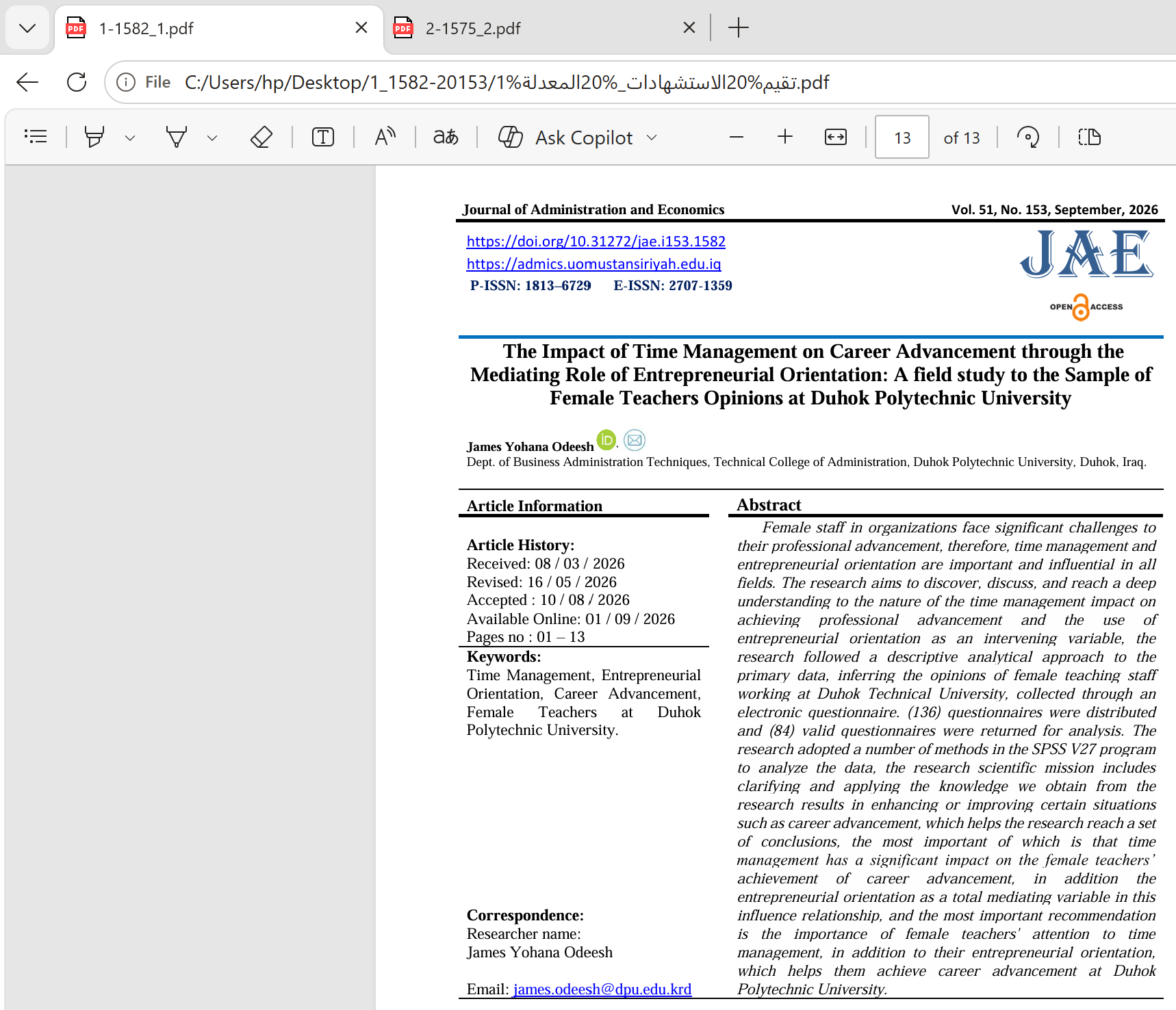
The Impact of Time Management on Career Advancement through the Mediating Role of Entrepreneurial Orientation: A field study to the Sample of Female Teachers Opinions at Duhok Polytechnic University
DOI:
https://doi.org/10.31272/jae.i153.1582Keywords:
Time Management, Entrepreneurial Orientation, Career Advancement, Female Teachers at Duhok Polytechnic UniversityAbstract
Female staff in organizations face significant challenges to their professional advancement, therefore, time management and entrepreneurial orientation are important and influential in all fields. The research aims to discover, discuss, and reach a deep understanding to the nature of the time management impact on achieving professional advancement and the use of entrepreneurial orientation as an intervening variable, the research followed a descriptive analytical approach to the primary data, inferring the opinions of female teaching staff working at Duhok Technical University, collected through an electronic questionnaire. (136) questionnaires were distributed and (84) valid questionnaires were returned for analysis. The research adopted a number of methods in the SPSS V27 program to analyze the data, the research scientific mission includes clarifying and applying the knowledge we obtain from the research results in enhancing or improving certain situations such as career advancement, which helps the research reach a set of conclusions, the most important of which is that time management has a significant impact on the female teachers’ achievement of career advancement, in addition the entrepreneurial orientation as a total mediating variable in this influence relationship, and the most important recommendation is the importance of female teachers' attention to time management, in addition to their entrepreneurial orientation, which helps them achieve career advancement at Duhok Polytechnic University
Downloads
References
[1] Edigide, S. N., Adomi, E. E., & Umukoro, G. (2024). Workload and career advancement of librarians in academic libraries in Delta State, Nigeria. Library and Information Perspectives and Research, 6(2), 16–23. http://doi.org/10.47524/lipr.v6i2.17 DOI: https://doi.org/10.47524/lipr.v6i2.17
[2] Panjaitan, M., Simatupang, S., Silalahi, M., Julyanthry, J., & Simanjuntak, M. D. (2025). Determinants of career development on employee performance. Jurnal Ilmiah Manajemen Kesatuan, 13(3), 1599–1608. https://jurnal.ibik.ac.id/index.php/jimkes/article/view/3180 DOI: https://doi.org/10.37641/jimkes.v13i3.3180
[3] Mardianty, D., & Sari, A. J. (2025). The effect of career development and work motivation on employee performance transportation agency. Jurnal Ilmiah Manajemen Kesatuan, 13(4), 2245–2256. https://jurnal.ibik.ac.id/index.php/jimkes/article/view/3269 DOI: https://doi.org/10.37641/jimkes.v13i4.3269
[4] Al-Jawali, Z.B.k. (2019). The impact of identifying career advancement opportunities on organizational justice. Scientific Journal of Business and Environmental Studies, 10(1), 432-459. https://journals.ekb.eg/article_50433.html
[5] Anwer, B. (2025). Breaking barriers: Exploring gender and sector disparities in professional development and career advancement. Journal of Women Empowerment and Studies, 5(1), 34–46. https://doi.org/10.55529/jwes.51.34.46 DOI: https://doi.org/10.55529/jwes.51.34.46
[6] Nweke, E. O., & Osakwe, M.-A. (2024). Time management and effective teaching in senior public secondary schools in River State. Afropolitan Journals, 15(1), 203–224. https://doi.org/10.62154/78dc6a88 DOI: https://doi.org/10.62154/78dc6a88
[7] Hormiga, E., De Saâ-Pérez, P., Diaz-Diaz, N. L., Ballesteros-Rodríguez, J. L., & Aguiar-Diaz, I. (2017). The influence of entrepreneurial orientation on the performance of academic research groups: The mediating role of knowledge sharing. The Journal of Technology Transfer, 42, 10–32. https://doi.org/10.1007/s10961-015-9463-2 DOI: https://doi.org/10.1007/s10961-015-9463-2
[8] Al-Ghamdi, S.M.A., & Taibah, H.A., (2024), The role of entrepreneurial orientation of educational administrative leaders on the continuous improvement of institutional performance, Arab Journal of Administration, 44(1), 221-236. https://doi.org/10.21608/aja.2023.218469.1472 DOI: https://doi.org/10.21608/aja.2023.218469.1472
[9] Saputri, M., Yarni, L., Putra, D. P., & Syawaluddin. (2024). Students academic procrastination: The effects of time management. BICC Proceeding, 2, 82–90. https://biccproceedings.org/index.php/bicc/article/view/109/50 DOI: https://doi.org/10.30983/bicc.v1i1.109
[10] Nigussie, T. (2019). The effect of time management practice on the academic achievement. European Journal of Business and Management, 11(4), 43–50. https://www.iiste.org/Journals/index.php/EJBM/article/view/46420
[11] Abdul Baqi, A. (2017), Time management -obstacles and solutions. Journal of the Research Unit in Human Resources Development and Management, 8(2), 62-78. https://search.emarefa.net/detail/BIM-859869
[12] Dogan, R. R., Oksoy, G., Almaci, S., Demir, S., & Tabuk, M. E. (2024). The relationship between youth perception of social support in physical activities and leisure time management attitude. International Journal of Sport Culture and Science, 12(2), 112–125. https://dergipark.org.tr/en/pub/intjscs/issue/85547/1394624 DOI: https://doi.org/10.14486/IntJSCS.2024.704
[13] Chaudhari, T. (2022). Time management essentials and importance. International Journal of Commerce and Management Research, 8(5), 6–8. https://www.managejournal.com/archives/2022/vol8/issue5
[14] Şahin, C. Y. (2020). The relationships between time management skill and activity participation among METU members. (Master's thesis), Department of Physical Education and Sport, Middle East Technical University. Ankara, Turkey
[15] Osin, E., & Boniwell, I. (2024). Positive time use: A missing link between time perspective, time management, and well-being. Frontiers in Psychology, 1–17. https://doi.org/10.3389/fpsyg.2024.1087932 DOI: https://doi.org/10.3389/fpsyg.2024.1087932
[16] Khan, M. J., & Ashraf, A. (2020). The effect of time management on the academic performance of students in the higher educational institutions of Islamabad. International Review of Management and Business Research, 9(3), 202–211. https://irmbrjournal.com/paper_details.php?id=946 DOI: https://doi.org/10.30543/9-3(2020)-16
[17] Alzahrani, F.M., & Issaoui, F. (2025), The impact of entrepreneurial orientation of business organizations on sustainable strategic success, Arab Journal for Scientific Publishing, 8(78), 236–265. https://doi.org/10.6007/IJARBSS/v13-i11/19430 DOI: https://doi.org/10.6007/IJARBSS/v13-i11/19430
[18] Ebrahim, M.E.A.E. (2024), The impact of entrepreneurial orientation on organizational success, Journal of the Higher Institute for Qualitative Studies, 4(14), 1403-1462. https://search.mandumah.com/Record/1514411
[19] Wales, W. J., Kraus, S., Filser, M., Stőckmann, C., & Govin, J. G. (2021). The status quo of research on entrepreneurial orientation: Conversational landmarks and theoretical scaffolding. Journal of Business Research, 128, 564–577. https://doi.org/10.1016/j.jbusres.2020.11.036 DOI: https://doi.org/10.1016/j.jbusres.2020.10.046
[20] Nuryakin. (2025). Trend in the literature review of entrepreneurial orientation: A bibliometric analysis. Studies in Business and Economics, 20(1), 163–179. https://doi.org/10.2478/sbe-2025-0009 DOI: https://doi.org/10.2478/sbe-2025-0009
[21] Hahn, D., Civera, A., & Cavallo, A. (2025). Employees’ entrepreneurial orientation in response to exogenous crises: The contingent role of entrepreneurial exposure. The Journal of Technology Transfer, 1–31. https://doi.org/10.1007/s10961-025-10202-0 DOI: https://doi.org/10.1007/s10961-025-10202-0
[22] Foroozanfar, M. H., Wang, W., Rehman, S. U., & Zaid, S. H. A. (2025). Investigating strategic control, independence of managers, organizational policies and subjective career advancement in tourism organizations. Industrial and Commercial Training, 57(3), 259–273. https://doi.org/10.1108/ICT-07-2023-0055 DOI: https://doi.org/10.1108/ICT-07-2023-0055
[23] Mahreen, A., Deng, F., & Ali, Z. (2025). It is never too late: Understanding career shocks–career development nexus from affective events theory. International Journal for Educational and Vocational Guidance, 1–26. https://doi.org/10.1007/s10775-025-09744-4 DOI: https://doi.org/10.1007/s10775-025-09744-4
[24] Al- Dabaa, W.S.A., Sobh, N.M.A., & Al-Nashili, D.H.A.M. (2025), The moderating role of the positive breaking of the organization rules in the relationship between the beliefs of the glass ceiling and women's career advancement, Scientific Journal for Financial and Commercial Studies and Research, 6(2), 522-572. https://search.emarefa.net/detail/BIM-1736413
[25] Nor, N. F. M., Ismail, S. R., & Rashid, N. A. (2024). Factors influencing the career advancement of Malaysian women homepreneurs on the TikTok platform. Information Management and Business Review, 16(3S(a)), 991–998. https://doi.org/10.22610/imbr.v16i3S(I)a.4187 DOI: https://doi.org/10.22610/imbr.v16i3S(I)a.4187
[26] Cheng, T. (2025). The impact of professional education programs on career development. Higher Education Evaluation and Development, 1–14. https://doi.org/10.1108/HEED-10-2024-0046 DOI: https://doi.org/10.1108/HEED-10-2024-0046
[27] Omer, Y. (2024). Impact of gender stereotypes on career advancement in STEM fields in Tanzania. International Journal of Gender Studies, 9(3), 54–64. https://doi.org/10.47604/ijgs.2880 DOI: https://doi.org/10.47604/ijgs.2880
[28] Mishra, A. M., Arora, R., & Ahmad, S. (2025). The impact of training and development on career advancement: A study on aviation sector in India. In Hybrid Intelligent Systems: Real World Applications (Vol. 5). Springer Nature Switzerland. https://doi.org/10.1007/978-3-031-78931-1 DOI: https://doi.org/10.1007/978-3-031-78931-1_22
[29] Liu, J., Yang, J., Liu, Y., Yang, Y., & Zhang, H. F. (2015). A modified career growth scale for Chinese nurses: Validity and reliability. International Journal of Nursing Sciences, 2(1), 80–85. https://doi.org/10.1016/j.ijnss.2015.01.008 DOI: https://doi.org/10.1016/j.ijnss.2015.01.010
Downloads
Published
Issue
Section
License
Copyright (c) 2026 James Yohana Odeesh

This work is licensed under a Creative Commons Attribution 4.0 International License.
The journal of Administration and Economics is an open- access journal that all contents are free of charge. Articles of this journal are licensed under the terms of the Creative Commons Attribution International Public License CC-BY 4.0 (https://creativecommons.org/licenses/by/4.0/legalcode) that licensees are unrestrictly allowedto search, download, share, distribute, print, or link to the full text of the articles, crawl them for indexing and reproduce any medium of the articles provided that they give the author(s) proper credits (citation). The journal allows the author(s) to retain the copyright of their published article.
Creative Commons-Attribution (BY)