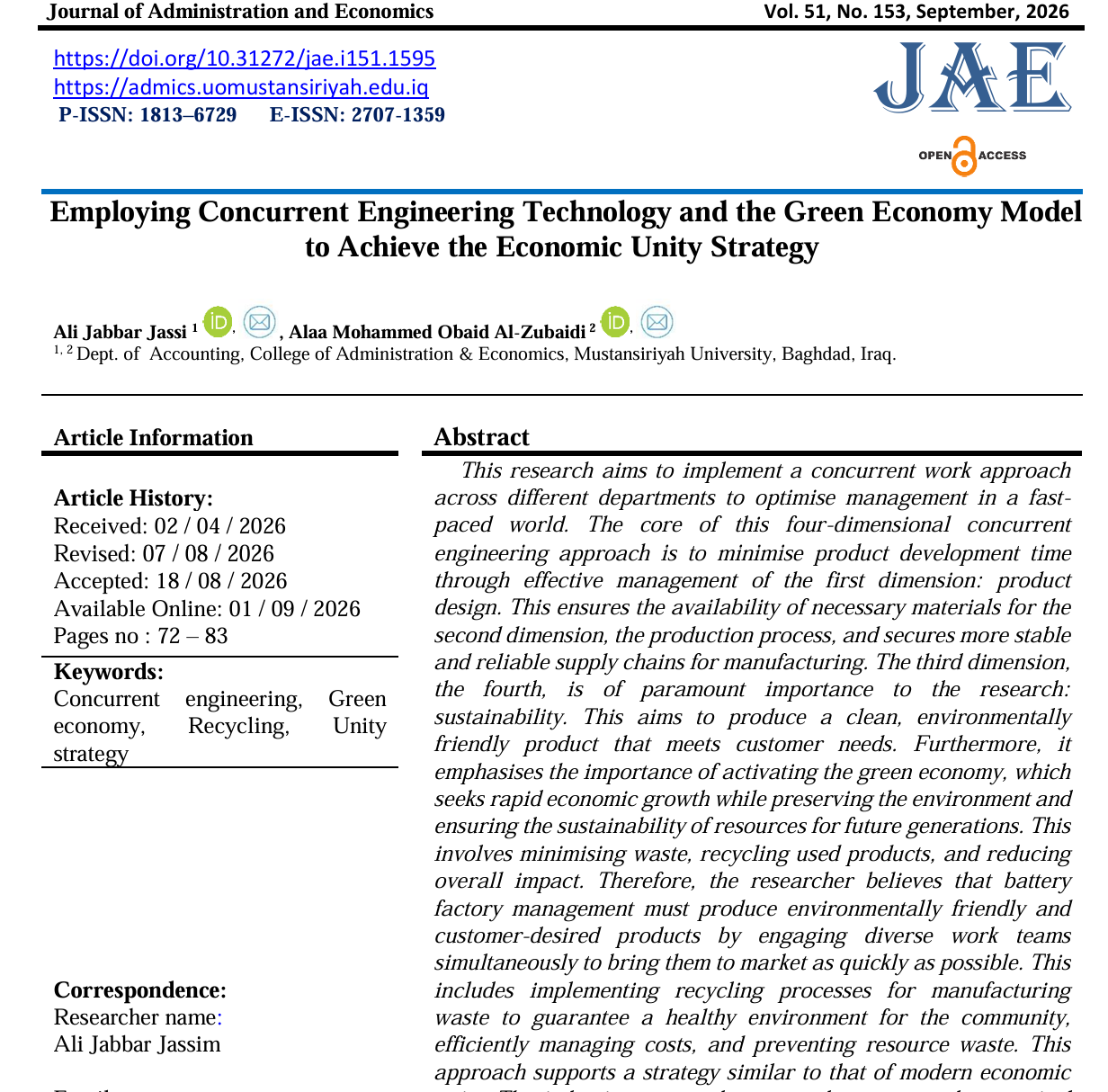
Employing concurrent engineering technology and the green economy model to achieve the economic unity strategy
DOI:
https://doi.org/10.31272/jae.i153.1595Keywords:
Concurrent engineering, green economy, recycling, unity strategyAbstract
This research aims to implement a concurrent work approach across different departments to optimize management in a fast-paced world. The core of this four-dimensional concurrent engineering approach is to minimize product development time through effective management of the first dimension: product design. This ensures the availability of necessary materials for the second dimension, the production process, and secures more stable and reliable supply chains for manufacturing. The third dimension, the fourth, is of paramount importance to the research: sustainability. This aims to produce a clean, environmentally friendly product that meets customer needs. Furthermore, it emphasizes the importance of activating the green economy, which seeks rapid economic growth while preserving the environment and ensuring the sustainability of resources for future generations. This involves minimizing waste, recycling used products, and reducing overall impact. Therefore, the researcher believes that battery factory management must produce environmentally friendly and customer-desired products by engaging diverse work teams simultaneously to bring them to market as quickly as possible. This includes implementing recycling processes for manufacturing waste to guarantee a healthy environment for the community, efficiently managing costs, and preventing resource waste. This approach supports a strategy similar to that of modern economic units. The inductive approach was used in presenting the practical aspect, based on the factory's data for the year 2024-2025, and the deductive approach was used in presenting the theoretical aspect
Downloads
References
[1] Salman, A. J. (2020). Using concurrent engineering to develop product and reduce costs. PalArch’s Journal of Archaeology of Egypt/Egyptology, 17(6). https://www.archives.palarch.nl/index.php/jae/article/view/
[2] Rihar, L., & Kušar, J. (2021). Concurrent engineering and QFD for sustainable projects. Sustainability, 13(3), 1091. https://doi.org/10.3390/su13031091
[3] Fares & Naila, Sweeney, Edward, 2024, Supply chain design through design thinking and 3D concurrent engineering. https://scholar.google.com/scholar
[4] Putnik, G. D., & Putnik, Z. (2020). Defining sequential, simultaneous, concurrent and collaborative engineering: On similarities and differences. https://doi.org/10.1007/s00170-020-05231-7
[5] Dhongre, A. U., Jha, B. K., Aachat, P. S., & Patil, V. R. (2017). Concurrent engineering: a review. International Research Journal of Engineering and Technology, 4(5). https://doi.org/10.1177/0008125618764691
[6] Ghodous, P., Da Silva, C. F., & Figay, N. (2017). Concurrent engineering: Research and applications – Special issue on CloudIoT in concurrent engineering. Concurrent Engineering Research and Applications, 25(2), 190–191. https://doi.org/10.1177/1063293X17693867
[7] Al-Dulaimi, A. K. A. M. (2022). The impact of employing concurrent engineering dimensions in achieving competitive advantage. Tikrit Journal of Administrative and Economic Sciences, Tikrit University, College of Administration and Economics, 18(58), 292–318.
[8] Azeez, K. A., & Al-Tayra, H. S. N. (2021). The role of developed concurrent engineering in enhancing competitive capability. Web ology, 18(SI), 322-338. Competitive Advantage: Evidence from Nordic Companies ، 4(7). https://scholar.google.com/scholar?
[9] Anambah, C. J., Baldwin, A. N., Kohlhagen, D., Prasad, B., Cutting-Deckle, A. F., Dufay, J., & Mommsen, M. (2020). Integrating concurrent engineering concepts in a steelwork construction project. Concurrent Engineering, 8(3), 199-212. https://doi.org/10.1177/1063293X0000800304
[10] Obeid, K. H. (2024). Application of 4D concurrent engineering technology to reduce costs: An applied study in the Kufa Cement Factory. Qadisiyah Journal of Administrative and Economic Sciences , 3(5)
[11] Liu, X.,Schraven, D., Bruijne, M., Jong, M., )2019) & Hertogh, M., Navigating Transitions for Sustainable Infrastructures-The Case of a "New High-Speed Railway Station in Jingmen, China", sustainability 11(4) https://doi.org/10.3390/su11041000
[12] Khader, A., & Reza, N. M. (2021). A proposed model for implementing sustainable accelerated manufacturing strategy using 4D concurrent engineering technology and its impact on achieving competitive advantages. Journal of Administration and Economics, 13(40), 129–155.
[13] Vassallo, Nicole & Rafalo, Paul. (2024). Reducing the Environmental Impacts of Plastic Cosmetic Packaging: A Multi-Attribute Life Cycle Assessment, Cosmetics, Vol.11, Issue.34, pp. (1-16) . https://doi.org/10.3390/cosmetics11010034
[14] Hysa, E., Kruja, A., & Laurenti, R. (2020). green economy innovation and environmental sustainability impact on economic growth: An integrated model for sustainable development Sustainability, 12, 4831. https://doi.org/10.3390/su12124831 .
[15] Esposito, M., Tse, T., & Soufani, K. (2018). Introducing a green economy: New thinking with managerial and policy implications California Management Review, 60(3), 5–19. https://doi.org/10.1177/0008125618764691
[16] Sileryte, R., (2023), Geographies of Waste : Significance Semantics and Statistics in pursuit of a Circular. Dissertation Master of Science in Geomatics Delft University of Technology, Netherlands.
[17] Ziyada, R. M. M. (2021). Ethical finance as an innovative approach to achieving sustainable development under the circular economy. International Journal of Educational and Psychological Sciences, 50(68).
[18] Hillis, L., Mikula-Wright, R., Pitt, F., Wilkinson, R., & Parkin, R. (2022). Regenerate & restore: A green economy. Investor Group on Climate Change Discussion paper,3(7) . https://scholar.google.com/scholar
[19] Dormancies, A., Garcés-Ayerbe, C., Renucci, A., & Rivera-Torres, P. (2022). How does it pay to be circular in production processes? Eco-innovativeness and green jobs as moderators of a cost-efficiency advantage in European SMEs. Journal article, 31, 1184–1203. https://doi.org/10.1016/j.jclepro.2022.131184
[20] Peter Lacy & Other), (2020, The green Economy Handbook Realizing the Circular Advantage,, Palgrave Macmillan,, London,,2020. https://doi.org/10.1057/978-1-349-95968-6
[21] General Company for Automotive and Equipment Industry / Battery Factory, Records of the Financial Division, Planning Division, Information Center Division, and Environment Division for the years 2024 – 2025 – 2026.
Downloads
Published
Issue
Section
License
Copyright (c) 2026 Ali Jabbar Jassim , Alaa Mohammed Obaid Al-Zubaidi

This work is licensed under a Creative Commons Attribution 4.0 International License.
The journal of Administration and Economics is an open- access journal that all contents are free of charge. Articles of this journal are licensed under the terms of the Creative Commons Attribution International Public License CC-BY 4.0 (https://creativecommons.org/licenses/by/4.0/legalcode) that licensees are unrestrictly allowedto search, download, share, distribute, print, or link to the full text of the articles, crawl them for indexing and reproduce any medium of the articles provided that they give the author(s) proper credits (citation). The journal allows the author(s) to retain the copyright of their published article.
Creative Commons-Attribution (BY)