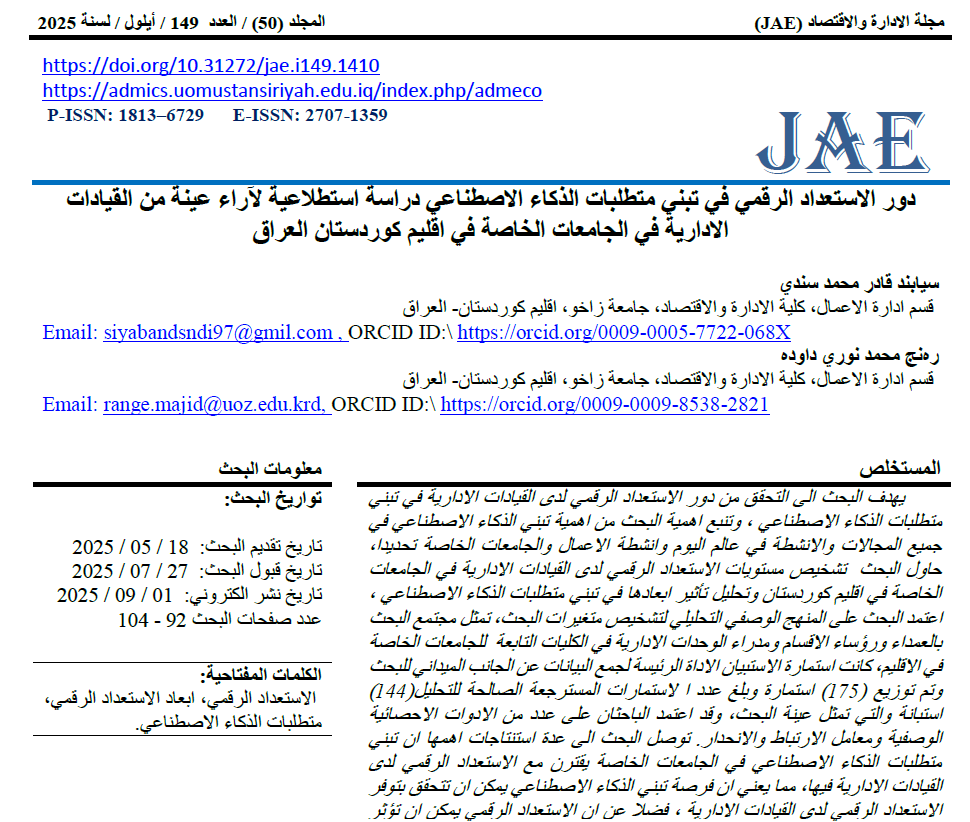
دور الاستعداد الرقمي في تبني متطلبات الذكاء الاصطناعي دراسة استطلاعية لآراء عينة من القيادات الادارية في الجامعات الخاصة في اقليم كوردستان العراق
DOI:
https://doi.org/10.31272/jae.i149.1410الكلمات المفتاحية:
الاستعداد الرقمي، ابعاد الاستعداد الرقمي، الذكاء، متطلبات الذكاء الاصطناعي، الجامعات الخاصةالملخص
هدفت الدراسة الى التحقق من دور الاستعداد الرقمي لدى القيادات الادارية في تبني متطلبات الذكاء الاصطناعي ، وتنبع اهمية الدراسة من اهمية تبني الذكاء الاصطناعي في جميع المجالات والانشطة في عالم اليوم وانشطة الاعمال والجامعات الخاصة تحديدا، حاولت الدراسة تشخيص مستويات الاستعداد الرقمي لدى القيادات الادارية في الجامعات الخاصة في اقليم كوردستان وتحليل تأثير ابعادها في تبني متطلبات الذكاء الاصطناعي ، اعتمد البحث عى المنهج الوصفي التحليلي لتشخيص متغيرات الدراسة، تمثل مجتمع البحث بالعمداء ورؤساء الاقسام ومدراء الوحدات الادارية في الكليات التابعة للجامعات الخاصة في الاقليم، كانت استمارة الاستبيان الاداة الرئيسة لجمع البيانات عن الجانب الميداني للبحث وتم توزيع (175) استمارة وبلغ عدد ا لاستمارات المسترجعة الصالحة للتحليل(144) استبانة والتي تمثل عينة البحث، وقد اعتمد الباحثان على عدد من الادوات الاحصائية الوصفية ومعامل الارتباط والانحدار. توصل البحث الى عدة استنتاجات اهمها ان تبني متطلبات الذكاء الاصطناعي في الجامعات الخاصة يقترن مع الاستعداد الرقمي لدى القيادات الادارية فيها، مما يعني ان فرصة تبني الذكاء الاصطناعي يمكن ان تتحقق بتوفر الاستعداد الرقمي لدى القيادات الادارية ، فضلا عن ان الاستعداد الرقمي يمكن ان تؤثر في تعزيز تبني الذكاء الاصطناعي، و جاء المعتقدات المشتركة كاحد ابعاد الاستعداد الرقمي بالمرتبة الاولى من حيث التاثير في تبني متطلبات الذكاء الاصطناعي وتلته القابليات التنظيمية ، واوصت الدراسة بضرورة تركيز على الوسائل التي من شأنه تعزيز الاستعداد الرقمي لدى القيادات الادارية ليتسنى تبني متطلبات الذكاء الاصطناعي فضلا عن التوصية بتشخيص دور متغيرات اخرى في تبني الذكاء الاصطناعي الدراسات المستقبلية.
التنزيلات
المراجع
[1] Ågerfalk, P. J. (2020), Artificial intelligence as digital agency. European Journal of Information Systems, 29(1), 1-8. https://doi.org/10.1080/0960085X.2020.1721947 DOI: https://doi.org/10.1080/0960085X.2020.1721947
[2] Ahmed, R.A.‑W. (Riyam Abd al‑Wahhab). (2024). The role of artificial intelligence technologies in improving the quality of hotel services. Journal of Administration and Economics, 49(144), 154–160. https://doi.org/10.31272/jae.i144.1249 DOI: https://doi.org/10.31272/jae.i144.1249
[3] Al Saud, S. (2017). Educational applications of artificial intelligence in social studies. Journal of Imam Muhammad ibn Saʿud Islamic University, 3(3), 133–163.
[4] Ali, Raghad H. (2025). Artificial intelligence technology and its role in achieving sustainable development goals. Journal of Administration and Economics, 50(147), 63–70. https://doi.org/10.31272/jae.i147.137
[5] Balasubramani Ramaseshan, Russel P. Kingshott, and Alisha Stein, 2015, “Firm Self-Service Technology Readiness,” Journal of Service Management, 26/5 , 751–776. https://doi.org/10.1108/JOSM-08-2014-0216 DOI: https://doi.org/10.1108/JOSM-08-2014-0216
[6] Barney, J. B. (1991),8 Firm resources and sustained competitive advantage. Journal of management, 17(1), 99-120. https://doi.org/10.1177/014920639101700108 DOI: https://doi.org/10.1177/014920639101700108
[7] Bharadwaj, A. (2000), A resource-based perspective on information technology capability and firm performance: an empirical investigation. MIS quarterly, 24(1), 169-196. https://doi.org/10.2307/3250983 DOI: https://doi.org/10.2307/3250983
[8] Chui, M., & Malhotra, S. (2018), Ai adoption advances, but foundational barriers remain. Mckinsey and Company.https://www.mckinsey.com/featured-insights/artificial-intelligence/ai-adoption-advances-but-foundational-barriers-remain
[9] Davenport, T. H., & Ronanki, R. (2018), Artificial intelligence for the real world. Harvard Business Review, 96(1), 108-116, https://hbr.org/2018/01/artificial-intelligence-for-the-real-world
[10] Dawoda, R. M. N., & Behijan, I. M. (2022). Implications of digital leadership for job performance: An exploratory study in academic departments at selected universities in the Kurdistan Region of Iraq. Journal of Humanities – University of Zakho, 10(1), 160–177. https://doi.org/10.26436/hjuoz.2021.10.1.825
[11] Fountaine, T., McCarthy, B., & Saleh, T. (2019), Building the AI-powered organization. Harvard Business Review, 97(4), 63–73. https://hbr.org/2019/07/building-the-ai-powered-organization
[12] Gfrerer, A., Hutter, K., Füller, J., & Ströhle, T. (2021), Ready or not: Managers’ and employees’ different perceptions of digital readiness. California Management Review, 63(2), 23–48. https://doi.org/10.1177/0008125620977487 DOI: https://doi.org/10.1177/0008125620977487
[13] González-Anta, B. (2024), Digitalization. In Encyclopedia of Business and Management (Vol. 8, pp. 1–6). Elsevier. https://doi.org/10.1016/b978-0-443-13701-3.00069-4 DOI: https://doi.org/10.1016/B978-0-443-13701-3.00069-4
[14] Grant, R. M. (1991). The resource-based theory of competitive advantage: Implications for strategy formulation. California Management Review, 33(3), 114–135. https://doi.org/10.2307/41166664 . DOI: https://doi.org/10.2307/41166664
[15] Hildebrandt, Y., & Beimborn, D. (2021), The Intangible Key for Digitalization: Conceptualizing and Measuring the “Digital Mindset.” https://doi.org/10.1145/3458026.3462152 DOI: https://doi.org/10.1145/3458026.3462152
[16] Ivanov, S. H., & Webster, C. (2017), Adoption of robots, artificial intelligence and service automation by travel, tourism and hospitality companies–a costbenefit analysis. In Robots, artificial intelligence and service automation in travel, tourism and hospitality (pp. 1-13). Emerald Group Publishing Limited. https://doi.org/10.1108/S1756-189720170000008001.
[17] Kaplan, R. S., & Norton, D. P. (2004), Measuring the strategic readiness of intangible assets. Harvard Business Review, 82(2), 52–63. https://hbr.org/2004/02/measuring-the-strategic-readiness-of-intangible-assets
[18] Kashkoul, H. M., Al‑Hamdani, M. M., Al‑Shammari, F. M., Al‑Habboubi, M. N., & Al‑Maliki, N. A. (2024). Digital leadership and its role in enhancing the quality of digital education: An analytical exploratory study at Warith al‑Anbiyaʾ and Al‑Zahra universities. Journal of Administration and Economics, 49(146), 1–10. https://doi.org/10.31272/jae.i146.1316 DOI: https://doi.org/10.31272/jae.i146.1316
[19] Kolbjørnsrud, V., Amico, R., & Thomas, R. J. (2016), How artificial intelligence will redefine management. Harvard Business Review. https://hbr.org/2016/11/how-artificial-intelligence-will-redefine-management
[20] Legg, S., & Hutter, M. (2007), Universal intelligence: A definition of machine intelligence. Minds and Machines, 17(4), 391–444. https://doi.org/10.1007/s11023-007-9079-x DOI: https://doi.org/10.1007/s11023-007-9079-x
[21] Ly, N. T., & Huong, N. T. (2024), Exploring the Nexus of Organizational Culture, Digital Capabilities, and Organizational Readiness for Change in Primary School in Digital Transformation: A Quantitative Analysis. International Journal of Educational Methodology 10(2), 325–343. https://doi.org/10.12973/ijem.10.2.325 DOI: https://doi.org/10.12973/ijem.10.2.325
[22] Mayol, J. (2023), Soluciones digitales y las ciencias de la salud. Cirugia Espanola, 101(8), 539–540. https://doi.org/10.1016/j.ciresp.2023.10.007 DOI: https://doi.org/10.1016/j.ciresp.2023.10.007
[23] Mikalef, P., & Gupta, M., (2021), Artificial Intelligence Capability: Conceptualization, measurement calibration, and empirical study on its impact on organizational creativity and firm performance, Information & Management, 58(8), 103434, doi: https://doi.org/10.1016/j.im.2021.103434 DOI: https://doi.org/10.1016/j.im.2021.103434
[24] Muehlburger, M., Krumay, B., Koch, S., & Currle, S. (2022), Individual digital transformation readiness: conceptualisation and scale development. International Journal of Innovation Management, 26(6), 2240013. https://doi.org/10.1142/s1363919622400138 . DOI: https://doi.org/10.1142/S1363919622400138
[25] Ransbotham, S., Gerbert, P., Reeves, M., Kiron, D., & Spira, M. (2018, September 17), Artificial intelligence in business gets real: Pioneering companies aim for AI at scale. MIT Sloan Management Review. https://sloanreview.mit.edu/projects/artificial-intelligence-in-business-gets-real
[26] Seddon, P. B. (2014). Implications for strategic IS research of the resource-based theory of the firm: A reflection. The Journal of Strategic Information Systems, 23(4), 257-269. https://doi.org/10.1016/j.jsis.2014.10.002 DOI: https://doi.org/10.1016/j.jsis.2014.11.001
[27] Solberg, E., Traavik, L. E. M., & Wong, S. I. ,(2020), Digital mindsets: Recognizing and leveraging individual beliefs for digital transformation. California Management Review, 62(4), 105–124. https://doi.org/10.1177/0008125620931839 DOI: https://doi.org/10.1177/0008125620931839
[28] Solodovnyk, D. ,(2024), Development of the content and structure of readiness of future education managers to use digital technologies. Visnyk Zhytomyrskogo Derzhavnogo Universytetu imeni Ivana Franka. Pedahohichni nauky, (2), 12–20. https://doi.org/10.35433/pedagogy.2(117).2024.12 DOI: https://doi.org/10.35433/pedagogy.2(117).2024.12
[29] Spector, J. M., & Ma, S., (2019), Inquiry and critical thinking skills for the next generation: From artificial intelligence back to human intelligence. Smart Learning Environments, 6(1), 8. https://doi.org/10.1186/s40561-019-0088-z DOI: https://doi.org/10.1186/s40561-019-0088-z
[30] Zheng, Q., (2024), Digital readiness and digital competences influence on information management system: Organizational support as moderator. Profesional de la Información, 33(4), e330408. https://doi.org/10.3145/epi.2024.ene.0408 DOI: https://doi.org/10.3145/epi.2024.ene.0408
التنزيلات
منشور
إصدار
القسم
الرخصة
الحقوق الفكرية (c) 2025 Siyaband Qadir Mohammad Sndi, Range M. Nori Dawoda

هذا العمل مرخص بموجب Creative Commons Attribution 4.0 International License.
مجلة الإدارة والاقتصاد هي مجلة مفتوحة المصدر حيث تكون جميع محتوياتها مجانية. تخضع مقالات هذه المجلة لشروط ترخيص المشاع الإبداعي المنسوب إلى المؤلف (CC-BY 4.0) (https://creativecommons.org/licenses/by/4.0/legalcode) الذي يسمح للمرخص لهم دون قيود بالبحث عن النص الكامل للمقالات أو تنزيله أو مشاركته أو توزيعه أو طباعته أو ربطه به، وفحصه للفهرسة وإعادة إنتاج أي وسيلة للمقالات بشرط أن ينسبوا إلى المؤلفين الفضل في ذلك (الاستشهاد). تسمح المجلة للمؤلفين بالاحتفاظ بحقوق الطبع والنشر لمقالهم المنشور.
. Creative Commons-Attribution (BY)