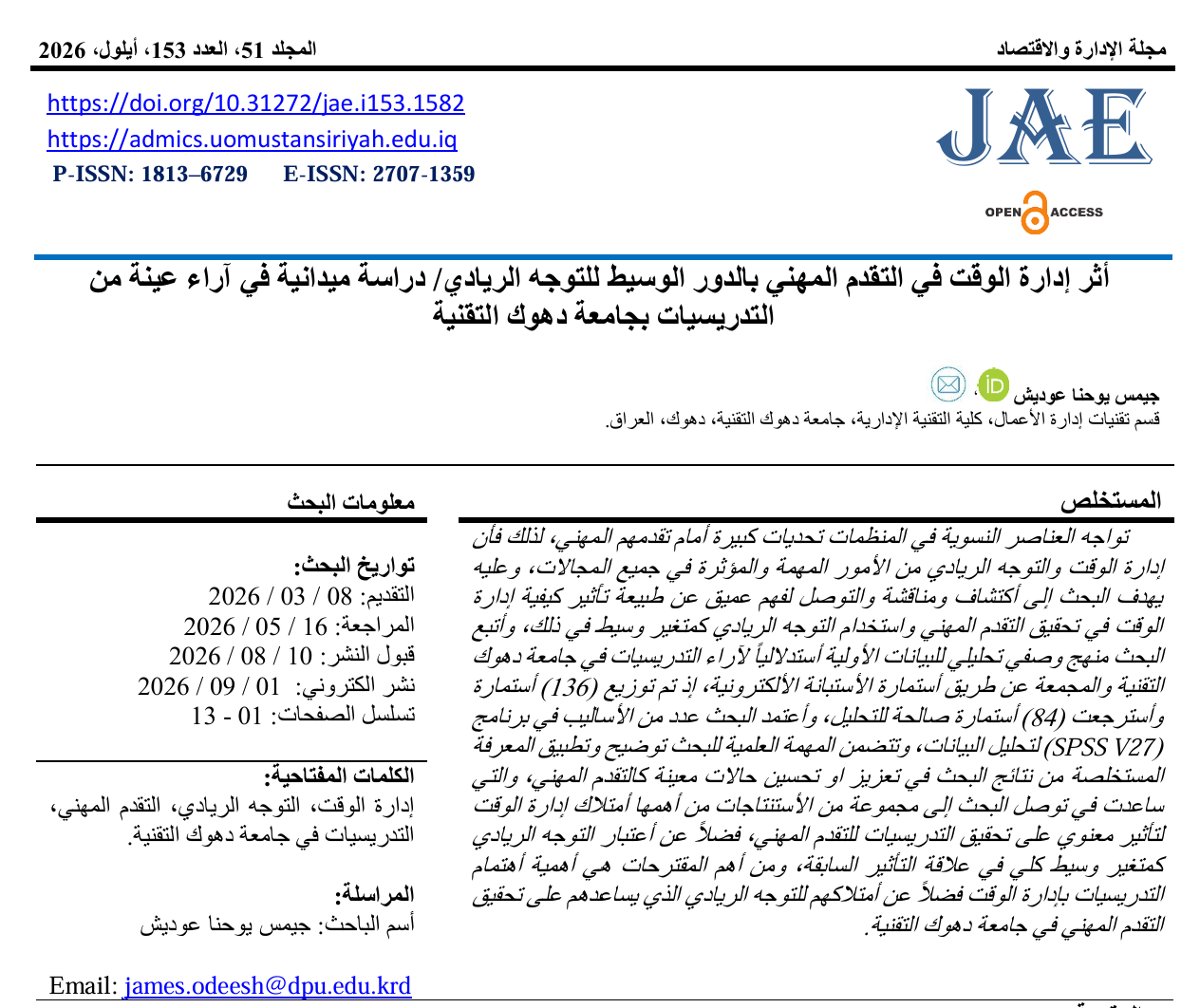
أثر إدارة الوقت في التقدم المهني بالدور الوسيط للتوجه الريادي/ دراسة ميدانية في آراء عينة من التدريسيات بجامعة دهوك التقنية
DOI:
https://doi.org/10.31272/jae.i153.1582الكلمات المفتاحية:
إدارة الوقت، التوجه الريادي ، التقدم المهني، التدريسيات في جامعة دهوك التقنيةالملخص
تواجه العناصر النسوية في المنظمات تحديات كبيرة أمام تقدمهم المهني، لذلك فأن إدارة الوقت والتوجه الريادي من الأمور المهمة والمؤثرة في جميع المجالات، وعليه يهدف البحث إلى أكتشاف ومناقشة والتوصل لفهم عميق عن طبيعة تأثير كيفية إدارة الوقت في تحقيق التقدم المهني واستخدام التوجه الريادي كمتغير وسيط في ذلك، وأتبع البحث منهج وصفي تحليلي للبيانات الأولية أستدلالياً لآراء التدريسيات في جامعة دهوك التقنية والمجمعة عن طريق أستمارة الأستبانة الألكترونية، إذ تم توزيع (136) أستمارة وأسترجعت (84) أستمارة صالحة للتحليل، وأعتمد البحث عدد من الأساليب في برنامج (SPSS V27) لتحليل البيانات، وتتضمن المهمة العلمية للبحث توضيح وتطبيق المعرفة المستخلصة من نتائج البحث في تعزيز او تحسين حالات معينة كالتقدم المهني، والتي ساعدت في توصل البحث إلى مجموعة من الأستنتاجات من أهمها أمتلاك إدارة الوقت لتأثير معنوي على تحقيق التدريسيات للتقدم المهني، فضلاً عن أعتبار التوجه الريادي كمتغير وسيط كلي في علاقة التأثير السابقة، ومن أهم المقترحات هي أهمية أهتمام التدريسيات بإدارة الوقت فضلاً عن أمتلاكهم للتوجه الريادي الذي يساعدهم على تحقيق التقدم المهني في جامعة دهوك التقنية.
التنزيلات
المراجع
[1] Edigide, S. N., Adomi, E. E., & Umukoro, G. (2024). Workload and career advancement of librarians in academic libraries in Delta State, Nigeria. Library and Information Perspectives and Research, 6(2), 16–23. http://doi.org/10.47524/lipr.v6i2.17 DOI: https://doi.org/10.47524/lipr.v6i2.17
[2] Panjaitan, M., Simatupang, S., Silalahi, M., Julyanthry, J., & Simanjuntak, M. D. (2025). Determinants of career development on employee performance. Jurnal Ilmiah Manajemen Kesatuan, 13(3), 1599–1608. https://jurnal.ibik.ac.id/index.php/jimkes/article/view/3180 DOI: https://doi.org/10.37641/jimkes.v13i3.3180
[3] Mardianty, D., & Sari, A. J. (2025). The effect of career development and work motivation on employee performance transportation agency. Jurnal Ilmiah Manajemen Kesatuan, 13(4), 2245–2256. https://jurnal.ibik.ac.id/index.php/jimkes/article/view/3269 DOI: https://doi.org/10.37641/jimkes.v13i4.3269
[4] Al-Jawali, Z.B.k. (2019). The impact of identifying career advancement opportunities on organizational justice. Scientific Journal of Business and Environmental Studies, 10(1), 432-459. https://journals.ekb.eg/article_50433.html
[5] Anwer, B. (2025). Breaking barriers: Exploring gender and sector disparities in professional development and career advancement. Journal of Women Empowerment and Studies, 5(1), 34–46. https://doi.org/10.55529/jwes.51.34.46 DOI: https://doi.org/10.55529/jwes.51.34.46
[6] Nweke, E. O., & Osakwe, M.-A. (2024). Time management and effective teaching in senior public secondary schools in River State. Afropolitan Journals, 15(1), 203–224. https://doi.org/10.62154/78dc6a88 DOI: https://doi.org/10.62154/78dc6a88
[7] Hormiga, E., De Saâ-Pérez, P., Diaz-Diaz, N. L., Ballesteros-Rodríguez, J. L., & Aguiar-Diaz, I. (2017). The influence of entrepreneurial orientation on the performance of academic research groups: The mediating role of knowledge sharing. The Journal of Technology Transfer, 42, 10–32. https://doi.org/10.1007/s10961-015-9463-2 DOI: https://doi.org/10.1007/s10961-015-9463-2
[8] Al-Ghamdi, S.M.A., & Taibah, H.A., (2024), The role of entrepreneurial orientation of educational administrative leaders on the continuous improvement of institutional performance, Arab Journal of Administration, 44(1), 221-236. https://doi.org/10.21608/aja.2023.218469.1472 DOI: https://doi.org/10.21608/aja.2023.218469.1472
[9] Saputri, M., Yarni, L., Putra, D. P., & Syawaluddin. (2024). Students academic procrastination: The effects of time management. BICC Proceeding, 2, 82–90. https://biccproceedings.org/index.php/bicc/article/view/109/50 DOI: https://doi.org/10.30983/bicc.v1i1.109
[10] Nigussie, T. (2019). The effect of time management practice on the academic achievement. European Journal of Business and Management, 11(4), 43–50. https://www.iiste.org/Journals/index.php/EJBM/article/view/46420
[11] Abdul Baqi, A. (2017), Time management -obstacles and solutions. Journal of the Research Unit in Human Resources Development and Management, 8(2), 62-78. https://search.emarefa.net/detail/BIM-859869
[12] Dogan, R. R., Oksoy, G., Almaci, S., Demir, S., & Tabuk, M. E. (2024). The relationship between youth perception of social support in physical activities and leisure time management attitude. International Journal of Sport Culture and Science, 12(2), 112–125. https://dergipark.org.tr/en/pub/intjscs/issue/85547/1394624 DOI: https://doi.org/10.14486/IntJSCS.2024.704
[13] Chaudhari, T. (2022). Time management essentials and importance. International Journal of Commerce and Management Research, 8(5), 6–8. https://www.managejournal.com/archives/2022/vol8/issue5
[14] Şahin, C. Y. (2020). The relationships between time management skill and activity participation among METU members. (Master's thesis), Department of Physical Education and Sport, Middle East Technical University. Ankara, Turkey
[15] Osin, E., & Boniwell, I. (2024). Positive time use: A missing link between time perspective, time management, and well-being. Frontiers in Psychology, 1–17. https://doi.org/10.3389/fpsyg.2024.1087932 DOI: https://doi.org/10.3389/fpsyg.2024.1087932
[16] Khan, M. J., & Ashraf, A. (2020). The effect of time management on the academic performance of students in the higher educational institutions of Islamabad. International Review of Management and Business Research, 9(3), 202–211. https://irmbrjournal.com/paper_details.php?id=946 DOI: https://doi.org/10.30543/9-3(2020)-16
[17] Alzahrani, F.M., & Issaoui, F. (2025), The impact of entrepreneurial orientation of business organizations on sustainable strategic success, Arab Journal for Scientific Publishing, 8(78), 236–265. https://doi.org/10.6007/IJARBSS/v13-i11/19430 DOI: https://doi.org/10.6007/IJARBSS/v13-i11/19430
[18] Ebrahim, M.E.A.E. (2024), The impact of entrepreneurial orientation on organizational success, Journal of the Higher Institute for Qualitative Studies, 4(14), 1403-1462. https://search.mandumah.com/Record/1514411
[19] Wales, W. J., Kraus, S., Filser, M., Stőckmann, C., & Govin, J. G. (2021). The status quo of research on entrepreneurial orientation: Conversational landmarks and theoretical scaffolding. Journal of Business Research, 128, 564–577. https://doi.org/10.1016/j.jbusres.2020.11.036 DOI: https://doi.org/10.1016/j.jbusres.2020.10.046
[20] Nuryakin. (2025). Trend in the literature review of entrepreneurial orientation: A bibliometric analysis. Studies in Business and Economics, 20(1), 163–179. https://doi.org/10.2478/sbe-2025-0009 DOI: https://doi.org/10.2478/sbe-2025-0009
[21] Hahn, D., Civera, A., & Cavallo, A. (2025). Employees’ entrepreneurial orientation in response to exogenous crises: The contingent role of entrepreneurial exposure. The Journal of Technology Transfer, 1–31. https://doi.org/10.1007/s10961-025-10202-0 DOI: https://doi.org/10.1007/s10961-025-10202-0
[22] Foroozanfar, M. H., Wang, W., Rehman, S. U., & Zaid, S. H. A. (2025). Investigating strategic control, independence of managers, organizational policies and subjective career advancement in tourism organizations. Industrial and Commercial Training, 57(3), 259–273. https://doi.org/10.1108/ICT-07-2023-0055 DOI: https://doi.org/10.1108/ICT-07-2023-0055
[23] Mahreen, A., Deng, F., & Ali, Z. (2025). It is never too late: Understanding career shocks–career development nexus from affective events theory. International Journal for Educational and Vocational Guidance, 1–26. https://doi.org/10.1007/s10775-025-09744-4 DOI: https://doi.org/10.1007/s10775-025-09744-4
[24] Al- Dabaa, W.S.A., Sobh, N.M.A., & Al-Nashili, D.H.A.M. (2025), The moderating role of the positive breaking of the organization rules in the relationship between the beliefs of the glass ceiling and women's career advancement, Scientific Journal for Financial and Commercial Studies and Research, 6(2), 522-572. https://search.emarefa.net/detail/BIM-1736413
[25] Nor, N. F. M., Ismail, S. R., & Rashid, N. A. (2024). Factors influencing the career advancement of Malaysian women homepreneurs on the TikTok platform. Information Management and Business Review, 16(3S(a)), 991–998. https://doi.org/10.22610/imbr.v16i3S(I)a.4187 DOI: https://doi.org/10.22610/imbr.v16i3S(I)a.4187
[26] Cheng, T. (2025). The impact of professional education programs on career development. Higher Education Evaluation and Development, 1–14. https://doi.org/10.1108/HEED-10-2024-0046 DOI: https://doi.org/10.1108/HEED-10-2024-0046
[27] Omer, Y. (2024). Impact of gender stereotypes on career advancement in STEM fields in Tanzania. International Journal of Gender Studies, 9(3), 54–64. https://doi.org/10.47604/ijgs.2880 DOI: https://doi.org/10.47604/ijgs.2880
[28] Mishra, A. M., Arora, R., & Ahmad, S. (2025). The impact of training and development on career advancement: A study on aviation sector in India. In Hybrid Intelligent Systems: Real World Applications (Vol. 5). Springer Nature Switzerland. https://doi.org/10.1007/978-3-031-78931-1 DOI: https://doi.org/10.1007/978-3-031-78931-1_22
[29] Liu, J., Yang, J., Liu, Y., Yang, Y., & Zhang, H. F. (2015). A modified career growth scale for Chinese nurses: Validity and reliability. International Journal of Nursing Sciences, 2(1), 80–85. https://doi.org/10.1016/j.ijnss.2015.01.008 DOI: https://doi.org/10.1016/j.ijnss.2015.01.010
التنزيلات
منشور
إصدار
القسم
الرخصة
الحقوق الفكرية (c) 2026 جيمس يوحنا عوديش

هذا العمل مرخص بموجب Creative Commons Attribution 4.0 International License.
مجلة الإدارة والاقتصاد هي مجلة مفتوحة المصدر حيث تكون جميع محتوياتها مجانية. تخضع مقالات هذه المجلة لشروط ترخيص المشاع الإبداعي المنسوب إلى المؤلف (CC-BY 4.0) (https://creativecommons.org/licenses/by/4.0/legalcode) الذي يسمح للمرخص لهم دون قيود بالبحث عن النص الكامل للمقالات أو تنزيله أو مشاركته أو توزيعه أو طباعته أو ربطه به، وفحصه للفهرسة وإعادة إنتاج أي وسيلة للمقالات بشرط أن ينسبوا إلى المؤلفين الفضل في ذلك (الاستشهاد). تسمح المجلة للمؤلفين بالاحتفاظ بحقوق الطبع والنشر لمقالهم المنشور.
. Creative Commons-Attribution (BY)