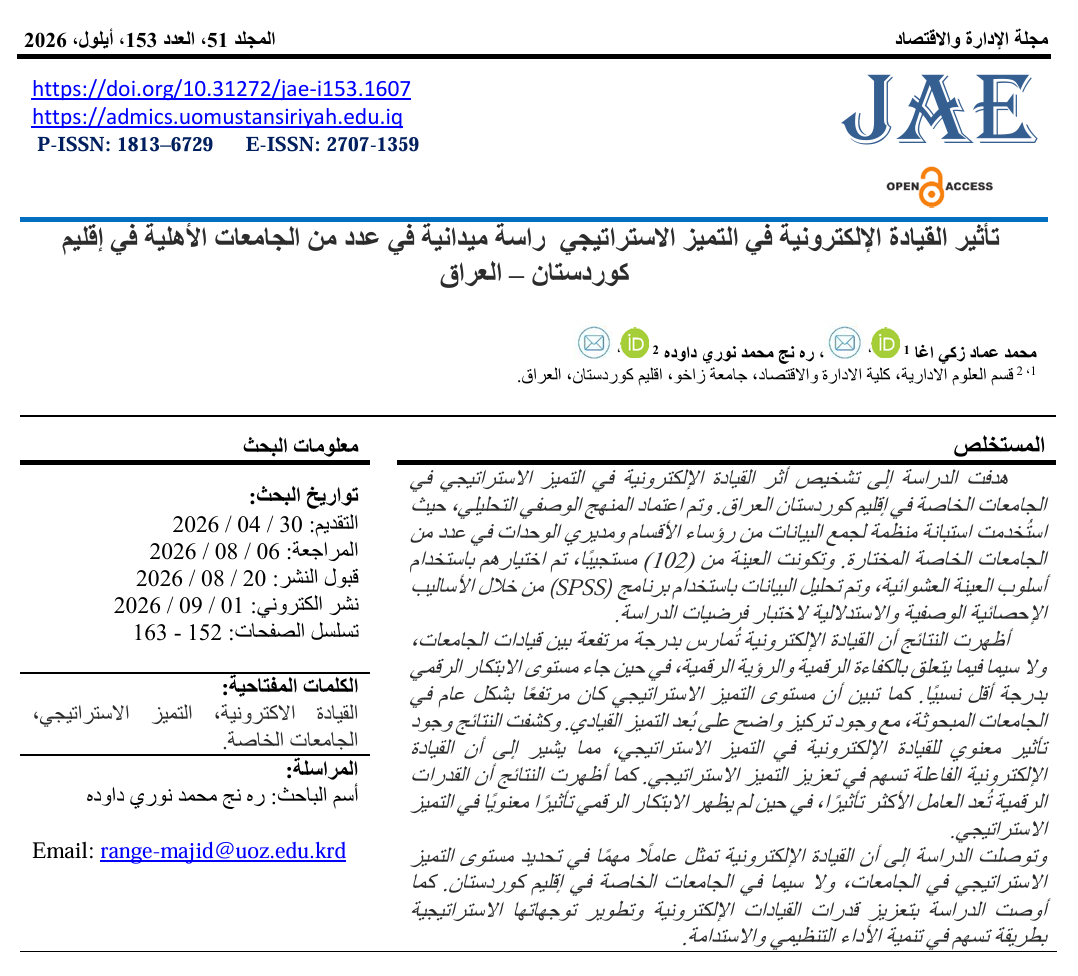
تأثير القيادة الإلكترونية في التميز الاستراتيجي راسة ميدانية في عدد من الجامعات الأهلية في إقليم كوردستان – العراق
DOI:
https://doi.org/10.31272/jae.i153.1607الكلمات المفتاحية:
القيادة الاكترونية، التميز الاستراتيجي، الجامعات الخاصةالملخص
هدفت الدراسة إلى تشخيص أثر القيادة الإلكترونية في التميز الاستراتيجي في الجامعات الخاصة في إقليم كوردستان العراق. وتم اعتماد المنهج الوصفي التحليلي، حيث استُخدمت استبانة منظمة لجمع البيانات من رؤساء الأقسام ومديري الوحدات في عدد من الجامعات الخاصة المختارة. وتكونت العينة من (102) مستجيبًا، تم اختيارهم باستخدام أسلوب العينة العشوائية، وتم تحليل البيانات باستخدام برنامج (SPSS) من خلال الأساليب الإحصائية الوصفية والاستدلالية لاختبار فرضيات الدراسة.أظهرت النتائج أن القيادة الإلكترونية تُمارس بدرجة مرتفعة بين قيادات الجامعات، ولا سيما فيما يتعلق بالكفاءة الرقمية والرؤية الرقمية، في حين جاء مستوى الابتكار الرقمي بدرجة أقل نسبيًا. كما تبين أن مستوى التميز الاستراتيجي كان مرتفعًا بشكل عام في الجامعات المبحوثة، مع وجود تركيز واضح على بُعد التميز القيادي. وكشفت النتائج وجود تأثير معنوي للقيادة الإلكترونية في التميز الاستراتيجي، مما يشير إلى أن القيادة الإلكترونية الفاعلة تسهم في تعزيز التميز الاستراتيجي. كما أظهرت النتائج أن القدرات الرقمية تُعد العامل الأكثر تأثيرًا، في حين لم يظهر الابتكار الرقمي تأثيرًا معنويًا في التميز الاستراتيجي.وتوصلت الدراسة إلى أن القيادة الإلكترونية تمثل عاملًا مهمًا في تحديد مستوى التميز الاستراتيجي في الجامعات، ولا سيما في الجامعات الخاصة في إقليم كوردستان. كما أوصت الدراسة بتعزيز قدرات القيادات الإلكترونية وتطوير توجهاتها الاستراتيجية بطريقة تسهم في تنمية الأداء التنظيمي والاستدامة.
التنزيلات
المراجع
[1] Van Wart, M., Roman, A., Wang, X. H., & Liu, C. (2019). Operationalizing the definition of e-leadership: Identifying the elements of e-leadership. International Review of Administrative Sciences, 85(1), 80–97. https://doi.org/10.1177/0020852316681446 .
[2] Anderson, N., Potocnik, K., & Zhou, J. (2023). Innovation and creativity in organisations: A state-of-the-science review. Journal of Management, 49(1), 1–45. https://doi.org/10.1177/ 01492063221144061.
[3] Field, A. (2018). Discovering statistics using IBM SPSS Statistics (5th ed.). Sage Publications. https://uk.sagepub.com.
[4] Ghasemi, A., & Zahediasl, S. (2012). Normality tests for statistical analysis. International Journal of Endocrinology and Metabolism, 10(2), 486–489. https://doi.org/10.5812/ijem.3505.
[5] Benitez, J., Arenas, Á., Castillo, A., & Esteves, J. (2022). Impact of digital leadership capability on innovation performance: The role of platform digitization capability. Information & Management, 59(2), 103590. https://doi.org/10.1016/j.im.2022.103590.
[6] Goldmann, P., Schäfer, B., & Altendorfer, C. (2025). Development and validation of the digital mindset scale. Journal of Business Research, 199, 115554. https://doi.org/10.1016/j.jbusres.2025.115554.
[7] Hayes, R. H., & Wheelwright, S. C. (1984). Restoring our competitive edge- Wiley.
[8] Hussain, T., Eskildsen, J., Edgeman, R., Ismail, M., Shoukry, A. M., & Gani, S. (2019). Imperatives of sustainable university excellence: A conceptual framework. Sustainability, 11(19), 5242. https://doi.org/10.3390/su11195242 .
[9] Westerman, G., Bonnet, D., & McAfee, A. (2014). Leading digital. Harvard Business Review Press.
[10] Karakose, T., Polat, H., Tülübaş, T., & Demirkol, M. (2024). “A Review of the Conceptual Structure and Evolution of Digital Leadership Research in Education.” Education Sciences, 14(11), 1166. https://doi.org/10.3390/educsci14111166 .
[11] Thompson &Harris (2025). A Narrative Review of Educational Technology in Higher Education, Social science chronicle, Volume – 05, Issue – 01, 01-27 , https://doi.org/10.56106/ssc.2025.002
[12] Stana, R., et al. (2024). E-leadership in hybrid environments. Information Systems Frontiers. https://doi.org/10.48550/arXiv.2409.01056 .
[13] Roodt op ’t, H., Bracht, E. M., van Dick, R., & Hernandez Bark, A. S. (2024). Navigating Through the Digital Workplace: Measuring Leader Digital Competence. Journal of Business and Psychology (2025) 40:179–205
https://doi.org/10.1007/s10869-024-09947-6 .
[14] Kashkoul, H. M., Al-Hamdani, M. M., Al-Shammari, F. M., Al-Haboubi, M. N., & Al-Maliki, N. A. (2024). Digital leadership and its role in enhancing the quality of digital education: An exploratory analytical study at Warith Al-Anbiyaa University and Al-Zahraa University. Journal of Administration and Economics, Al-Mustansiriyah University, 146(49), 1–10. https://doi.org/10.31272/jae-i146.1316.
[15] King, F., et al. (2023), A pragmatic meta-model to navigate complexity in teachers’ professional Learning VOL. 49, NO. 6, 958–977, https://doi.org/10.1080/19415257.2023.2248478
[16] Judijanto, L., Wulan, T. S., Wibowo, O. H., Mitasari, R., & Prasetyo, A. R. (2025). “Integration of Strategic Management and Organizational Culture in Enhancing Corporate Resilience in the Digital Era.” Jurnal Informasi dan Teknologi, 7(2), 161–167. https://doi.org/10.60083/jidt.vi0.680.
[17] Müller, S. D., Konzag, H., Nielsen, J. A., & Sandholt, H. B. (2024). “Digital transformation leadership competencies: A contingency approach.” International Journal of Information Management, 75, 102734. https://doi.org/10.1016/j.ijinfomgt.2023.102734.
[18] Northouse, P. G. (2022). Leadership: Theory and practice (9th ed.). Sage-.
[19] Ogunsola, J. A., Quadri, G. O., & Adigun, O. T. (2026). “The Strategic Role of Higher Education in Promoting Entrepreneurship and Managing Innovation Complexities: A Conceptual Framework Analysis.” Journal of Innovation and Entrepreneurship, 15, 9. https://doi.org/10.1186/s13731-026-00632-x.
[20] Salmerón, R., et al. (2020). Multicollinearity diagnostics in regression. Statistical Methods in Medical Research. https://doi.org/ 10.1177/0962280220910211 .
[21] Saunders, M., Lewis, P., & Thornhill, A. (2019). Research methods for business students. Pearson..
[22] Shakir. Renas Abbabker & Dawoda. Range M. Nori ,2026, The Role of Responsible Leadership in Achieving High-PerformanceRequirements:An Analytical Study of the Opinions of a Sample of Administrative Unit Managers in Private Universities in Kurdistan,Iraq, Journal of Administration and Economics, Mustansiriyah Uni. Vol. 51 No. (151), https://doi.org/10.31272/jae-i151.1517 .
[23] Sndi. Siyaband Qadir Mohammad & Range M. Nori Dawoda , 2025, The Role of Digital Readiness in Adopting Artificial Intelligence Requirements: An Exploratory Study among Administrative Leaders in Private Universities in Kurdistan Iraq, Journal of Administration and Economics, Mustansiriyah Uni ,Vol. (50) No. 149, https://doi.org/10.31272/jae-i149.1410.
[24] Cottafava, D., Cavaglià, G., & Corazza, L. (2021). Sustainable University: From the Worldwide Conception to the Brazilian Amazonia. Sustainability, 13(19), 10875. https://doi.org/10.3390/su131910875 .
[25] Hayes, A. F. (2022). Introduction to Mediation, Moderation, and Conditional Process Analysis: A Regression-Based Approach (3rd ed.). New York, NY: The Guilford Press. ISBN: 9781462549030.
[26] Marcoulides, K. M., & Raykov, T. (2019). “Evaluation of Variance Inflation Factors in Regression Models Using Latent Variable Modeling Methods.” Educational and Psychological Measurement, 79(5), 874–896. https://doi.org/10.1177/0013164418817803
التنزيلات
منشور
إصدار
القسم
الرخصة
الحقوق الفكرية (c) 2026 ره نج محمد نوري داوده، محمد عماد زكي اغا

هذا العمل مرخص بموجب Creative Commons Attribution 4.0 International License.
مجلة الإدارة والاقتصاد هي مجلة مفتوحة المصدر حيث تكون جميع محتوياتها مجانية. تخضع مقالات هذه المجلة لشروط ترخيص المشاع الإبداعي المنسوب إلى المؤلف (CC-BY 4.0) (https://creativecommons.org/licenses/by/4.0/legalcode) الذي يسمح للمرخص لهم دون قيود بالبحث عن النص الكامل للمقالات أو تنزيله أو مشاركته أو توزيعه أو طباعته أو ربطه به، وفحصه للفهرسة وإعادة إنتاج أي وسيلة للمقالات بشرط أن ينسبوا إلى المؤلفين الفضل في ذلك (الاستشهاد). تسمح المجلة للمؤلفين بالاحتفاظ بحقوق الطبع والنشر لمقالهم المنشور.
. Creative Commons-Attribution (BY)