أثر تقنيات الذكاء الاصطناعي في بناء القدرات الإدارية للمديرين وانعكاسها على الأداء المؤسسي
DOI:
https://doi.org/10.31272/jae.i153.1618الكلمات المفتاحية:
تقنيات الذكاء الاصطناعي، القدرات الإدارية، الأداء المؤسسيالملخص
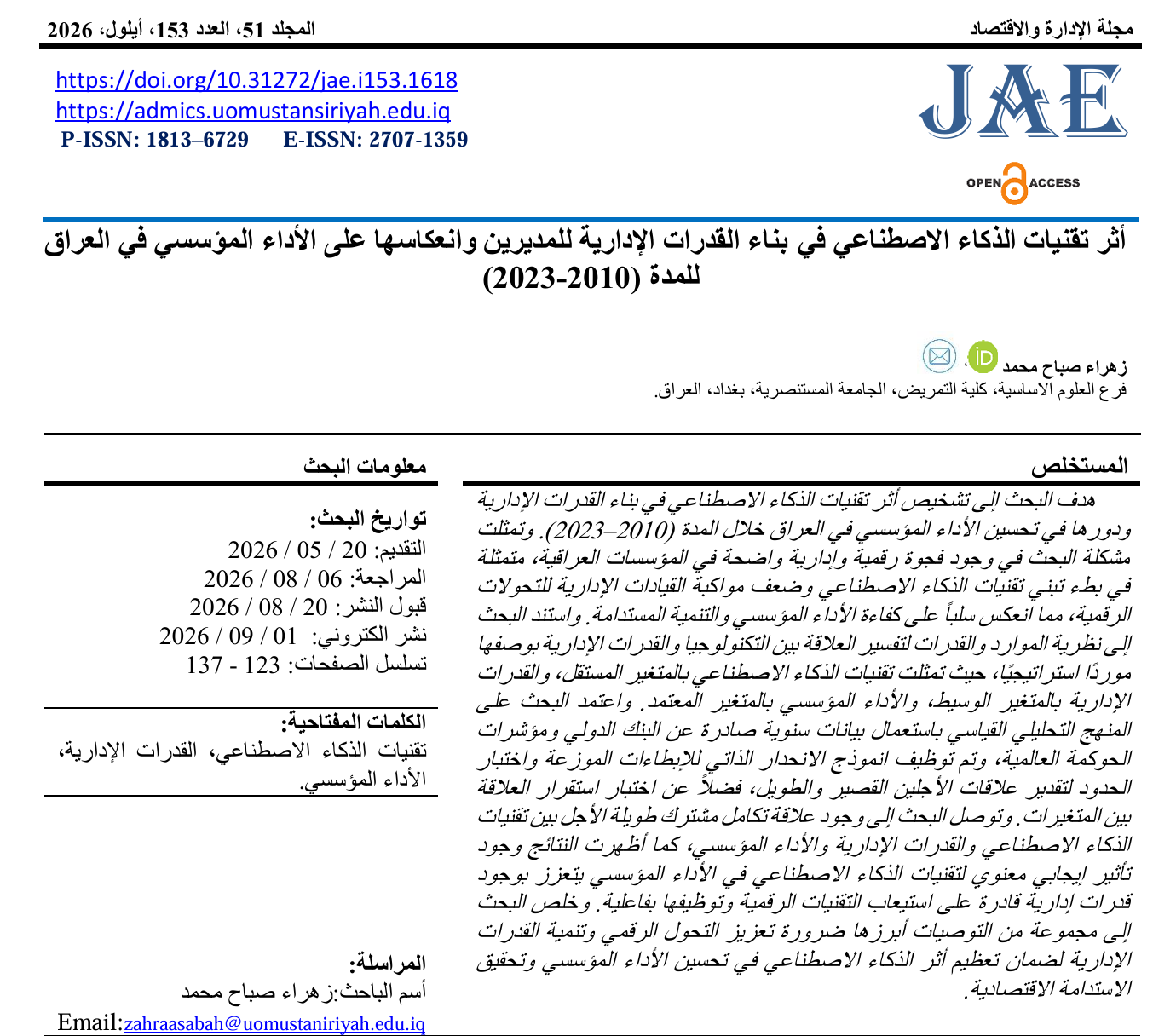
هدف البحث إلى تشخيص أثر تقنيات الذكاء الاصطناعي في بناء القدرات الإدارية ودورها في تحسين الأداء المؤسسي في العراق خلال المدة (2010–2023)
وتمثلت مشكلة البحث في وجود فجوة رقمية وإدارية واضحة في المؤسسات العراقية، متمثلة في بطء تبني تقنيات الذكاء الاصطناعي وضعف مواكبة القيادات الإدارية للتحولات الرقمية، مما انعكس سلباً على كفاءة الأداء المؤسسي والتنمية المستدامة.
واستند البحث إلى نظرية الموارد والقدرات (Resource-Based View) لتفسير العلاقة بين التكنولوجيا والقدرات الإدارية بوصفها موردًا استراتيجيًا يسهم في تحقيق ميزة تنافسية مستدامة. تمثلت تقنيات الذكاء الاصطناعي بالمتغير المستقل، في حين مثلت القدرات الإدارية المتغير الوسيط، بينما عُدَّ الأداء المؤسسي المتغير المعتمد.
اعتمد البحث على المنهج التحليلي القياسي باستخدام بيانات سنوية صادرة عن البنك الدولي ومؤشرات الحوكمة العالمية، وتم توظيف نموذج الانحدار الذاتي للإبطاءات الموزعة (ARDL) واختبار الحدود (Bounds Test) لتحليل علاقات الأجلين القصير والطويل، فضلاً عن اختبار جذر الوحدة ونموذج تصحيح الخطأ (ECM) للتحقق من استقرار العلاقة بين المتغيرات.
توصل البحث إلى وجود علاقة تكامل مشترك طويلة الأجل بين تقنيات الذكاء الاصطناعي والقدرات الإدارية والأداء المؤسسي، كما أظهرت النتائج وجود تأثير إيجابي معنوي لتقنيات الذكاء الاصطناعي في الأداء المؤسسي، ويتعزز هذا التأثير بوجود قدرات إدارية قادرة على استيعاب التقنيات الرقمية وتوظيفها بفاعلية. وقد خلص البحث إلى مجموعة من التوصيات، أبرزها ضرورة تعزيز التحول الرقمي وتنمية القدرات الإدارية لضمان تعظيم أثر الذكاء الاصطناعي في تحسين الأداء المؤسسي وتحقيق الاستدامة الاقتصادية.
التنزيلات
المراجع
[1] Anwar, D., Ramadhan, A., & Saputra, H. (2025). Artificial intelligence and ICT in enhancing economic and productivity indicators for smart cities. Edu-Tech Enterprise, 3(1), 12–28.
[2] Tian, X. (2024). Artificial intelligence adoption and corporate performance: Evidence from emerging markets. Business Strategy and the Environment, 33(3), 1420–1435. https://doi.org/10.1002/bse.3556
[3] Bag, S., Wood, L. C., & Khan, Z. (2024). Artificial intelligence technologies and organizational performance: The moderating role of environmental dynamism. International Journal of Production Economics, 268, Article 109122. https://doi.org/10.1016/j.ijpe.2023.109122
[4] Kassa, B., & Worku, A. (2025). The mediating role of employee productivity in the relationship between AI adoption and institutional performance. African Journal of Management, 11(1), 54–73.
[5] Elbashir, M. Z., & Collier, P. A. (2023). The efficacy of decision support systems in resource allocation and organizational performance. International Journal of Accounting Information Systems, 49, Article 100609. https://doi.org/10.1016/j.ijaccinf.2023.100609
[6] Gyau, A., Kusi-Appiah, E., & Owusu, R. (2024). Empowering dynamic capabilities through artificial intelligence adoption: A strategic perspective. Journal of Business & Industrial Marketing, 39(4), 781–796. https://doi.org/10.1108/JBIM-03-2023-0145
[7] Mikalef, P., Conboy, K., & Krogstie, J. (2023). Artificial intelligence as an enabler of organizational agility and competitive advantage: An empirical study. Information & Management, 60(2), Article 103719. https://doi.org/10.1016/j.im.2022.103719
[8] Hasan, M., & Hussein, A. (2023). Artificial intelligence as a lever for organizational capabilities and strategic analysis. Journal of Strategic Management, 18(2), 114–130.
[9] Alsheibani, S., Cheung, C., & Messom, C. (2024). Re-evaluating artificial intelligence capabilities: A dynamic capabilities perspective on institutional value creation. Journal of Enterprise Information Management, 37(2), 310–332. https://doi.org/10.1108/JEIM-02-2022-0057
[10] Cronjé, J. (2024). Digital transformation and leadership: Cultivating digital skills for the integration of smart systems in organizations. South African Journal of Business Management, 55(1), 45–59. https://doi.org/10.4102/sajbm.v55i1.4111
[11] Wamba, S. F., Bawack, R. E., & Guthrie, C. (2023). Are we preparing for the automation age? The role of digital skills in leveraging big data analytics capabilities. Journal of Business Research, 156, Article 113428. https://doi.org/10.1016/j.jbusres.2022.113428
[12] Dwivedi, Y. K., Kshetri, N., Hughes, L., & Ribeiro-Navarrete, S. (2023). So what if AI can write an essay? Anticipating the future of artificial intelligence in organizations and management. International Journal of Information Management, 71, Article 102642. https://doi.org/10.1016/j.ijinfomgt.2023.102642
[13] Nuseir, M. T., & Refae, G. A. (2022). The effect of digital leadership and digital skills on institutional performance in the post-pandemic era. Journal of High Technology Management Research, 33(2), Article 100441. https://doi.org/10.1016/j.hitech.2022.100441
[14] Al-Azzawi, S., & Obaid, H. (2023). Dawr al-hulul al-dhakiyyah fi raf' kafa'at al-ada' fi al-mu'assasat al-'ammah: Dirasah tahlyliyyah li-tahaddiyat al-jahiziyyah al-raqmiyyah [The role of smart solutions in enhancing performance efficiency in public institutions: An analytical study of digital readiness challenges]. Journal of Administrative and Economic Sciences, 29(115), 89–112.
[15] Organisation for Economic Co-operation and Development. (2024). Artificial intelligence in the public sector: Building capacity for effective governance. OECD Publishing. https://www.oecd.org
[16] Kaplan, A., & Haenlein, M. (2019). Siri, Siri, in my hand: Who’s the fairest in the land? On the interpretations, illustrations, and implications of artificial intelligence. Business Horizons, 62(1), 15–25. https://doi.org/10.1016/j.bushor.2018.08.004
[17] Mikalef, P., Gupta, M., Krogstie, J., Pappas, I. O., & Pavlou, P. (2024). Artificial intelligence capability and firm performance: A sustainable perspective. Information Systems Frontiers, 26(2), 523–541. https://doi.org/10.1007/s10796-023-10460-z
[18] Russell, S., & Norvig, P. (2021). Artificial intelligence: A modern approach (4th ed.). Pearson.
[19] Makki, O. (2024). The role of data analysis in enhancing strategic decisions and economic forecasting. Kirkuk Journal of Administrative and Economic Sciences, 14(2), 88–105.
[20] Al-Anat, O. F., & Al-Khazraji, A. W. (2024). The role of intelligent decision support systems based on artificial intelligence technology in improving the quality of strategic decisions: An exploratory study in a sample of Iraqi business organizations. Journal of Management and Economics, 47(141), 112–129.
[21] Al-Himyari, A. B. (2025). The role of artificial intelligence in automating administrative and accounting processes to enhance performance and efficiency in institutions. Journal of Economic Research and Studies, 19(1), 142–159.
[22] Marr, B. (2025). Artificial intelligence in business: Practical applications for strategic management. Kogan Page.
[23] Al-Zubaidi, G. R., & Al-Sairafi, M. A. H. (2024). The role of deep learning techniques in analyzing credit risks and customer behavior: An analytical study. Iraqi Journal of Administrative Sciences, 20(78), 115–138.
[24] Al-Saidi, H. M. (2024). The impact of natural language processing techniques on analyzing administrative documents and financial reports and extracting information in banking institutions. Journal of Economic and Administrative Sciences, 30(138), 42–59.
[25] Al-Tamimi, R. J., & Al-Jubouri, O. A. (2024). Applications of computer vision as a dimension of artificial intelligence in operational control and total quality management: An empirical study in Iraqi industrial companies. Baghdad Journal of Economic Sciences University, 21(66), 185–202.
[26] Al-Rubaei, M. H. (2024). The role of predictive analysis based on artificial intelligence in evaluating strategic performance and forecasting demand volume in the contemporary business environment. Al-Muthanna Journal of Administrative and Economic Sciences, 14(3), 91–108.
[27] Al-Khafaji, H. A., & Al-Taee, Y. H. (2024). The role of machine learning techniques in enhancing the analytical capabilities of managers and its impact on the rationality of strategic decisions: An exploratory study. Al-Ghari Journal of Economic and Administrative Sciences, 20(3), 115–134.
[28] Badawi, M. A. (2024). Predictive analysis based on artificial intelligence and its impact on activating strategic planning and achieving organizational flexibility in business organizations. Arab Journal of Administration, 44(2), 189–208.
[29] Barney, J. (1991). Firm resources and sustained competitive advantage. Journal of Management, 17(1), 99–120. https://doi.org/10.1177/014920639101700108
[30] Abu Sen, A. I. (2024). The impact of artificial intelligence systems on enhancing managerial dynamic capabilities and its role as a mediating path to improve institutional performance in complex business environments. Arab Journal of Administration, 44(3), 215–236.
التنزيلات
منشور
إصدار
القسم
الرخصة
الحقوق الفكرية (c) 2026 زهراء صباح محمد

هذا العمل مرخص بموجب Creative Commons Attribution 4.0 International License.
مجلة الإدارة والاقتصاد هي مجلة مفتوحة المصدر حيث تكون جميع محتوياتها مجانية. تخضع مقالات هذه المجلة لشروط ترخيص المشاع الإبداعي المنسوب إلى المؤلف (CC-BY 4.0) (https://creativecommons.org/licenses/by/4.0/legalcode) الذي يسمح للمرخص لهم دون قيود بالبحث عن النص الكامل للمقالات أو تنزيله أو مشاركته أو توزيعه أو طباعته أو ربطه به، وفحصه للفهرسة وإعادة إنتاج أي وسيلة للمقالات بشرط أن ينسبوا إلى المؤلفين الفضل في ذلك (الاستشهاد). تسمح المجلة للمؤلفين بالاحتفاظ بحقوق الطبع والنشر لمقالهم المنشور.
. Creative Commons-Attribution (BY)