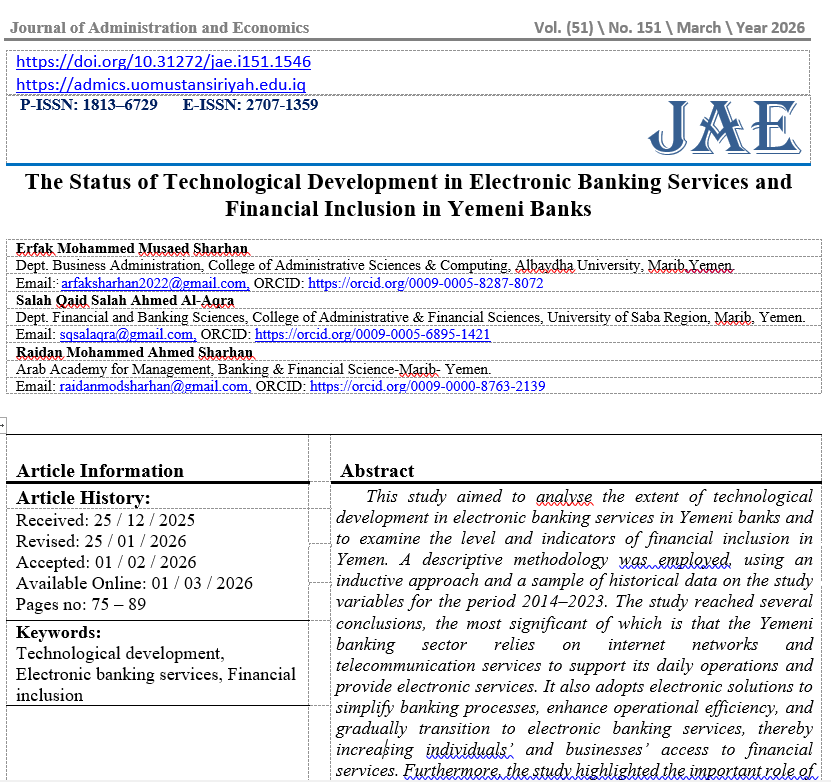
The Status of Technological Development in Electronic Banking Services and Financial Inclusion in Yemeni Banks
DOI:
https://doi.org/10.31272/jae.i151.1546Keywords:
Technological development, Electronic banking services, Financial inclusionAbstract
This study aimed to analyse the extent of technological development in electronic banking services in Yemeni banks and to examine the level and indicators of financial inclusion in Yemen. A descriptive methodology was employed, using an inductive approach and a sample of historical data on the study variables for the period 2014–2023. The study reached several conclusions, the most significant of which is that the Yemeni banking sector relies on internet networks and telecommunication services to support its daily operations and provide electronic services. It also adopts electronic solutions to simplify banking processes, enhance operational efficiency, and gradually transition to electronic banking services, thereby increasing individuals’ and businesses’ access to financial services. Furthermore, the study highlighted the important role of the Central Bank of Yemen in keeping pace with the technological development of electronic banking services by working to strengthen the country’s financial infrastructure, facilitating banking services, establishing regulatory and legislative frameworks to ensure a secure and reliable environment for the provision of such services, and making efforts to improve financial inclusion in Yemen.
Downloads
References
1 Al‑Asadi, N. A. (2024) The impact of electronic payment means on enhancing financial inclusion: An applied study in the Iraqi banking sector. Afro‑Asian Journal of Scientific Research, 2(1), 89–99.
https://doi.org/10.5281/zenodo.10891461
2 Yalees Chaouche, A., & Sid Amar, Z. (2023). Digital banking services and their role in enhancing financial inclusion in the Middle East and North Africa region. Journal of Economic Integration (Algeria), 11(2), 57-72. Retrieved from https://www.asjp.cerist.dz/en/article/220222
3 Kamel, Y., Saad; M.; & Faiza I. (2023). The effectiveness of electronic payment systems in enhancing financial inclusion: An analytical study on a sample of Iraqi banks. Journal of Sustainable Studies, 5(4), 1–24.
4 Kurdousi, M; Wasiya S., (2023). Financial technology as a means to enhance financial inclusion in the post‑COVID‑19 era. Journal of New Economy, 14(2), 356–374. https://doi.org/10.29141/2658-5081-2023-24-2-1 DOI: https://doi.org/10.29141/2658-5081-2023-24-2-1
5 Karim, H., M.; Mustafa S., Abdul‑Reda; & Qusay,. A., D. (2023). Financial technology innovations and their role in promoting the concept of financial inclusion in light of the COVID-19 pandemic: An exploratory study of a sample of customers of Egypt Bank and Al-Taif Islamic Bank in Baghdad. Warith Scientific Journal, Iraq, 5(5). https://doi.org/10.51520/2706-6207.1352
6 Najjar, H. (2023). Developing electronic banking services as a requirement to enhance financial inclusion: The case of Algeria. Journal of Finance and Business Economics, 7(4), 98–113. https://asjp.cerist.dz/en/article/239638
7 Al‑Awsh, A., Y. (2023). The extent of applying dimensions of financial inclusion in Yemeni banks: A field study on clients of Yemeni banks in Hadhramaut Governorate. University of Aden Journal of Humanities and Social Sciences, 4(4), 652-663. https://doi.org/10.48129/kadenhss.v4i4.2001
8 Mustafa., M. I.; Ibrahim., S. A.; & Hussein., A. S. (2022). The effect of offering electronic banking products on indicators of financial inclusion amid the COVID‑19 pandemic for the period 2010–2020. Al‑Tirath University College Journal, (34), 477–486. https://search.emarefa.net/detail/BIM-1407295
9 Abdul Salam., A. K., S; & Asim., H. M. (2022). The role of financial inclusion in enhancing the quality of electronic banking services in Sudanese banks. Journal of Economic, Administrative, and Legal Sciences, 6(22), 37–56. https://doi.org/10.26389/AJSRP.S100522 DOI: https://doi.org/10.26389/AJSRP.L090622
10 Hajila., M; & Ismail., T (2022). The contribution of electronic banking transactions to enhancing financial inclusion in Algeria. Algerian Journal of Economy and Finance, 9(1), 7–22. https://asjp.cerist.dz/en/article
11 Salah Al‑Din,. M., A.; Aysar., R., A., A. (2021). The impact of electronic banking services on indicators measuring financial inclusion: An analytical study in the Iraqi banking system. Dinar Journal, 1(21), 457–486. https://www.iasj.net
12 Al‑Khazraji., F. (2020). The extent of using electronic banking services and their impact on financial inclusion in Iraq. Journal of Baghdad College of Economic Sciences, 257–271. https://search.emarefa.net
13 Mustafa., S., Mohammed., M., J; & Haider., M,. K. (2020). The role of financial technology in promoting financial inclusion, Iraq. Warith Journal of Scientific Research, 2, 151–160. https://doi.org/10.5281/zenodo.4316934
14 Hamo., M; Zidan., M. (2016). Managing banking technology to improve banks’ competitiveness, with reference to Algerian banks. Academy for Social and Human Studies, (16), 85–96. https://www.asjp.cerist.dz
15 Harfoush, S. (2019). Financial technology: A promising industry in the Arab world. Afak Ilmiyya Journal, 11 (3) ، 724-744 https://asjp.cerist.dz/en/article/96371
16 Ramzi., T. (2023). Financial technology as a modern direction to improve electronic banking services – An analytical study of the UAE and Saudi Arabia experience with reference to the case of Algeria. Al‑Afāq for Economic Studies, 8(1), 530–551. DOI: https://doi.org/10.5281/zenodo.7611843
17 Al‑Jiyusi., S & Al‑Samid‘i., M. (2009). Marketing financial services Amman, Jordan: Dar Wael Publishing.
18 Ritesh R. (2024) The Evolution of Digital Banking: Impacts on Traditional Financial Institutions, International Journal of Progressive Research In Engineering Management And Science (Ljprems), 4(9), 753-763 https://www.doi.org/10.58257/IJPREMS33842
19 Al-Husseini, M., G, & Al-Shafaei, M., M. (2024). Digitalization of Banking Operations and Its Role in Enhancing Financial Inclusion: A Study of a Sample of Commercial Banks in Iraq for the Period 2017–2022. Al-Ghary Journal of Economic and Administrative Sciences, Vol. 20, Special Issue. 2129–2159, with reference to the Digital Banking Services Report (2023): The Role of social media in Banks https://www.digitalbankingreport.com DOI: https://doi.org/10.36325/ghjec.v20i00.17114
20 USAID. (n.d.). Modernizing Money in Yemen. https://www.usaid.gov/yemen/news/modernizing-money-yemen
[21] Central Bank of Yemen. (2024, April 27). Central Bank Governor calls for financial inclusion that enhances sustainable development. Retrieved from https://cby-ye.com/news/669
[22] International Growth Centre (IGC). (2023). Reforming Yemen's telecommunications sector: Policy options for improving private sector participation. Retrieved from https://www.theigc.org
[23] World Bank. (2023). Global Financial Inclusion Database (Global Findex) – Republic of Yemen Data. Retrieved from https://microdata.worldbank.org
[24] Ministry of Telecommunications and Information Technology. (2021). Telecommunications and Information Technology Indicators Report. Sana'a, Republic of Yemen. Retrieved from https://mtit.gov.ye
25 Al-Ajam, A. S., & Nor, K. M. (2013). Adoption of Internet Banking by Yemeni Consummers: An Empirical Investigation. Australian Journal of Basic and Applied Sciences2013, 7(2). 182-189. https://www.ajbasweb.com
26 Sana’a Center for Strategic Studies. (2022). Challenges and Prospects of Electronic Money and Payment Systems in Yemen. Sana’a, Yemen. https://sanaacenter.org
27 Arab Monetary Fund (AMF). (2015). Requirements for adopting a comprehensive national strategy to enhance financial inclusion in Arab countries. Regional Working Group on Financial Inclusion in Arab Countries, Abu Dhabi, UAE.
28 Arab Monetary Fund. (2020). Financial Inclusion (Targeted at the youth age group in the Arab world. Edited by Hanan Al-Tayyib. Abu Dhabi, United Arab Emirates: Arab Monetary Fund. https://www.amf.org.
Downloads
Published
Issue
Section
License
Copyright (c) 2026 Arfaq Mohammed Mosaad Sharhan, Saleh Qaid Saleh Ahmed Al-Aqra, & Raydan Mohammed Ahmed Sharhan

This work is licensed under a Creative Commons Attribution 4.0 International License.
The journal of Administration and Economics is an open- access journal that all contents are free of charge. Articles of this journal are licensed under the terms of the Creative Commons Attribution International Public License CC-BY 4.0 (https://creativecommons.org/licenses/by/4.0/legalcode) that licensees are unrestrictly allowedto search, download, share, distribute, print, or link to the full text of the articles, crawl them for indexing and reproduce any medium of the articles provided that they give the author(s) proper credits (citation). The journal allows the author(s) to retain the copyright of their published article.
Creative Commons-Attribution (BY)