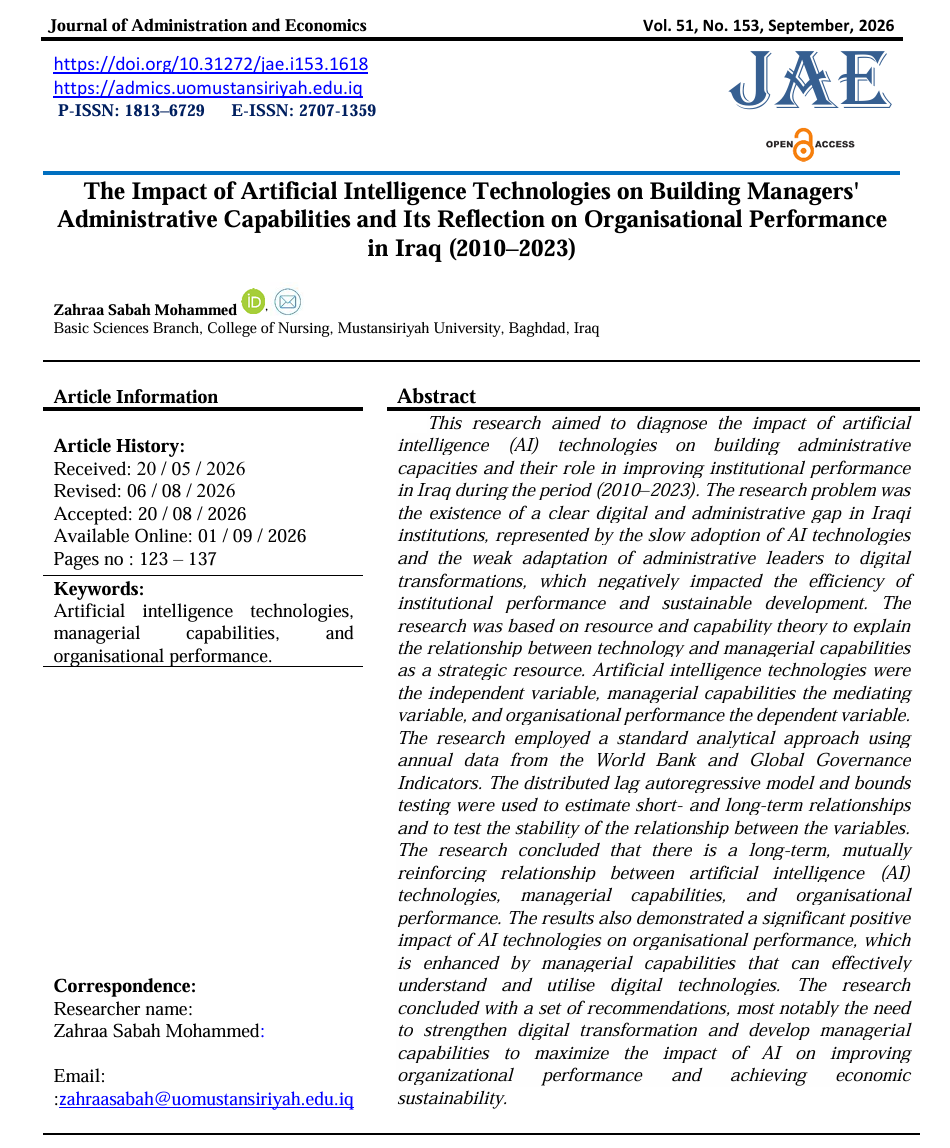
The impact of artificial intelligence technologies on building the managerial capabilities of managers and its reflection on institutional performance
DOI:
https://doi.org/10.31272/jae.i153.1618Keywords:
Artificial intelligence technologies, managerial capabilities, institutional performanceAbstract
The research aimed to diagnose the impact of artificial intelligence techniques in building administrative capabilities and their role in improving institutional performance in Iraq during the period (2010-2023)
The problem of the research was the presence of a clear digital and administrative gap in Iraqi institutions, represented by the slow adoption of artificial intelligence technologies and the weakness of administrative leadership in keeping up with digital transformations, which negatively affected the efficiency of institutional performance and sustainable development.
The research was based on the Resource-Based View to explain the relationship between technology and administrative capabilities as a strategic resource that contributes to achieving a sustainable competitive advantage. Artificial intelligence technologies represented the independent variable, while administrative capabilities represented the mediating variable, while institutional performance was the dependent variable.
The research relied on the standard analytical approach using annual data issued by the World Bank and global governance indicators. The autoregressive distributed lags (ARDL) model and the Bounds Test were employed to analyze short- and long-term relationships, as well as the unit root test and the error correction model (ECM) to verify the stability of the relationship between variables.
The research found that there is a long-term co-integration relationship between artificial intelligence technologies, administrative capabilities, and institutional performance. The results also showed that there is a significant positive effect of artificial intelligence technologies on institutional performance, and this effect is enhanced by the presence of administrative capabilities capable of absorbing digital technologies and employing them effectively. The research concluded with a set of recommendations, most notably the need to enhance digital transformation and develop administrative capabilities to ensure maximizing the impact of artificial intelligence in improving institutional performance and achieving economic sustainability.
Downloads
References
[1] Anwar, D., Ramadhan, A., & Saputra, H. (2025). Artificial intelligence and ICT in enhancing economic and productivity indicators for smart cities. Edu-Tech Enterprise, 3(1), 12–28.
[2] Tian, X. (2024). Artificial intelligence adoption and corporate performance: Evidence from emerging markets. Business Strategy and the Environment, 33(3), 1420–1435. https://doi.org/10.1002/bse.3556
[3] Bag, S., Wood, L. C., & Khan, Z. (2024). Artificial intelligence technologies and organizational performance: The moderating role of environmental dynamism. International Journal of Production Economics, 268, Article 109122. https://doi.org/10.1016/j.ijpe.2023.109122
[4] Kassa, B., & Worku, A. (2025). The mediating role of employee productivity in the relationship between AI adoption and institutional performance. African Journal of Management, 11(1), 54–73.
[5] Elbashir, M. Z., & Collier, P. A. (2023). The efficacy of decision support systems in resource allocation and organizational performance. International Journal of Accounting Information Systems, 49, Article 100609. https://doi.org/10.1016/j.ijaccinf.2023.100609
[6] Gyau, A., Kusi-Appiah, E., & Owusu, R. (2024). Empowering dynamic capabilities through artificial intelligence adoption: A strategic perspective. Journal of Business & Industrial Marketing, 39(4), 781–796. https://doi.org/10.1108/JBIM-03-2023-0145
[7] Mikalef, P., Conboy, K., & Krogstie, J. (2023). Artificial intelligence as an enabler of organizational agility and competitive advantage: An empirical study. Information & Management, 60(2), Article 103719. https://doi.org/10.1016/j.im.2022.103719
[8] Hasan, M., & Hussein, A. (2023). Artificial intelligence as a lever for organizational capabilities and strategic analysis. Journal of Strategic Management, 18(2), 114–130.
[9] Alsheibani, S., Cheung, C., & Messom, C. (2024). Re-evaluating artificial intelligence capabilities: A dynamic capabilities perspective on institutional value creation. Journal of Enterprise Information Management, 37(2), 310–332. https://doi.org/10.1108/JEIM-02-2022-0057
[10] Cronjé, J. (2024). Digital transformation and leadership: Cultivating digital skills for the integration of smart systems in organizations. South African Journal of Business Management, 55(1), 45–59. https://doi.org/10.4102/sajbm.v55i1.4111
[11] Wamba, S. F., Bawack, R. E., & Guthrie, C. (2023). Are we preparing for the automation age? The role of digital skills in leveraging big data analytics capabilities. Journal of Business Research, 156, Article 113428. https://doi.org/10.1016/j.jbusres.2022.113428
[12] Dwivedi, Y. K., Kshetri, N., Hughes, L., & Ribeiro-Navarrete, S. (2023). So what if AI can write an essay? Anticipating the future of artificial intelligence in organizations and management. International Journal of Information Management, 71, Article 102642. https://doi.org/10.1016/j.ijinfomgt.2023.102642
[13] Nuseir, M. T., & Refae, G. A. (2022). The effect of digital leadership and digital skills on institutional performance in the post-pandemic era. Journal of High Technology Management Research, 33(2), Article 100441. https://doi.org/10.1016/j.hitech.2022.100441
[14] Al-Azzawi, S., & Obaid, H. (2023). Dawr al-hulul al-dhakiyyah fi raf' kafa'at al-ada' fi al-mu'assasat al-'ammah: Dirasah tahlyliyyah li-tahaddiyat al-jahiziyyah al-raqmiyyah [The role of smart solutions in enhancing performance efficiency in public institutions: An analytical study of digital readiness challenges]. Journal of Administrative and Economic Sciences, 29(115), 89–112.
[15] Organisation for Economic Co-operation and Development. (2024). Artificial intelligence in the public sector: Building capacity for effective governance. OECD Publishing. https://www.oecd.org
[16] Kaplan, A., & Haenlein, M. (2019). Siri, Siri, in my hand: Who’s the fairest in the land? On the interpretations, illustrations, and implications of artificial intelligence. Business Horizons, 62(1), 15–25. https://doi.org/10.1016/j.bushor.2018.08.004
[17] Mikalef, P., Gupta, M., Krogstie, J., Pappas, I. O., & Pavlou, P. (2024). Artificial intelligence capability and firm performance: A sustainable perspective. Information Systems Frontiers, 26(2), 523–541. https://doi.org/10.1007/s10796-023-10460-z
[18] Russell, S., & Norvig, P. (2021). Artificial intelligence: A modern approach (4th ed.). Pearson.
[19] Makki, O. (2024). The role of data analysis in enhancing strategic decisions and economic forecasting. Kirkuk Journal of Administrative and Economic Sciences, 14(2), 88–105.
[20] Al-Anat, O. F., & Al-Khazraji, A. W. (2024). The role of intelligent decision support systems based on artificial intelligence technology in improving the quality of strategic decisions: An exploratory study in a sample of Iraqi business organizations. Journal of Management and Economics, 47(141), 112–129.
[21] Al-Himyari, A. B. (2025). The role of artificial intelligence in automating administrative and accounting processes to enhance performance and efficiency in institutions. Journal of Economic Research and Studies, 19(1), 142–159.
[22] Marr, B. (2025). Artificial intelligence in business: Practical applications for strategic management. Kogan Page.
[23] Al-Zubaidi, G. R., & Al-Sairafi, M. A. H. (2024). The role of deep learning techniques in analyzing credit risks and customer behavior: An analytical study. Iraqi Journal of Administrative Sciences, 20(78), 115–138.
[24] Al-Saidi, H. M. (2024). The impact of natural language processing techniques on analyzing administrative documents and financial reports and extracting information in banking institutions. Journal of Economic and Administrative Sciences, 30(138), 42–59.
[25] Al-Tamimi, R. J., & Al-Jubouri, O. A. (2024). Applications of computer vision as a dimension of artificial intelligence in operational control and total quality management: An empirical study in Iraqi industrial companies. Baghdad Journal of Economic Sciences University, 21(66), 185–202.
[26] Al-Rubaei, M. H. (2024). The role of predictive analysis based on artificial intelligence in evaluating strategic performance and forecasting demand volume in the contemporary business environment. Al-Muthanna Journal of Administrative and Economic Sciences, 14(3), 91–108.
[27] Al-Khafaji, H. A., & Al-Taee, Y. H. (2024). The role of machine learning techniques in enhancing the analytical capabilities of managers and its impact on the rationality of strategic decisions: An exploratory study. Al-Ghari Journal of Economic and Administrative Sciences, 20(3), 115–134.
[28] Badawi, M. A. (2024). Predictive analysis based on artificial intelligence and its impact on activating strategic planning and achieving organizational flexibility in business organizations. Arab Journal of Administration, 44(2), 189–208.
[29] Barney, J. (1991). Firm resources and sustained competitive advantage. Journal of Management, 17(1), 99–120. https://doi.org/10.1177/014920639101700108
[30] Abu Sen, A. I. (2024). The impact of artificial intelligence systems on enhancing managerial dynamic capabilities and its role as a mediating path to improve institutional performance in complex business environments. Arab Journal of Administration, 44(3), 215–236.
Downloads
Published
Issue
Section
License
Copyright (c) 2026 Zahraa Sabah Mohammed

This work is licensed under a Creative Commons Attribution 4.0 International License.
The journal of Administration and Economics is an open- access journal that all contents are free of charge. Articles of this journal are licensed under the terms of the Creative Commons Attribution International Public License CC-BY 4.0 (https://creativecommons.org/licenses/by/4.0/legalcode) that licensees are unrestrictly allowedto search, download, share, distribute, print, or link to the full text of the articles, crawl them for indexing and reproduce any medium of the articles provided that they give the author(s) proper credits (citation). The journal allows the author(s) to retain the copyright of their published article.
Creative Commons-Attribution (BY)