تحليل ابعاد ظاهرة تأكل راس المال البشري في العراق بعد عام 2003
DOI:
https://doi.org/10.31272/jae.i146.1343الكلمات المفتاحية:
راس المال البشري، التأكل، الهدر، السياسة الاقتصادية، الانفاق الصحي، الانفاق لتعليمي، الانفاق العسكريالملخص
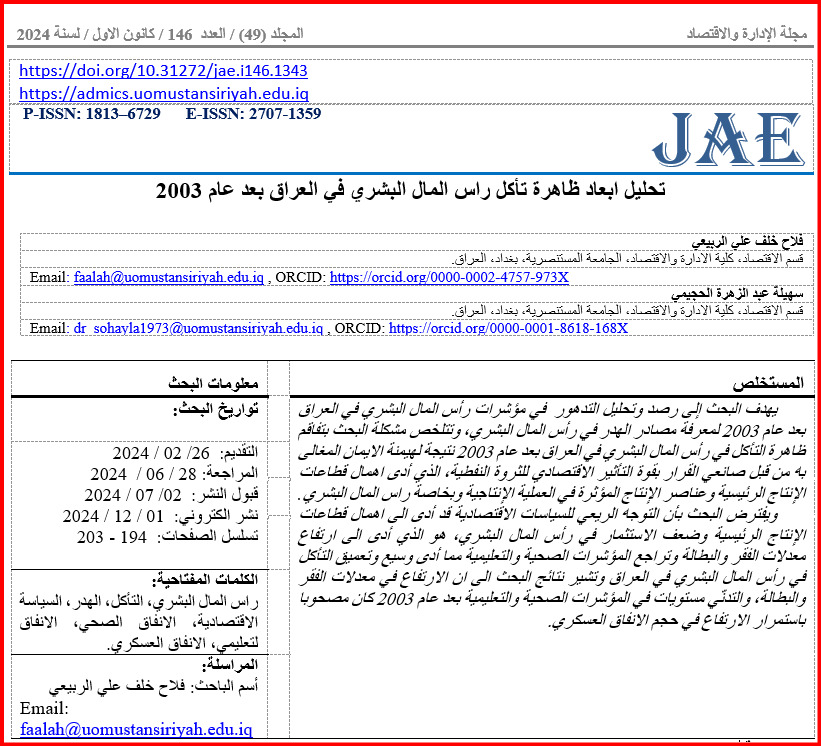
يهدف البحث إلى رصد وتحليل التدهور في مؤشرات رأس المال البشري في العراق بعد عام 2003 لمعرفة مصادر الهدر في رأس المال البشري. وتتلخص مشكلة البحث بتفاقم ظاهرة التأكل في رأس المال البشري في العراق بعد عام 2003 نتيجة لهيمنة الايمان المغالى به من قبل صانعي القرار بقوة التأثير الاقتصادي للثروة النفطية، الذي أدى اهمال قطاعات الإنتاج الرئيسية وعناصر الإنتاج المؤثرة في العملية الإنتاجية وبخاصة راس المال البشري. ويفترض البحث بأن التوجه الريعي للسياسات الاقتصادية قد أدى الى اهمال قطاعات الإنتاج الرئيسية وضعف الاستثمار في رأس المال البشري، هو الذي أدى الى ارتفاع معدلات الفقر والبطالة وتراجع المؤشرات الصحية والتعليمية مما أدى وسيع وتعميق التأكل في رأس المال البشري في العراق وتشير نتائج البحث الى ان الارتفاع في معدلات الفقر والبطالة، والتدنّي مستويات في المؤشرات الصحية والتعليمية بعد عام 2003 كان مصحوبا باستمرار الارتفاع في حجم الانفاق العسكري
التنزيلات
المراجع
[1] Ali Hussein Mohammed, Nidal Shaker Jawda, "The Impact of Military Spending on the Development Path in Iraq for the Period (1990-2016)."
[2] Ashraf Al-Arabi (2007), "Human Capital in Egypt, The Concept and Measurement," Journal of Arab Economic Research, Issue 39.
[3] Becker, G. S. Human Capital. Chicago: University of Chicago Press, 1993. ISBN (Paper): 978-0-226-04120-9 DOI: 10.7208/chicago/9780226041223.001.0001 DOI: https://doi.org/10.7208/chicago/9780226041223.001.0001
[4] H.G. Johnson, (2004) "Towards a generalized capital accumulation approach to economic development, economics of education."
[5] International Bank for Reconstruction and Development (2021) The Human Capital Index 2020 Update: Human Capital in the Time of COVID-19.
[6] International Labour Organization (ILO) - "Generation 2050 Working Paper: Transforming Iraq’s Demographic Dividend into an Economic Window of Opportunity," Baghdad, 2022.
[7] Iraqi Ministry of Health, Planning and Resource Development Directorate, Statistical Reports for the Years (2003-2021).
[8] Mardin Mahsoum Faraj, Saman Ali Arif, "The Impact of Military Expenditures on Some Macroeconomic Variables in Iraq..." Journal of Business Economics for Applied Research, 2023.
[9] Ministry of Planning, Central Statistical Organization (CSO), "Secondary Education in Iraq for the Academic Year 2010-2021."
[10] Ministry of Planning, "Analysis of Poverty Trends in Iraq - 2021."
[11] Ministry of Planning, Central Statistical Organization (CSO), Environment Statistics Division, "Priority Indicators of Environment and Sustainable Development in Iraq," October 2018.
[12] Ministry of Planning, Central Statistical Organization (CSO), Statistical Abstract, 2020.
[13] Ministry of Planning, Central Statistical and Information Technology Organization, Statistical Abstract for the Years (2003-2021), Baghdad.
[14] Mohammed Thabit Al-Kar'awi, "Investment in Human Capital and the Requirements for Transformation Towards the Digitalization of the Knowledge Economy," Al-Ghari Journal for Economic and Administrative Sciences, 2022.
[15] Nagham Hameed Abdel Khader, Khalid Rokan Awad, Rabab Nadhim Khazzam, "Analysis of the Relationship between Investment in Human Capital and Economic Growth in Iraq..." Journal of Business Economics for Applied Research, 2023.
[16] Suhaira Abdul Zahra Al-Juhaishi, Amira Khalaf Lefta Shahin, Amer Sami, "The Phenomenon of the Demographic Dividend and the Waste of Human Capital in Iraq..." Al-Kunooz Al-Ilmiyya Journal, 2023.
[17] Theodore W. Schultz: "Human Capital: Policy Issues and Research Opportunities," NBER.
[18] The Iraqi Journal of Economic Sciences, 2020, Vol. 18, Issue 65.
[19] Tugce YerlitasIlona, BuciunieneIlona Buciuniene, "Antecedents of Human Capital Erosion," Academy of Management Proceedings, 2022. DOI: 10.5465/AMBPP.2022.12835abstract DOI: https://doi.org/10.5465/AMBPP.2022.12835abstract
[20] UNESCO, "Education for People and Planet," Global Education Monitoring Report, 2021: 978-92-3-100433-9.
[21] United Nations Development Programme (UNDP), "Statistical Report on Sustainable Development Goals – Human Development Statistics Division 2021." : 9789210056083
[22] United Nations Development Programme (UNDP), Human Development Report, 2010 : 978-0-230-28445-6.
[23] United Nations Development Programme (UNDP), Human Development Report, 2005: International Cooperation. 0-19-530511-6 / 978-0195305111
[24] Will Kenton (2023), "Human Capital Definition," Investopedia.
[25] World Health Organization (WHO), "COVID-19 Dynamic Dashboard," 2021.
[26] World Bank Group: (2021a) Addressing the Human Capital Crisis: A Public Expenditure Review for Human Development Sectors in Iraq.
التنزيلات
منشور
إصدار
القسم
الرخصة
الحقوق الفكرية (c) 2024 فلاح خلف علي الربيعي، سهيلة عبد الزهرة الحجيمي

هذا العمل مرخص بموجب Creative Commons Attribution 4.0 International License.
مجلة الإدارة والاقتصاد هي مجلة مفتوحة المصدر حيث تكون جميع محتوياتها مجانية. تخضع مقالات هذه المجلة لشروط ترخيص المشاع الإبداعي المنسوب إلى المؤلف (CC-BY 4.0) (https://creativecommons.org/licenses/by/4.0/legalcode) الذي يسمح للمرخص لهم دون قيود بالبحث عن النص الكامل للمقالات أو تنزيله أو مشاركته أو توزيعه أو طباعته أو ربطه به، وفحصه للفهرسة وإعادة إنتاج أي وسيلة للمقالات بشرط أن ينسبوا إلى المؤلفين الفضل في ذلك (الاستشهاد). تسمح المجلة للمؤلفين بالاحتفاظ بحقوق الطبع والنشر لمقالهم المنشور.
. Creative Commons-Attribution (BY)