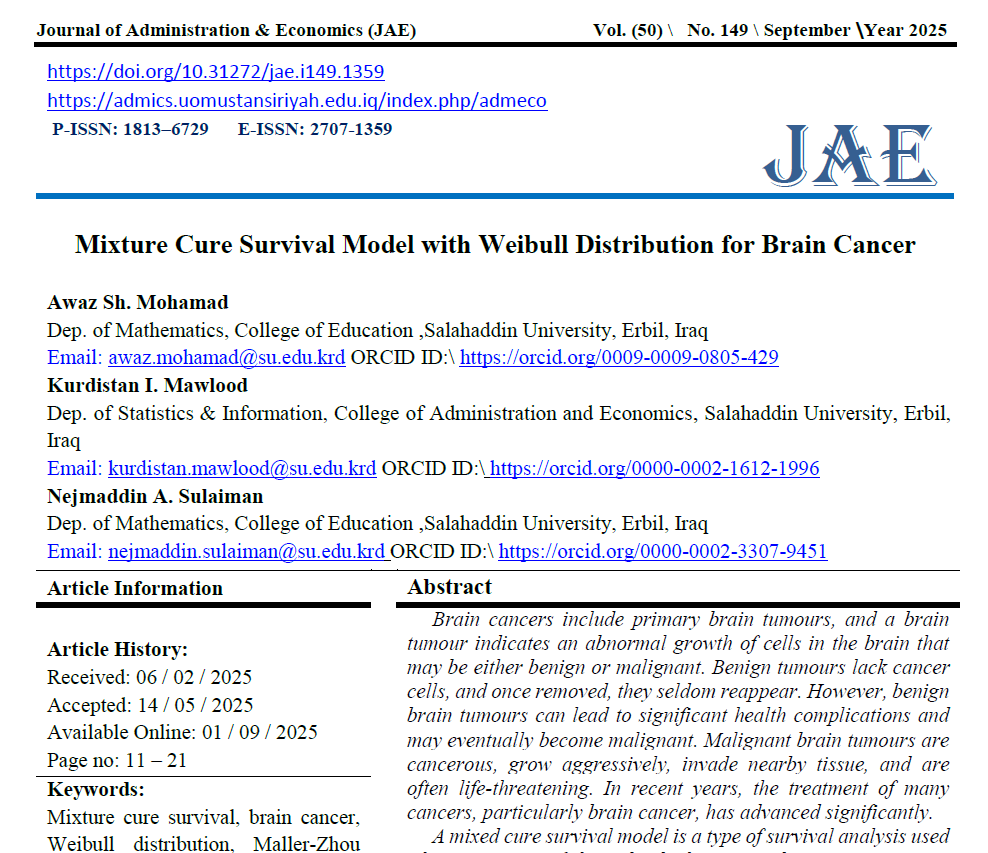
Mixture Cure Survival Model with Weibull Distribution for Brain Cancer
DOI:
https://doi.org/10.31272/jae.i149.1359Keywords:
Weibull Distribution, Mixture Cure Survival Model, Akaike Information Criterion.Abstract
Brain cancers include primary brain tumours, and a brain tumour refers to an abnormal growth of cells in the brain that can be either benign or malignant. Benign tumours lack cancer cells, and once removed, they seldom reappear. However, benign brain tumours can lead to significant health complications and may eventually become malignant. Malignant brain tumours are cancerous, grow aggressively, invade nearby tissue, and are often life-threatening. In recent years, the treatment of many cancers, particularly brain cancer, has advanced significantly. Consequently, the number of patients who fail to achieve favorable outcomes, including death, has decreased. In the statistical evaluation of this type of disease, recovery models are applied instead of traditional survival models. This study analyzed 215 cases of brain cancer from Rzgari Hospital in Erbil city during the period from 2020 to 2024. Among these cases, 99 patients (31.4%) were classified as cured. The data was modelled using the mixture cure approach with several statistical distributions, incorporating the cured fraction in this population and the significance of the Maller-Zhou test. Based on the research outcomes and a comparison of the Akaike Information Criterion and Bayesian Information Criterion, the cure model employing the Weibull distribution for survival time was deemed the most suitable.
Downloads
References
[1] Ahmad, S. M. (2022). MIXTURE SURVIVAL ANALYSIS MODELS FOR ANALYZING ANDPREDICTING CARDIOVASCULAR. Electronic Journal of Applied Statistical Analysis, 95. DOI: 10.1285/i20705948v15n1p95
[2] Baghestani, A. R., Moghaddam, S. S., & Majd, H. A. (2016). Survival Analysis of Patients with Breast Cancer using Weibull. Asian pacific journal, 8567-8571. https://doi.org/10.7314/APJCP.2015.16.18.8567 DOI: https://doi.org/10.7314/APJCP.2015.16.18.8567
[3] Chen.Y., L., & J. Wang, M. ((2019)). A mixture cure model for breast cancer data. 2935-2948. https://doi.org/10.1007/s00362-017-0935-3 DOI: https://doi.org/10.1007/s00362-017-0935-3
[4] Eyler, C.E., Foo, W.C., LaFiura, K.M., McLendon, R.E., Hjelmeland, A.B., 2008. Brain cancer stem cells display preferential sensitivity to Akt inhibition. Stem cells, 26(12), pp.3027-3036. https://doi.org/10.1634/stemcells.2008-0645 DOI: https://doi.org/10.1634/stemcells.2007-1073
[5] Hajar, F. T., & Ibrahim, W. S. (2019). Use the logistic regression model to find the most important factors affecting lung cancer in Iraq in 2017. Journal of Administration and Economics, 44(121). http://doi.org/10.31272/JAE.42.2019.121.21
[6] Hastie, T., Tibshirani, R., & Friedman, J. (2001). The Elements of Statistical Learning. USA: New York, NY, USA. https://doi.org/10.1007/978-0-387-84858-7 DOI: https://doi.org/10.1007/978-0-387-84858-7
[7] Khudhair, P. D. J. K., & salih Hadi, N. (2024). On Discrete Frechet Distribution: Estimation and Application. Journal of Administration and Economics, 49(142). https://doi.org/10.31272/jae.i142.1040 DOI: https://doi.org/10.31272/jae.i142.1040
[8] Lambert, P. C., & Thompson, J. R. (2007). Estimating and modeling the cure fraction in population-based cancer survival analysis. Biostatistics, 8, 576–594. https://doi.org/10.1093/biostatistics/kxl031 DOI: https://doi.org/10.1093/biostatistics/kxl030
[9] Lee, E. T., & Wang, J. W. (2003). Statistical Methods for Survival Data Analysis (3rd ed.). Canada: John Wiley & Sons, Inc. https://doi.org/10.1002/0471458546 DOI: https://doi.org/10.1002/0471458546
[10] Mohamad, A.S., Mawlood, K.I. and Sulaiman, N.A., (2025). Application of a Non-Mixture Cure RateModel for Analyzing Survival of Patients with Brain Cancer. Communications on Applied Nonlinear Analysis, 32(3), pp.701–710. https://internationalpubls.com/index.php/cana/article/view/3062/1763 DOI: https://doi.org/10.52783/cana.v32.3062
[11] MALLER, R. A. (1992). Estimating the proportion of immunes in a censored sample. Biometrika, 731–739. https://doi.org/10.1093/biomet/79.3.731 https://doi.org/10.1115/1.4010337 DOI: https://doi.org/10.1093/biomet/79.4.731
[12] Webull, W. (1951). A Statistical Distribution Function of Wide Applicability. Journal of Applied Mechanics, American Society of Mechanical Engineers. https://doi.org/10.1115/1.4010337 DOI: https://doi.org/10.1115/1.4010337
Downloads
Published
Issue
Section
License
Copyright (c) 2025 Awaz Sh. Mohamad, Kurdistan I. Mawlood, Nejmaddin A. Sulaiman

This work is licensed under a Creative Commons Attribution 4.0 International License.
The journal of Administration and Economics is an open- access journal that all contents are free of charge. Articles of this journal are licensed under the terms of the Creative Commons Attribution International Public License CC-BY 4.0 (https://creativecommons.org/licenses/by/4.0/legalcode) that licensees are unrestrictly allowedto search, download, share, distribute, print, or link to the full text of the articles, crawl them for indexing and reproduce any medium of the articles provided that they give the author(s) proper credits (citation). The journal allows the author(s) to retain the copyright of their published article.
Creative Commons-Attribution (BY)