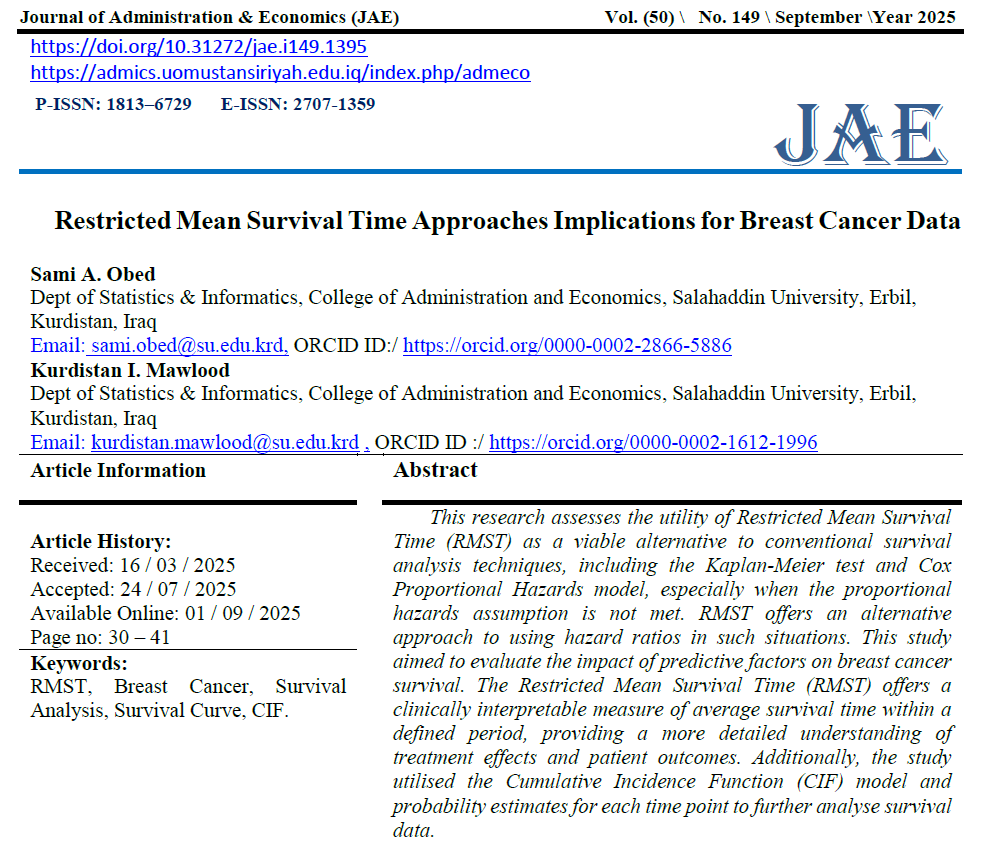
Restricted Mean Survival Time Approaches Implications for Breast Cancer Data
DOI:
https://doi.org/10.31272/jae.i149.1395Keywords:
RMST, Breast Cancer, Survival Analysis, Survival Curve, CIFAbstract
This research assesses the utility of Restricted Mean Survival Time (RMST) as a viable alternative to conventional survival analysis techniques, including the Kaplan-Meier test and Cox Proportional Hazards model, especially when the proportional hazards assumption is not met. RMST offers an alternative approach to using hazard ratios in such situations. This study aimed to evaluate the impact of predictive factors on breast cancer survival. The Restricted Mean Survival Time (RMST) offers a clinically interpretable measure of average survival time within a defined period, providing a more detailed understanding of treatment effects and patient outcomes. Additionally, the study utilized the Cumulative Incidence Function (CIF) model and probability estimates for each time point to further analyze survival data.
Using data from 4,420 breast cancer patients at Rizgary Hospital, this research quantifies the impact of various prognostic factors on survival outcomes. The study demonstrates that RMST effectively captures differences in survival probabilities across treatment groups, with patients undergoing surgery or receiving radiotherapy showing significantly higher survival rates than those who did not. Additionally, the analysis reveals that factors such as family history and tumor grade significantly influence survival outcomes, highlighting the heterogeneity of breast cancer. Statistical comparisons using RMST, alongside traditional tests like the Log-rank and Gehan-Wilcoxon tests, confirm significant differences in survival curves, particularly in early-stage survival, emphasizing the importance of timely interventions
Downloads
References
[1] Abulizi, Xianmixikemaier, Heather J. Ribaudo, and Philippe Flandre. 2019. The Use of the Restricted Mean Survival Time as a Treatment Measure in HIV/AIDS Clinical Trial: Reanalysis of the ACTG A5257 Trial. DOI: https://doi.org/10.1097/QAI.0000000000001978
[2] A’Hern, Roger P. 2016. ‘Restricted Mean Survival Time: An Obligatory End Point for Time-to-Event Analysis in Cancer Trials?’ Journal of Clinical Oncology 34(28):3474–76. https://doi: 10.1200/JCO.2016.67.8045. DOI: https://doi.org/10.1200/JCO.2016.67.8045
[3] Calkins, Keri L., Chelsea E. Canan, Richard D. Moore, Catherine R. Lesko, and Bryan Lau. 2018. ‘An Application of Restricted Mean Survival Time in a Competing Risks Setting: Comparing Time to ART Initiation by Injection Drug Use’. BMC Medical Research Methodology 18(1). https://doi: 10.1186/s12874-018-0484-z. DOI: https://doi.org/10.1186/s12874-018-0484-z
[4] Chiumente, Marco, Daniele Mengato, and Andrea Messori. 2020. ‘Tisagenlecleucel in Non-Hodgkin Lymphoma: The Restricted Mean Survival Time as a Tool for Estimating Progression-Free Life Expectancy Better than the Median’. Acta Haematologica 143(6):598–99. DOI: https://doi.org/10.1159/000505891
[5] He, Yifan, and Yong Zhou. 2020. ‘Nonparametric and Semiparametric Estimators of Restricted Mean Survival Time under Length-Biased Sampling’. Lifetime Data Analysis 26(4):761–88. https://doi: 10.1007/s10985-020-09498-x. DOI: https://doi.org/10.1007/s10985-020-09498-x
[6] Hajer, F. T., & Ibrahim, W. S. (2029). Use the logistic regression model to find the most critical factors affecting lung cancer in Iraq in 2017, Journal of Administration and Economics, 44(121).
[7] Ibrahim, W. S., & Jaber. A. K. A. (2023). A study of patient with bladder cancer using the survival function of the new expanded adapter Whipple distribution. Journal of Administration and Economics, 48(139). https://doi.org/10.31272/jae.i139.1090 DOI: https://doi.org/10.31272/jae.i139.1090
[8] Inam, D. R., Noaman, A., Huda, A L, Abd, A., & A.-A. (2019). Comparison of Classical and Bayesian methods to Estimate the shape parameter and Reliability function in Burr type X or two param4eter of exponential Rayleigh distribution under different Loss function. https://doi.org/10.31272/JAE.42.2019.11
[9] Jackson, Richard J. 2015. Some Statistical Methods for the Analysis of Survival Data in Cancer Clinical Trials.
[10] Mawlood, Kurdistan I., & Obed, Sami A. (2019). QALAAI ZANIST SCIENTIFIC JOURNAL Study and Analysis of the Chest Cancer Data Using Survival Models ARTICLE INFO ABSTRACT. A Scientific Quarterly Refereed Journal Issued by Lebanese French University-Erbil, 4. https://doi.org/10.25212/lfu.qzj.4.2.24
[11] Lyu, Jingjing, Yawen Hou, and Zheng Chen. 2020a. ‘The Use of Restricted Mean Time Lost under Competing Risks Data’. BMC Medical Research Methodology 20(1). https://doi: 10.1186/s12874-020-01040-9. DOI: https://doi.org/10.1186/s12874-020-01040-9
[12] Messori, Andrea, Vera Damuzzo, Laura Agnoletto, Luca Leonardi, Marco Chiumente, and Daniele Mengato. 2020. ‘A Model-Independent Method to Determine Restricted Mean Survival Time in the Analysis of Survival Curves’. SN Comprehensive Clinical Medicine 2(1):66–68. https://doi: 10.1007/s42399-019-00199-7. DOI: https://doi.org/10.1007/s42399-019-00199-7
[13] Trinquart, Ludovic, Justine Jacot, Sarah C. Conner, and Raphaël Porcher. 2016. ‘Comparison of Treatment Effects Measured by the Hazard Ratio and by the Ratio of Restricted Mean Survival Times in Oncology Randomized Controlled Trials’. Journal of Clinical Oncology 34(15):1813–19. https://doi: 10.1200/JCO.2015.64.2488. DOI: https://doi.org/10.1200/JCO.2015.64.2488
[14] Zucker, David M. 1998. ‘Restricted Mean Life with Covariates: Modification and Extension of a Useful Survival Analysis Method’. Journal of the American Statistical Association 93(442):702–9. https://doi: 10.1080/01621459.1998.10473722. DOI: https://doi.org/10.1080/01621459.1998.10473722
Downloads
Published
Issue
Section
License
Copyright (c) 2025 Kurdistan Ibrahim Mawlood، Sami Ali Obed

This work is licensed under a Creative Commons Attribution 4.0 International License.
The journal of Administration and Economics is an open- access journal that all contents are free of charge. Articles of this journal are licensed under the terms of the Creative Commons Attribution International Public License CC-BY 4.0 (https://creativecommons.org/licenses/by/4.0/legalcode) that licensees are unrestrictly allowedto search, download, share, distribute, print, or link to the full text of the articles, crawl them for indexing and reproduce any medium of the articles provided that they give the author(s) proper credits (citation). The journal allows the author(s) to retain the copyright of their published article.
Creative Commons-Attribution (BY)