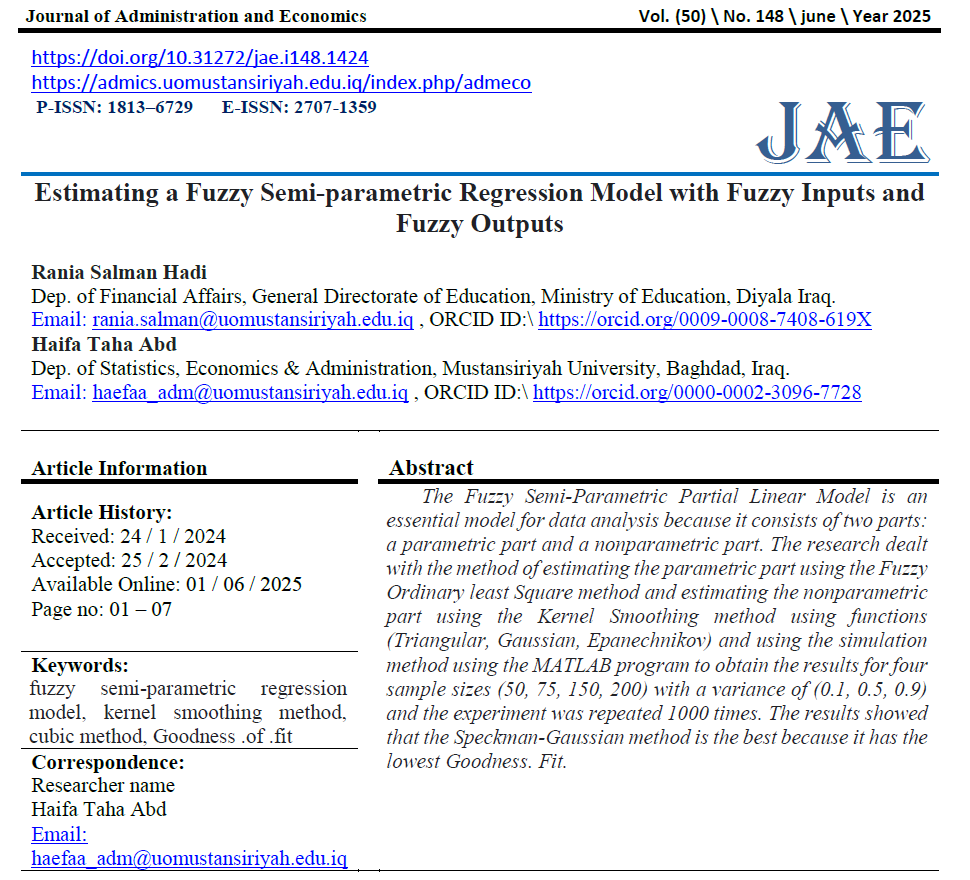
Estimating a Fuzzy Semi-parametric Regression Model with Fuzzy Inputs and Fuzzy Outputs
DOI:
https://doi.org/10.31272/jae.i148.1424Keywords:
fuzzy semi-parametric regression model, kernel smoothing method, cubic method, Goodness .of .fitAbstract
The Fuzzy Semi-Parametric Partial Linear Model is an essential model for data analysis because it consists of two parts: a parametric part and a nonparametric part. The research dealt with the method of estimating the parametric part using the Fuzzy Ordinary least Square method and estimating the nonparametric part using the Kernel Smoothing method using functions (Triangular, Gaussian, Epanechnikov) and using the simulation method using the MATLAB program to obtain the results for four sample sizes (50, 75, 150, 200) with a variance of (0.1, 0.5, 0.9) and the experiment was repeated 1000 times. The results showed that the Speckman-Gaussian method is the best because it has the lowest Goodness. Fit.
Downloads
References
[1] Abbas, M. S. (2017). Estimation of a fuzzy nonparametric regression model using some smoothing methods with a practical application [Doctoral dissertation, Department of Statistics, University of Baghdad, Iraq].
[2] Abbas, M. S. (2021). An applied comparison between fuzzy regression models [Master's thesis, Department of Statistics, Al-Mustansiriya University, Baghdad, Iraq].
[3] Ataeian, S. M., & Darbandi, M. J. (2011). Analysis of Quality of Experience by applying Fuzzy logic: A study on response time [Unpublished master’s thesis]. Blekinge Institute of Technology.
[4] Chen, H. (1988). Convergence rates for parametric components in a partly linear model. The Annals of Statistics, 16(1), 136–146. https://doi.org/10.1214/aos/1176350731 DOI: https://doi.org/10.1214/aos/1176350695
[5] Diamond, P. (1988). Fuzzy Least Squares Information. Sciences, 46, 141–157. https://doi.org/10.1016/0020-0255(88)90045-3 DOI: https://doi.org/10.1016/0020-0255(88)90047-3
[6] Faisal, R. D. (2020). Using some methods for estimating nonparametric and semiparametric regression functions with application [Master's thesis, Department of Statistics, Al-Qadisiyah University, Diwaniyah, Iraq].
[7] Hammoud, M. Y. (2000). A comparison of nonparametric Kernel estimators for estimating regression functions [Master's thesis, Department of Statistics, University of Baghdad].
[8] Harezlak, J. (2018). Semiparametric Regression with R. Department of Statistics, Ithaca, New York. DOI: https://doi.org/10.1007/978-1-4939-8853-2
[9] Härdle, W., & Müller, M. (1997). Multivariate and semiparametric kernel regression. Discussion Papers, Interdisciplinary Research Project 373: Quantification.
[10] Hesamian, G., Akbari, M. G., & Asadollahi, M. (2017). Fuzzy semi-parametric partially linear model with fuzzy inputs and fuzzy outputs. Expert Systems with Applications, 71, 230–239. https://doi.org/10.1016/j.eswa.2016.11.025 DOI: https://doi.org/10.1016/j.eswa.2016.11.032
[11] Mohamed, B., Hamdi, A., & Abdul Hamid, N. (2019). Using the fuzzy TOPSIS method to study the importance of factors that distinguish the performance of institutions. Journal of Economic, Management and Commercial Sciences, 12(2).
[12] Shamal, I. H. (2022). Some methods for estimating the fuzzy semiparametric logistic regression model with estimation [Doctoral dissertation, Department of Statistics, University of Baghdad].
Downloads
Published
Issue
Section
License
Copyright (c) 2025 Rania Salman Hadi, Haifa Taha Abd

This work is licensed under a Creative Commons Attribution 4.0 International License.
The journal of Administration and Economics is an open- access journal that all contents are free of charge. Articles of this journal are licensed under the terms of the Creative Commons Attribution International Public License CC-BY 4.0 (https://creativecommons.org/licenses/by/4.0/legalcode) that licensees are unrestrictly allowedto search, download, share, distribute, print, or link to the full text of the articles, crawl them for indexing and reproduce any medium of the articles provided that they give the author(s) proper credits (citation). The journal allows the author(s) to retain the copyright of their published article.
Creative Commons-Attribution (BY)