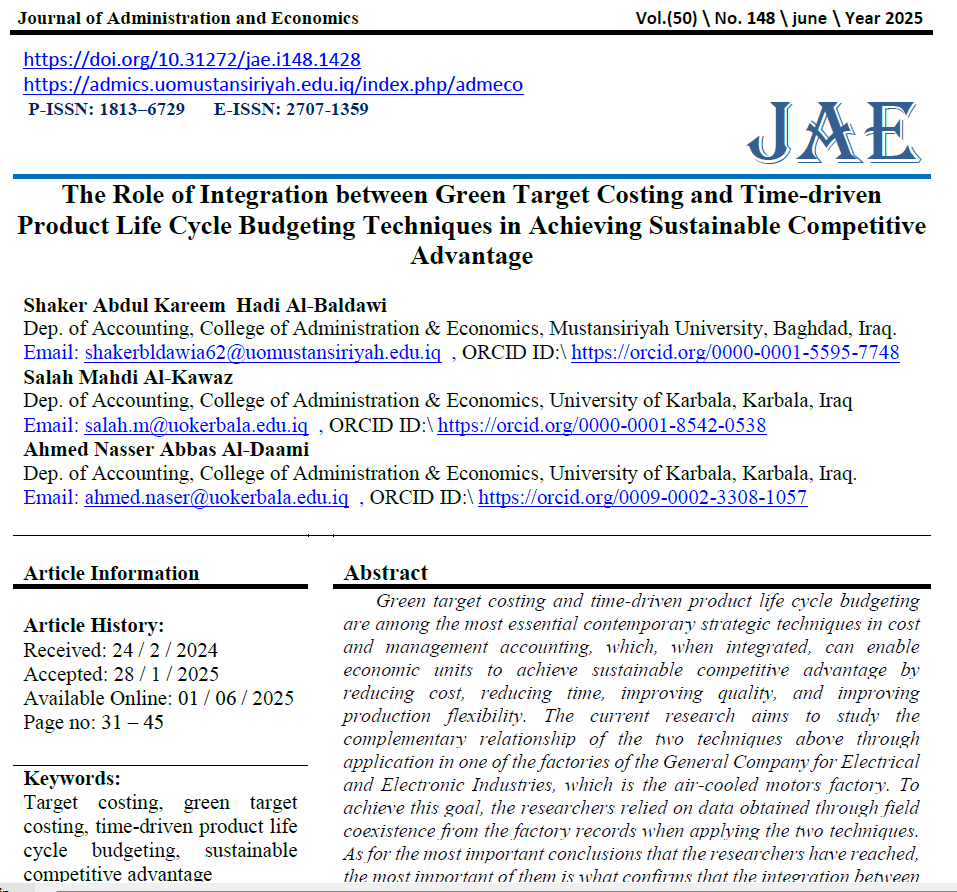
The Role of Integration between Green Target Costing and Time-driven Product Life Cycle Budgeting Techniques in Achieving Sustainable Competitive Advantage
DOI:
https://doi.org/10.31272/jae.i148.1428Keywords:
Target costing, green target costing, time-driven product life cycle budgeting, sustainable competitive advantageAbstract
Green target costing and time-driven product life cycle budgeting are among the most essential contemporary strategic techniques in cost and management accounting, which, when integrated, can enable economic units to achieve sustainable competitive advantage by reducing cost, reducing time, improving quality, and improving production flexibility. The current research aims to study the complementary relationship of the two techniques above through application in one of the factories of the General Company for Electrical and Electronic Industries, which is the air-cooled motors factory. To achieve this goal, the researchers relied on data obtained through field coexistence from the factory records when applying the two techniques. As for the most important conclusions that the researchers have reached, the most important of them is what confirms that the integration between green target costing and time-driven product life cycle budgeting is likely to lead to a significant improvement in terms of reducing resource consumption, reducing cost, reducing response time, and improving the level of quality, in addition to preserving the environment from pollution and reducing harmful emissions, which may be reflected in achieving sustainable competitive advantage.
Downloads
References
[1] Al-Awad, Z. Y. (2022). Muwāzanat dawrat ḥayāt al-muntaj wa-dawrūhā fī taḥqīq abʻād al-mīzah al-tanāfusīyah [Balancing the product life cycle and its role in achieving the dimensions of competitive advantage] (Unpublished master's thesis). University of Karbala, Karbala, Iraq.
[2] Asli, K. (2011). The value of environmental management and green product design within sustainable development and competitive strategies of the companies. African Journal of Agricultural Research, 6(1), 51–59.
[3] Ayesh, H. A. H. (2022). Taṭbīq tiqniyyāt al-taklifah al-mustahdafah wa-al-taklifah ʻalá asās al-muwāṣafāt li-daʻm istrātījīyat al-taṣnīʻ al-faʻʻāl wa-taḥqīq al-mīzah al-tanāfusīyah al-mustadāmah [Applying target costing and specifications-based costing techniques to support an effective manufacturing strategy and achieve sustainable competitive advantage] (Unpublished master's thesis). University of Karbala, Karbala, Iraq.
[4] Bleeker, R. (2003, September). Key features of activity-based budgeting. Journal of Cost Management.
[5] Bragg, S. M. (2010). Cost reduction analysis tools and strategies. John Wiley & Sons, Inc. DOI: https://doi.org/10.1002/9781118268346
[6] Mouloudi, A., & Yahiaoui, A. (2019). Tamkīn al-ʻāmilīn wa-dawrūh fī taḥqīq al-mīzah al-tanāfusīyah al-mustadāmah [Employee empowerment and its role in achieving sustainable competitive advantage] (Unpublished master's thesis). University of Ahmed Draia-Adrar, Algeria.
[7] Ning, X. (2015). The application of green quality management system in ship industry (Doctoral dissertation). Huazhong University of Science and Technology.
[8] Nishimura, A. (2014). Transforming cost design in to environmentally conscious cost design in Japan: likelihood and problems for further development. J Manage Control. DOI: https://doi.org/10.1007/s00187-014-0190-x
[9] Sayhood, N. H. (2023). Tawẓīf al-taklifah al-mustahdafah al-khaḍrāʼ wa-muwāzanat al-taḥsīn al-mustamirr al-mustadām fī taḥqīq al-mīzah al-tanāfusīyah [Employing green target costing and sustainable continuous improvement budgeting to achieve competitive advantage] (Unpublished doctoral dissertation). University of Karbala, Karbala, Iraq.
[10] Warren, C. S., Reeve, J. M., & Duchac, J. E. (2009). Managerial accounting concepts and principles (10th ed.). South-Western.
Downloads
Published
Issue
Section
License
Copyright (c) 2025 Shaker Abdul Kareem Hadi Al-Baldawi, Salah Mahdi Al-Kawaz, Ahmed Nasser Abbas Al-Daami

This work is licensed under a Creative Commons Attribution 4.0 International License.
The journal of Administration and Economics is an open- access journal that all contents are free of charge. Articles of this journal are licensed under the terms of the Creative Commons Attribution International Public License CC-BY 4.0 (https://creativecommons.org/licenses/by/4.0/legalcode) that licensees are unrestrictly allowedto search, download, share, distribute, print, or link to the full text of the articles, crawl them for indexing and reproduce any medium of the articles provided that they give the author(s) proper credits (citation). The journal allows the author(s) to retain the copyright of their published article.
Creative Commons-Attribution (BY)