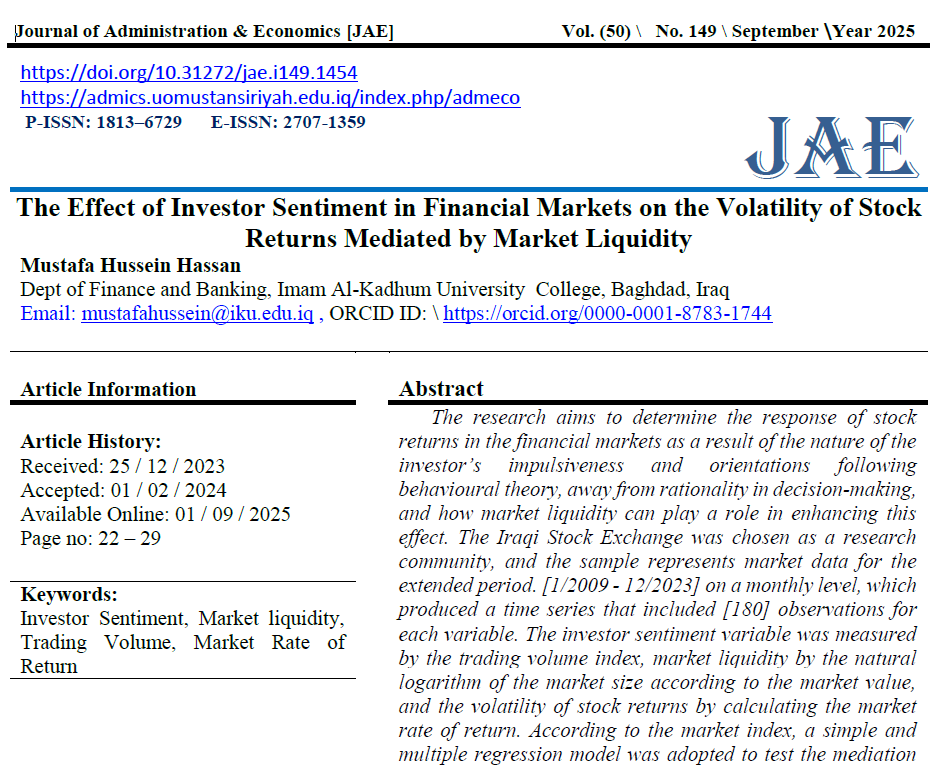
The effect of investor sentiment in financial markets on the volatility of stock returns, mediated by market liquidity
DOI:
https://doi.org/10.31272/jae.i149.1454Keywords:
Investor Sentiment, Market liquidity, Trading Volume, Market Rate of ReturnAbstract
The research aims to determine the response of stock returns in the financial markets as a result of the nature of the investor’s impulsiveness and orientations in accordance with behavioral theory, away from rationality in decision-making, and how market liquidity can play a role in enhancing this effect. The Iraqi Stock Exchange was chosen as a research community and the sample represents market data for the extended period. [1/2009 - 12/2023] on a monthly level, which produced a time series that included [180] observations for each variable. The investor sentiment variable was measured by the trading volume index, market liquidity by the natural logarithm of the market size according to the market value, and the volatility of stock returns by calculating the market rate of return. According to the market index, a simple and multiple regression model was adopted to test the mediation hypothesis, and the results showed that there is a positive, significant effect of investor morale on stock returns, which reflects a state of pessimism or optimism in price trends. It also showed that increasing investor options and market depth directly enhances the effect of investor morale on Volatility of returns
Downloads
References
[1] Baker, M, & Stein, J. (2004), Market Liquidity as a Sentiment Indicator, Journal of Financial Markets 7, 271-299. https://doi.org/10.1016/j.finmar.2003.11.005. DOI: https://doi.org/10.1016/j.finmar.2003.11.005
[2] Baker, M., & Wurgler, J. (2006). Investor sentiment and the cross‐section of stock returns. The journal of Finance, 61(4), 1645-1680. https://dx.doi.org/10.2139/ssrn.464843. DOI: https://doi.org/10.1111/j.1540-6261.2006.00885.x
[3] Baker, M., & Wurgler, J. (2007). Investor sentiment in the stock market. Journal of economic perspectives, 21[2], 129-151. DOI: 10.1257/jep.21.2.129. DOI: https://doi.org/10.1257/jep.21.2.129
[4] Black, Fisher, (1971). Towards a Fully Automated Exchange, Part I, Financial Analysts Journal 27, 29-34. ISSN 0015-198X, ZDB-ID 219409-0.
[5] Boyle, J. F., Boyle, D. M., Hermanson, D. R., & Krull Jr, G. W. (2025). Chairs’ Views of the Market for Doctorally Qualified Accounting Faculty. Issues in Accounting Education, 40(1), 11-22. https://doi.org/10.2308/ISSUES-2023-075 DOI: https://doi.org/10.2308/ISSUES-2023-075
[6] Chen, H., Chong, T. T. L., & She, Y. (2014). A principal component approach to measuring investor sentiment in China. Quantitative Finance, 14(4), 573-579. https://doi.org/10.1080/14697688.2013.869698. DOI: https://doi.org/10.1080/14697688.2013.869698
[7] Datar, M. K. (2000). Stock market liquidity: Measurement and implications. In Proceedings of the 4th Capital Market Conference. DOI: 10.12691/jfa-7-1-2. DOI: https://doi.org/10.12691/jfa-7-1-2
[8] Engle, R. F., & Lange, J. (2001). Predicting VNET: A Model Of The Dynamics Of Market Depth. Journal Of Financial Markets, 4(2), 113-142. https://doi.org/10.1016/S1386-4181(00)00019-7. DOI: https://doi.org/10.1016/S1386-4181(00)00019-7
[9] Enow, S. T., Kasse, S., & Dubihlela, J. (2022). Exploring the concept of market depth in the south African market: an empirical analysis. Academy of Accounting and Financial Studies Journal, 26(5), 1-10. ISSN: 1528-2635-26-5-362
[10] Fama, E. F. (1998). Market efficiency, long-term returns, and behavioral finance. Journal of financial economics, 49(3), 283-306. https://dx.doi.org/10.2139/ssrn.15108. DOI: https://doi.org/10.2139/ssrn.15108
[11] Harris, L., 1990, Liquidity, Trading Rules, and Electronic Trading Systems, New York University Salomon Center Monograph Series in Finance, Monograph # 1990-4. ISSN/ISBN: 9781944960131
[12] Hengelbrock, J., Theissen, E., and Westheide, C. (2013). “Market response to investor sentiment.” J. Bus. Financ. Account., 40(7–8), 901–917. DOI:10.54254/2754-1169/2025.21179 DOI: https://doi.org/10.1111/jbfa.12039
[13] Hu, J., Sui, Y., & Ma, F. (2021). The measurement method of investor sentiment and its relationship with stock market. Computational Intelligence and Neuroscience, 2021, 1-11. https://doi.org/10.1155/2021/6672677. DOI: https://doi.org/10.1155/2021/6672677
[14] Lee, Charles M. C., Andrei Shleifer, & Richard H. Thaler, (1991). Investor Sentiment and the Closed-End Fund Puzzle, Journal of Finance 46, 75-109. https://doi.org/10.2307/2328690. DOI: https://doi.org/10.1111/j.1540-6261.1991.tb03746.x
[15] Lei, Y. C. (2005). The trading volume trend, investor sentiment, and stock returns. Louisiana State University and Agricultural & Mechanical College. https://repository.lsu.edu/gradschool_dissertations/2012.
[16] Lemmon, M., & Portniaguina, E. (2006). Consumer confidence and asset prices: Some empirical evidence. The Review of Financial Studies, 19(4), 1499-1529. https://doi.org/10.1093/rfs/hhj038. DOI: https://doi.org/10.1093/rfs/hhj038
[17] Kyle, Albert S., 1985, Continuous Auctions and Insider Trading, Econometrica 53, 1315-1335. https://doi.org/10.2307/1913210. DOI: https://doi.org/10.2307/1913210
[18] Nagy, A., and Obenberger, W. (2015). “Factors Influencing Individual Investor Behavior.” Financ. Anal. J., 50(4), 63–68. DOI:10.33844/ijol.2018.60407 DOI: https://doi.org/10.2469/faj.v50.n4.63
[19] Shen, J., Yu, J., & Zhao, S. (2017). Investor sentiment and economic forces. Journal of Monetary Economics, 86, 1-21. https://doi.org/10.1016/j.jmoneco.2017.01.001. DOI: https://doi.org/10.1016/j.jmoneco.2017.01.001
[20] Stambaugh, R. F., Yu, J., & Yuan, Y. (2012). The short of it: Investor sentiment and anomalies. Journal of financial economics, 104[2], 288-302. https://doi.org/10.1016/j.jfineco.2011.12.001. DOI: https://doi.org/10.1016/j.jfineco.2011.12.001
[21] Uchil, R. (2020). Impact of Investor Sentiment on Investment Decision and Stock Market Volatility [Doctoral dissertation, National Institute of Technology Karnataka, Surathkal]. https://dx.doi.org/10.2139/ssrn.3942255. DOI: https://doi.org/10.2139/ssrn.3942255
[22] Vamossy, D. F. (2021). Investor emotions and earnings announcements. Journal of Behavioral and Experimental Finance, 30, 100474. https://doi.org/10.1016/j.jbef.2021.100474. DOI: https://doi.org/10.1016/j.jbef.2021.100474
[23] Wuyts, G. (2007). Stock market liquidity: Determinants and implications. Review of Business and Economics, (2), 279-316. https://lirias.kuleuven.be/bitstream/123456789/203 ... EM_2-07_05_Wuyts.pdf
[24] Zhou, G. (2018). Measuring investor sentiment. Annual Review of Financial Economics, 10, 239-259. https://dx.doi.org/10.2139/ssrn.3051414. DOI: https://doi.org/10.1146/annurev-financial-110217-022725
[25] Zweig, Martin E., (1973). An Investor Expectations Stock Price Predictive Model Using Closed-End Fund Premiums, Journal of Finance 28, 67-78. https://doi.org/10.2307/2978169. DOI: https://doi.org/10.1111/j.1540-6261.1973.tb01346.x
Downloads
Published
Issue
Section
License
Copyright (c) 2025 Mustafa Hussein Hassan

This work is licensed under a Creative Commons Attribution 4.0 International License.
The journal of Administration and Economics is an open- access journal that all contents are free of charge. Articles of this journal are licensed under the terms of the Creative Commons Attribution International Public License CC-BY 4.0 (https://creativecommons.org/licenses/by/4.0/legalcode) that licensees are unrestrictly allowedto search, download, share, distribute, print, or link to the full text of the articles, crawl them for indexing and reproduce any medium of the articles provided that they give the author(s) proper credits (citation). The journal allows the author(s) to retain the copyright of their published article.
Creative Commons-Attribution (BY)