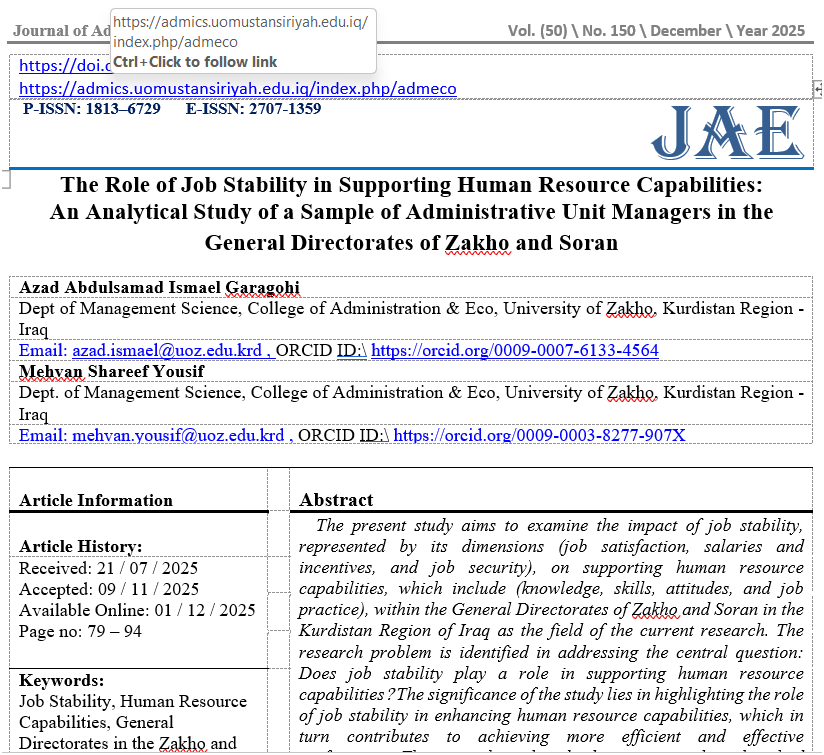
The Role of Job Stability in Supporting Human Resource Capabilities:An Analytical Study of a Sample of Administrative Unit Managers in the General Directorates of Zakho and Soran
DOI:
https://doi.org/10.31272/jae.i150.1456Keywords:
Job Stability, Human Resource Capabilities, General Directorates in the Zakho and Soran AdministrationsAbstract
The present study aims to examine the impact of job stability, represented by its dimensions (job satisfaction, salaries and incentives, and job security), on supporting human resource capabilities, which include (knowledge, skills, attitudes, and job practice), within the General Directorates of Zakho and Soran in the Kurdistan Region of Iraq as the field of the current research. The research problem is identified in addressing the central question: Does job stability play a role in supporting human resource capabilities? The significance of the study lies in highlighting the role of job stability in enhancing human resource capabilities, which in turn contributes to achieving more efficient and effective performance. The research employed a descriptive-analytical method and used a questionnaire as the primary tool for data collection from a sample of 352 administrative unit managers in the targeted directorates. The research hypotheses were tested using the (AMOS V.24) software package. The findings revealed that job stability has a direct impact on supporting human resource capabilities by providing a work environment characterised by stability and reassurance, which reflects positively on workplace interaction, organisational commitment, and institutional performance improvement. Based on these conclusions, the researchers propose several recommendations, the most important of which emphasise the need to enhance job stability through employee care and the creation of a safe work environment, to strengthen employees’ sense of trust and security, reduce psychological stress, and ultimately support human resource capabilities.
Downloads
References
[1] Taher, J., & Belkacem, B., (2022), Mechanisms for Achieving Job Stability in Economic Institutions: A Field Study at the National Social Security Fund for Salaried Workers (CNAS), Aflou Branch. Al-Muntada Journal of Economic Studies and Research, 6(2). https://asjp.cerist.dz/index.php/en/downArticle/428/6/2/206122
[2] Abu Subh, T. Z. A., & Arabiat, A. A. H., (2021), Career ambition and its relationship with job stability among Jordanian artists. Al-Azhar Education: A Peer-Reviewed Journal for Educational, Psychological, and Social Research, 40(192), 491–515. https://doi.org/10.21608/jsrep.2021.213966 DOI: https://doi.org/10.21608/jsrep.2021.213966
[3] Ali Gaafar, H., & Al-Romeedy, B. (2022). The Impact of Job Happiness and Job Stability on Employees in Egyptian Travel Agencies. Journal of Association of Arab Universities for Tourism and Hospitality 23(1), 103-118. https://doi.org/10.21608/jaauth.2021.110058.1276 DOI: https://doi.org/10.21608/jaauth.2021.110058.1276
[4] Gouidri, N., & Khasef, Z., (2023), The impact of the work environment on employees’ job stability: A field study of a sample of hospital physicians at the Public Hospital Institution of Tayebat (Published master’s thesis), Faculty of Economic Sciences, Commercial Sciences and Management Sciences, Kasdi Merbah University – Ouargla, People’s Democratic Republic of Algeria. https://dspace.univ-ouargla.dz/jspui/handle/123456789/34726
[5] Al-Saadi, G. M. H., (2023), The reality of job stability among employees in the directorates of the Iraqi Ministry of Youth and Sports from their perspective. Journal of Sport Education Sciences, Al-Taqniya Al-Wusta University, Al-Rusafa Institute of Administration, 16(7). http://dx.doi.org/10.33170/jocope.v16i7.976-986 DOI: https://doi.org/10.33170/jocope.v16i7.976-986
[6] Nemteanu, M. S., Dinu, V., & Dabija, D. C., (2021), Job insecurity, job instability, and job satisfaction in the context of the COVID-19 pandemic, Journal of Competitiveness, 113(2), 65–82. http://dx.doi.org/10.7441/joc.2021.02.04 DOI: https://doi.org/10.7441/joc.2021.02.04
[7] Hamedani, S. S., & Bawazir, A. A., (2024), The Impact of Working Environment, Salary, and Job Security on Job Satisfaction among Workers in Sarawak’s Government Linked Company: The Case of Sarawak Digital Economy Corporation, Journal of Entrepreneurship and Business Innovation, 11(1), 20-36. http://dx.doi.org/10.5296/jebi.v11i1.21623 DOI: https://doi.org/10.5296/jebi.v11i1.21623
[8] Al-Madhhali, R. M., Al-Qasabi, K. A., Al-Fawaeir, A. M., & Al-Raymi., (2024), The role of job stability in enhancing employees’ self-efficacy: An exploratory analytical study of the opinions of a sample of employees in the Directorates of Education in the Sultanate of Oman, University of Sharjah Journal of Humanities and Social Sciences, 1(21). https://doi.org/10.36394/jhss/21/1/8 DOI: https://doi.org/10.36394/jhss/21/1/8
[9] Kabi, Y. A., (2024), Job stability among principals of gifted secondary schools from the perspective of the teaching staff, Al-Mustansiriyah Journal of Arts, 48(105, Part 1). https://amm.uomustansiriyah.edu.iq/index.php/mustansiriyah/article/view/1197
[10] Al-Humaidawi, A. A. K., & Al-Hiyali, B. A. M., (2022), Job stability among kindergarten teachers. Journal of the College of Basic Education, Al-Mustansiriyah University, 28(116). https://cbej.uomustansiriyah.edu.iq/index.php/cbej/article/view/6015/5430
[11] Awad, A. S., (2019), The effect of material distribution on organizational performance: An exploratory study in the Northern State Cement Company / Kirkuk Plant. Journal of Administration and Economics, Al-Mustansiriyah University, 118(2019). http://doi.org/10.31272/JAE.42.2019.118.1 DOI: https://doi.org/10.31272/JAE.42.2019.118.1
[12] Qadouri, I. W., & Ibrahim, M. M., (2024), The effect of environmental practices on job satisfaction: An exploratory study of a sample of employees at the Iraqi Tourism Authority in Baghdad, Journal of Administration and Economics, Al-Mustansiriyah University, 49(144). https://doi.org/10.31272/jae.i144.1241 DOI: https://doi.org/10.31272/jae.i144.1241
[13] Ogunmakin, A. A., (2023), Effect of Financial Incentives on Employee Morale and Motivation of Small and Medium Scale Enterprises in Ekiti State, American Journal of Industrial and Business Management, 13(6), 465-484. http://dx.doi.org/10.4236/ajibm.2023.136030 DOI: https://doi.org/10.4236/ajibm.2023.136030
[14] Darius, B., (2023), The Impact of Salary and Incentives: Given the Equity of Human Reliance, International Journal of Academic and Applied Research, 7(6), 78-86. https://www.researchgate.net/publication/372157378
[15] Tawfeeq, K., & Daoud, R. N. (2022). Servant leadership and its role in achieving job security An exploratory study of the opinions of a sample of employees in a number of private universities in the Kurdistan Region–Iraq. Humanities Journal of University of Zakho, 10(3), 813-834. https://doi.org/10.26436/hjuoz.2022.10.3.910 DOI: https://doi.org/10.26436/hjuoz.2022.10.3.910
[16] Doden, W., Grosemans, I., De Cuyper, N., Tschopp, C., & Grote, G., (2024), Employability in the post-job security era: testing competing effects of perceived job insecurity on perceived employability change, European Journal of Work and Organizational Psychology, 33(1), 11-23. https://doi.org/10.1080/1359432X.2023.2263201 DOI: https://doi.org/10.1080/1359432X.2023.2263201
[17] Al-Ma’adidi, A. N. A., (2024), Employing the dimensions of neuro-linguistic programming in enhancing the core competencies of human resources: An analytical study of the opinions of a sample of employees in the Nineveh Directorate of Education (Unpublished master’s thesis), College of Administration and Economics, University of Mosul, Iraq. https://doi.org/10.56286/ntujahs.v3i2 DOI: https://doi.org/10.56286/ntujahs.v3i2
[18] Ibrahim, R. A., Al-Kar’awi, M. T., & Khalaf, B. M., (2021), Strategic capabilities practices to enhance organizational agility under environmental changes: An applied study on a sample of private universities – The Islamic University and Al-Kafeel University in Najaf Al-Ashraf, Journal of Administration and Economics, Al-Mustansiriyah University, 46(127). https://doi.org/10.31272/jae.i127.94
[19] Sukmana, P, (2022), The Influence of Human Resource Capability and Performance Allowances on Employee Work Performance at the Directorate of Regional Budget Planning, Directorate General of Regional Financial Development, Ministry of Home Affairs Indonesia, Journal of Economics, Finance and Management Studies, 5(4), 10370-1045. https://doi.org/10.47191/jefms/v5-i4-12 DOI: https://doi.org/10.47191/jefms/v5-i4-12
[20] Alnor, N. H. A., (2023), The Effect of Developing Human Capabilities on the Company's Performance through Developing the Company's Capabilities, Journal of Wseas Transactions on Business and Economics, 21(2024), 95-108. http://dx.doi.org/10.37394/23207.2024.21.9 DOI: https://doi.org/10.37394/23207.2024.21.9
[21] Gitonga, A. G., (2019), Influence of Human Resource Capability in Relating Talent Management Strategy and Competitive Advantage, Journal of Human Resource Management, 7(4), 120-130. https://doi.org/10.11648/j.jhrm.20190704.16
[22] Wajdi, M. F., Widiyanti, M., Desmintari, D., & Wahyuni, P, (2020), Effect of human resource capability and technology on organizational performance: Moderating role of organizational culture, Journal of Talent Development & Excellence, 12(1), 2166-2181. http://eprints.upnyk.ac.id/id/eprint/24810
[23] Putra, Y. M., Hidayah, N., Harnovinsah, H., & Ahmad, N. H., (2024), Enhancing Regional Financial Quality: The Role of Government Accounting Standards, Human Resource Capability, and IT Utilization, Journal of Social and Economic Bulletin, 1(1), 29-43. https://ejournal.bacadulu.net/index.php/sebi
[24] Chapagain, Ch. P., (2004), Human resource capacity building through appreciative inquiry approach in achieving developmental goals, doctoral dissertation, Madison University, USA. https://www.academia.edu/download/30910004/AI-PhD-DISSERTATION1.pdf
[25] Al-Himyari, S. K. A. (2019), The role of perceived organizational justice in enhancing human resource capabilities: An analytical study of the opinions of a sample of employees at the Babylon Health Directorate (Published master’s thesis). College of Administration and Economics, University of Karbala, Iraq. https://library.alkafeel.net/dic/print/page-book/256120/?show
[26] Al-Kar’awi, M. T. F., (2015), Entrepreneurial business strategy for adopting the smart organizations model through building human resource capabilities: A field study in mobile telecommunications companies in Iraq (Published doctoral dissertation), College of Administration and Economics, University of Karbala, Iraq. https://uokerbala.edu.iq/archives/research-paper
[27] Belmerabet, S., (2024), Knowledge management in the public economic institution in Algeria: A field study at the Operational Directorate of Algeria Telecom, Constantine (Published doctoral dissertation), Faculty of Political Science, University of Constantine 3 – Salah Boubnider, People’s Democratic Republic of Algeria. https://dspace.univ-constantine3.dz/jspui/handle/123456789/5770
[28] Tajpour, M., Hosseini, E., Mohammadi, M., & Bahman-Zangi, B., (2022), the effect of knowledge management on the sustainability of technology-driven businesses in emerging markets: The mediating role of social media, Journal of Sustainability, 14(14). https://doi.org/10.3390/su14148602 DOI: https://doi.org/10.3390/su14148602
[29] Noah, J. B., & Aziz, A. A., (2020), A Systematic review on soft skills development among university graduates, EDUCATUM Journal of Social Sciences, 6(1), 53-68. http://dx.doi.org/10.37134/ejoss.vol6.1.6.2020 DOI: https://doi.org/10.37134/ejoss.vol6.1.6.2020
[30] Al-Gharibawi, N. N. R., (2023), Core competencies of human resources and their impact on product quality: The interactive role of quality of work life: An exploratory analytical study of the opinions of employees in Al-Naseem Al-Warith Engineering Industries Company (Published doctoral dissertation), College of Administration and Economics, University of Karbala, Republic of Iraq. https://drive.google.com/file/d/1sUjtwJAlZxAPb8c6h12SpnGLqfoCD04r/view
[31] Sadiartha, A. A. N. G., (2021), Work Attitude, Work Skills, and Core Competencies of Employee in Maintaining Business Sustainability of LPD Bali Province, International Journal of Multicultural and Multireligious Understanding, 8(4), 723-734. http://dx.doi.org/10.18415/ijmmu.v8i4.2442 DOI: https://doi.org/10.18415/ijmmu.v8i4.2442
[32] Čižo, E., Awan, R. A., Ali, R., & Abid, N., (2022), Impact of employee attitude on their pro-social behavior: a case study, Entrepreneurship and Sustainability, 9(4), 416-426. http://doi.org/10.9770/jesi.2022.9.4(22) DOI: https://doi.org/10.9770/jesi2022.9.4(22)
[33] Kehoe, R. R., & Wright, P. M., (2013), The impact of high-performance human resource practices on employees’ attitudes and behaviors, Journal of management, 39(2), 366-391. https://doi.org/10.1177/0149206310365901 DOI: https://doi.org/10.1177/0149206310365901
Downloads
Published
Issue
Section
License
Copyright (c) 2025 Azad Abdulsamad Ismael Garagohi, Mehvan Shareef Yousif

This work is licensed under a Creative Commons Attribution 4.0 International License.
The journal of Administration and Economics is an open- access journal that all contents are free of charge. Articles of this journal are licensed under the terms of the Creative Commons Attribution International Public License CC-BY 4.0 (https://creativecommons.org/licenses/by/4.0/legalcode) that licensees are unrestrictly allowedto search, download, share, distribute, print, or link to the full text of the articles, crawl them for indexing and reproduce any medium of the articles provided that they give the author(s) proper credits (citation). The journal allows the author(s) to retain the copyright of their published article.
Creative Commons-Attribution (BY)