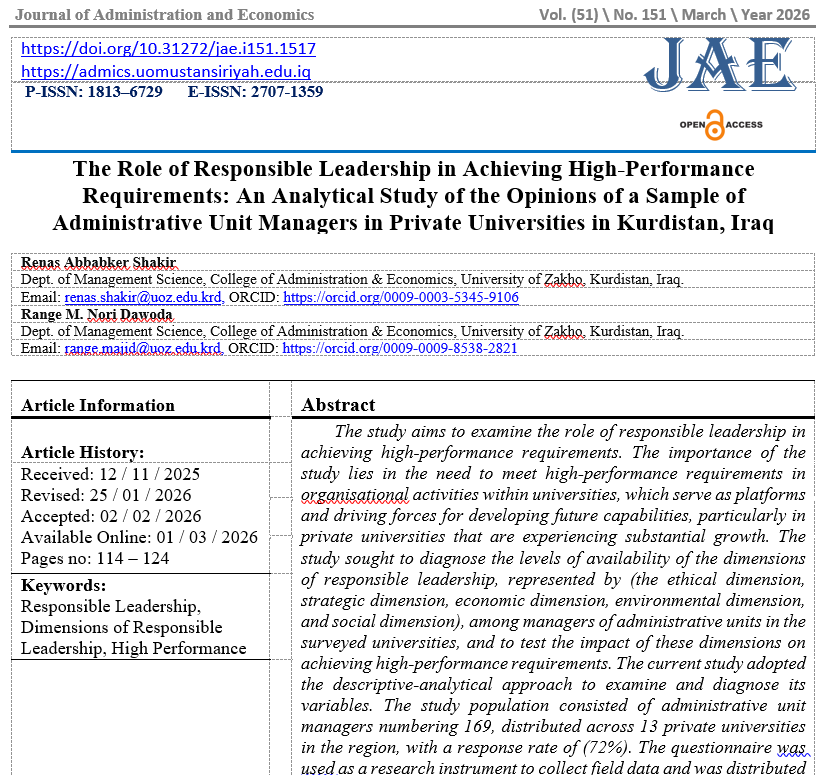
The Role of Responsible Leadership in Achieving High-Performance Requirements: An Analytical Study of the Opinions of a Sample of Administrative Unit Managers in Private Universities in Kurdistan, Iraq
DOI:
https://doi.org/10.31272/jae.i151.1517Keywords:
Responsible Leadership, , Dimensions of Responsible Leadership, , High PerformanceAbstract
The research aims to investigate the role of responsible leadership in achieving the requirements of high performance. The importance of this study stems from the significance of adopting high-performance requirements in the organizational activities of universities, which serve as platforms and drivers for preparing future capabilities—particularly in private universities that are witnessing significant growth. The research sought to diagnose the levels of availability of responsible leadership dimensions among administrative unit managers in private universities in the Kurdistan Region and to analyze the impact of these dimensions on the adoption of high-performance requirements. The study adopted the descriptive-analytical approach to identify the research variables. The research population consisted of administrative unit managers in the colleges of private universities in the region. A questionnaire was used as the main tool for collecting field data. Using Google Forms, 122 questionnaires were collected, and the data were subjected to several statistical tests to identify the correlation and regression relationships between the research variables. The study reached several conclusions, the most important of which is that the adoption of high-performance requirements in private universities is associated with the dimensions of responsible leadership among administrative unit managers. This means that the possibility of adopting high-performance requirements can be achieved through the presence of responsible leadership dimensions among these managers. Furthermore, the dimensions of responsible leadership can enhance the adoption of high-performance requirements in private universities in the region. The social dimension of responsible leadership ranked first in terms of its impact on adopting high-performance requirements. The research recommended focusing on methods that would enhance the availability of responsible leadership dimensions among administrative unit managers to facilitate the adoption of high-performance requirements.
Downloads
References
[1] Voegtlin, C., Frisch, C., Walther, A., & Schwab, P. (2019). Theoretical development and empirical examination of a three-roles model of responsible leadership. Journal of Business Ethics, 156(4), 901–919. https://doi.org/10.1007/s10551-017-3569-1 DOI: https://doi.org/10.2139/ssrn.3368100
[2] Haque, A., Fernando, M., & Caputi, P. (2018). Responsible leadership, affective commitment and intention to quit: An individual level analysis. Leadership & Organization Development Journal. 40(1), 45–64. https://doi.org/10.1108/LODJ-12-2017-0397 DOI: https://doi.org/10.1108/LODJ-12-2017-0397
[3] Siddiqui, S. H., Ijaz, A., Javeria, A., & Naz, M. (2023). Systematic review and development of responsible leadership scale. Pakistan Journal of Humanities and Social Sciences. 11(1), 38–52. https://doi.org/10.52131/pjhss.2023.1101.0328 DOI: https://doi.org/10.52131/pjhss.2023.1101.0328
[4] Estronca, C. (2023). Responsible leadership at the core of an oil company (MSc dissertation, Universidade Católica Portuguesa).
[5] Vieira, M. T., Cremonezi, G. O. G., Spers, V. E. R., Medeiros, A. L., & Rigolid, A. G. M. (2021). Sustainability in the economic, environmental, and social dimensions and the relationship with social responsibility indicators. Academy of Entrepreneurship Journal. 27 (45).
[6] Enrico, J. H., & Soetjipto, B. W. (2021). Examining responsible leadership through the strategic and ethical lens. In Proceedings of the Eighth Padang International Conference on Economics Education, Economics, Business and Management, Accounting and Entrepreneurship (PICEEBA-8 2021) (pp. 410–415). Atlantis Press. https://doi.org/10.2991/aebmr.k.220201.001
[7] Agarwal, S., & Bhal, K. T. (2020). A multidimensional measure of responsible leadership: Integrating strategy and ethics. Group & Organization Management, 45(5), 637–673. https://doi.org/10.1177/1059601120930140 DOI: https://doi.org/10.1177/1059601120930140
[8] Karianne.Kalshoven, K., Den Hartog, D. N., & De Hoogh, A. H. B. (2011). Ethical leadership at work questionnaire (ELW): Development and validation of a multidimensional measure. The Leadership Quarterly, 22, 5–69. DOI: https://doi.org/10.1016/j.leaqua.2010.12.007
[9] Hill, C. W. L., & Jones, G. R. (2007). Strategic management: An integrated approach (7th ed.). Houghton Mifflin.
[10] Janaswamy, K., Sarkar, S., Mishra, R. K., & Gupta, A. D. (2024). Leading the sustainable dimension of business –The responsible leadership way. Journal of Global Responsibility. 15(4): 526–541. https://doi.org/10.1108/jgr-06-2023-0112 DOI: https://doi.org/10.1108/JGR-06-2023-0112
[11] Shaheen, A. F., & Abdelrahman, A. A. (2021). The concept of responsible leadership development: Relationship between business leaders and social and environmental dimensions. Journal of Management World, 2021(3), 104-115. https://doi.org/10.53935/jomw.v2021i3.164 DOI: https://doi.org/10.53935/jomw.v2021i3.164
[12] de Waal, A. (2011). Creating high performance organisations: The determining factors (Working Paper No. 2011/10). Maastricht School of Management. https://ideas.repec.org/p/msm/wpaper/2011-10.html
[13] Do, T. T., & Mai, N. K. (2020). High-performance organization: A literature review. Journal of Strategy and Management, 13(2), 297–309. https://doi.org/10.1108/JSMA-11-2019-0198 DOI: https://doi.org/10.1108/JSMA-11-2019-0198
[14] de Waal, A. (2018). Success factors of high performance organization transformations. Measuring Business Excellence, 22 (4): 375–390. https://doi.org/10.1108/MBE-08-2018-0055 DOI: https://doi.org/10.1108/MBE-08-2018-0055
[15] de Waal, A., & Frijns, M. (2009). Working on high performance in Asia: The case of Nabil Bank. Measuring Business Excellence, 13(3), 29–38. https://doi.org/10.1108/13683040910984301 DOI: https://doi.org/10.1108/13683040910984301
[16] de Waal, A., & Kraaijveld, E. (2022). Learnings from a successful transformation to a high-performance organization: A longitudinal case study. SN Bus Econ 2, 177. https://doi.org/10.1007/s43546-022-00354-8 DOI: https://doi.org/10.1007/s43546-022-00354-8
[17] Jokomo, N. T., de Waal, A., & Solomon, G. (2022). Can a small business enterprise become a high performance organisation: A South-African case study. International Journal of Management and Applied Research, 9(2), 91–114. https://doi.org/10.18646/2056.92.22-005 DOI: https://doi.org/10.18646/2056.92.22-005
[18] Khan, K., Khan, Q., Jamil, S. H., & Akbar, S. (2024). A study on high performance organization framework and organization performance: Lens of dynamic capability theory. Cogent Business & Management, 11(1), 2285415. https://doi.org/10.1080/23311975.2023.2285415 DOI: https://doi.org/10.1080/23311975.2023.2285415
[19] de Waal, A. A., & Hanna, D. (2016). HPO model + HPO framework = Organizational improvement for a European multinational. Global Business and Organisational Excellence, 35(6), 30–43. https://doi.org/10.1002/joe.21696 DOI: https://doi.org/10.1002/joe.21696
[20] O’Brien, R. M. (2007). A caution regarding rules of thumb for variance inflation factors. Quality & Quantity, 41(5), 673–690. https://doi.org/10.1007/s11135-006-9018-6 DOI: https://doi.org/10.1007/s11135-006-9018-6
[21] Usman, M., Del Giudice, M., Papa, A., & Singh, S. K. (2025). Ethical leadership and its impact on corporate sustainability and financial performance: The role of alignment with the Sustainable Development Goals. Sustainability, 17(15), 6682. https://doi.org/10.3390/su17156682 DOI: https://doi.org/10.3390/su17156682
Downloads
Published
Issue
Section
License
Copyright (c) 2026 Renas Ababaker Shaker, & Ranj Mohammed Noori Dawda

This work is licensed under a Creative Commons Attribution 4.0 International License.
The journal of Administration and Economics is an open- access journal that all contents are free of charge. Articles of this journal are licensed under the terms of the Creative Commons Attribution International Public License CC-BY 4.0 (https://creativecommons.org/licenses/by/4.0/legalcode) that licensees are unrestrictly allowedto search, download, share, distribute, print, or link to the full text of the articles, crawl them for indexing and reproduce any medium of the articles provided that they give the author(s) proper credits (citation). The journal allows the author(s) to retain the copyright of their published article.
Creative Commons-Attribution (BY)