The Effect of E-leadership on Strategic Excellence A Field Study in Private Universities in Kurdistan Region-Iraq
DOI:
https://doi.org/10.31272/jae.i153.1607Keywords:
e-leadership, strategic excellence, Privet UniversitiesAbstract
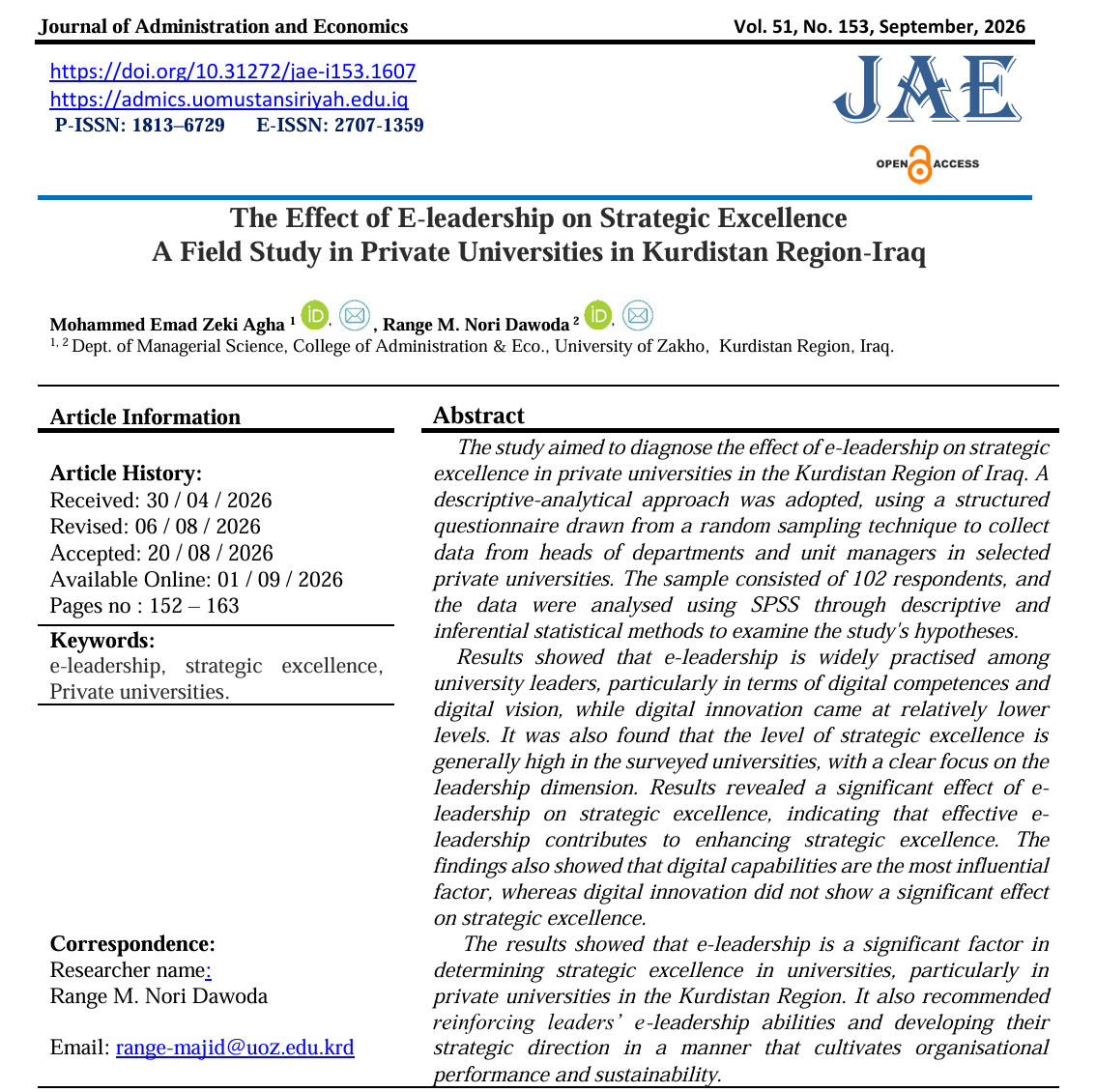
The study aimed to diagnose the effect of e-leadership on strategic excellence in private universities in the Kurdistan Region of Iraq. A descriptive-analytical approach was adopted, using a structured questionnaire drawn from a random sampling technique to collect data from heads of departments and unit managers in selected private universities. The sample consisted of 102 respondents, and the data were analysed using SPSS through descriptive and inferential statistical methods to examine the study's hypotheses.
Results showed that e-leadership is widely practised among university leaders, particularly in terms of digital competences and digital vision, while digital innovation came at relatively lower levels. It was also found that the level of strategic excellence is generally high in the surveyed universities, with a clear focus on the leadership dimension. Results revealed a significant effect of e-leadership on strategic excellence, indicating that effective e-leadership contributes to enhancing strategic excellence. The findings also showed that digital capabilities are the most influential factor, whereas digital innovation did not show a significant effect on strategic excellence.
The results showed that e-leadership is a significant factor in determining strategic excellence in universities, particularly in private universities in the Kurdistan Region. It also recommended reinforcing leaders’ e-leadership abilities and developing their strategic direction in a manner that cultivates organisational performance and sustainability
Downloads
References
[1] Van Wart, M., Roman, A., Wang, X. H., & Liu, C. (2019). Operationalizing the definition of e-leadership: Identifying the elements of e-leadership. International Review of Administrative Sciences, 85(1), 80–97. https://doi.org/10.1177/0020852316681446 .
[2] Anderson, N., Potocnik, K., & Zhou, J. (2023). Innovation and creativity in organisations: A state-of-the-science review. Journal of Management, 49(1), 1–45. https://doi.org/10.1177/ 01492063221144061.
[3] Field, A. (2018). Discovering statistics using IBM SPSS Statistics (5th ed.). Sage Publications. https://uk.sagepub.com.
[4] Ghasemi, A., & Zahediasl, S. (2012). Normality tests for statistical analysis. International Journal of Endocrinology and Metabolism, 10(2), 486–489. https://doi.org/10.5812/ijem.3505.
[5] Benitez, J., Arenas, Á., Castillo, A., & Esteves, J. (2022). Impact of digital leadership capability on innovation performance: The role of platform digitization capability. Information & Management, 59(2), 103590. https://doi.org/10.1016/j.im.2022.103590.
[6] Goldmann, P., Schäfer, B., & Altendorfer, C. (2025). Development and validation of the digital mindset scale. Journal of Business Research, 199, 115554. https://doi.org/10.1016/j.jbusres.2025.115554.
[7] Hayes, R. H., & Wheelwright, S. C. (1984). Restoring our competitive edge- Wiley.
[8] Hussain, T., Eskildsen, J., Edgeman, R., Ismail, M., Shoukry, A. M., & Gani, S. (2019). Imperatives of sustainable university excellence: A conceptual framework. Sustainability, 11(19), 5242. https://doi.org/10.3390/su11195242 .
[9] Westerman, G., Bonnet, D., & McAfee, A. (2014). Leading digital. Harvard Business Review Press.
[10] Karakose, T., Polat, H., Tülübaş, T., & Demirkol, M. (2024). “A Review of the Conceptual Structure and Evolution of Digital Leadership Research in Education.” Education Sciences, 14(11), 1166. https://doi.org/10.3390/educsci14111166 .
[11] Thompson &Harris (2025). A Narrative Review of Educational Technology in Higher Education, Social science chronicle, Volume – 05, Issue – 01, 01-27 , https://doi.org/10.56106/ssc.2025.002
[12] Stana, R., et al. (2024). E-leadership in hybrid environments. Information Systems Frontiers. https://doi.org/10.48550/arXiv.2409.01056 .
[13] Roodt op ’t, H., Bracht, E. M., van Dick, R., & Hernandez Bark, A. S. (2024). Navigating Through the Digital Workplace: Measuring Leader Digital Competence. Journal of Business and Psychology (2025) 40:179–205
https://doi.org/10.1007/s10869-024-09947-6 .
[14] Kashkoul, H. M., Al-Hamdani, M. M., Al-Shammari, F. M., Al-Haboubi, M. N., & Al-Maliki, N. A. (2024). Digital leadership and its role in enhancing the quality of digital education: An exploratory analytical study at Warith Al-Anbiyaa University and Al-Zahraa University. Journal of Administration and Economics, Al-Mustansiriyah University, 146(49), 1–10. https://doi.org/10.31272/jae-i146.1316.
[15] King, F., et al. (2023), A pragmatic meta-model to navigate complexity in teachers’ professional Learning VOL. 49, NO. 6, 958–977, https://doi.org/10.1080/19415257.2023.2248478
[16] Judijanto, L., Wulan, T. S., Wibowo, O. H., Mitasari, R., & Prasetyo, A. R. (2025). “Integration of Strategic Management and Organizational Culture in Enhancing Corporate Resilience in the Digital Era.” Jurnal Informasi dan Teknologi, 7(2), 161–167. https://doi.org/10.60083/jidt.vi0.680.
[17] Müller, S. D., Konzag, H., Nielsen, J. A., & Sandholt, H. B. (2024). “Digital transformation leadership competencies: A contingency approach.” International Journal of Information Management, 75, 102734. https://doi.org/10.1016/j.ijinfomgt.2023.102734.
[18] Northouse, P. G. (2022). Leadership: Theory and practice (9th ed.). Sage-.
[19] Ogunsola, J. A., Quadri, G. O., & Adigun, O. T. (2026). “The Strategic Role of Higher Education in Promoting Entrepreneurship and Managing Innovation Complexities: A Conceptual Framework Analysis.” Journal of Innovation and Entrepreneurship, 15, 9. https://doi.org/10.1186/s13731-026-00632-x.
[20] Salmerón, R., et al. (2020). Multicollinearity diagnostics in regression. Statistical Methods in Medical Research. https://doi.org/ 10.1177/0962280220910211 .
[21] Saunders, M., Lewis, P., & Thornhill, A. (2019). Research methods for business students. Pearson..
[22] Shakir. Renas Abbabker & Dawoda. Range M. Nori ,2026, The Role of Responsible Leadership in Achieving High-PerformanceRequirements:An Analytical Study of the Opinions of a Sample of Administrative Unit Managers in Private Universities in Kurdistan,Iraq, Journal of Administration and Economics, Mustansiriyah Uni. Vol. 51 No. (151), https://doi.org/10.31272/jae-i151.1517 .
[23] Sndi. Siyaband Qadir Mohammad & Range M. Nori Dawoda , 2025, The Role of Digital Readiness in Adopting Artificial Intelligence Requirements: An Exploratory Study among Administrative Leaders in Private Universities in Kurdistan Iraq, Journal of Administration and Economics, Mustansiriyah Uni ,Vol. (50) No. 149, https://doi.org/10.31272/jae-i149.1410.
[24] Cottafava, D., Cavaglià, G., & Corazza, L. (2021). Sustainable University: From the Worldwide Conception to the Brazilian Amazonia. Sustainability, 13(19), 10875. https://doi.org/10.3390/su131910875 .
[25] Hayes, A. F. (2022). Introduction to Mediation, Moderation, and Conditional Process Analysis: A Regression-Based Approach (3rd ed.). New York, NY: The Guilford Press. ISBN: 9781462549030.
[26] Marcoulides, K. M., & Raykov, T. (2019). “Evaluation of Variance Inflation Factors in Regression Models Using Latent Variable Modeling Methods.” Educational and Psychological Measurement, 79(5), 874–896. https://doi.org/10.1177/0013164418817803
Downloads
Published
Issue
Section
License
Copyright (c) 2026 Range M. Nori Dawoda, Mohammed Emad Zeki Agha

This work is licensed under a Creative Commons Attribution 4.0 International License.
The journal of Administration and Economics is an open- access journal that all contents are free of charge. Articles of this journal are licensed under the terms of the Creative Commons Attribution International Public License CC-BY 4.0 (https://creativecommons.org/licenses/by/4.0/legalcode) that licensees are unrestrictly allowedto search, download, share, distribute, print, or link to the full text of the articles, crawl them for indexing and reproduce any medium of the articles provided that they give the author(s) proper credits (citation). The journal allows the author(s) to retain the copyright of their published article.
Creative Commons-Attribution (BY)