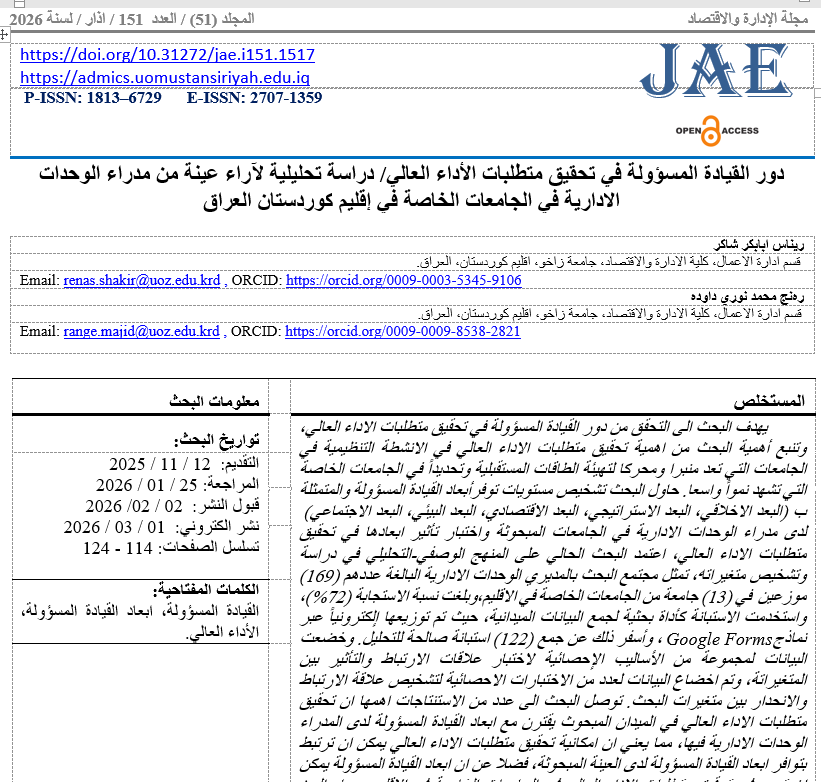
دور القيادة المسؤولة في تحقيق متطلبات الأداء العالي /دراسة تحليلية لآراء عينة من مدراء الوحدات الادارية في الجامعات الخاصة في إقليم كوردستان العراق
DOI:
https://doi.org/10.31272/jae.i151.1517الكلمات المفتاحية:
القيادة المسؤولة، ، ابعاد القيادة المسؤولة، ، الأداء العالي.الملخص
يهدف البحث الى التحقق من دور القيادة المسؤولة في تحقيق متطلبات الاداء العالي، وتنبع أهمية البحث من اهمية تبني متطلبات الاداء العالي في الانشطة التنظيمية في الجامعات التي تعد منبرا ومحركا لتهيئة الطاقات المستقبلية وتحديداً في الجامعات الخاصة التي تشهد نمواً واسعا. حاول البحث تشخيص مستويات توفرأبعاد القيادة المسؤولة لدى مدراء الوحدات الادارية في الجامعات الخاصة في اقليم كوردستان وتحليل تأثير ابعادها في تبني متطلبات الاداء العالي، اعتمد البحث على المنهج الوصفي التحليلي لتشخيص متغيرات البحث، تمثل مجتمع البحث بالمدراء الوحدات الادارية في الكليات التابعة للجامعات الخاصة في الاقليم، وتم الاعتماد على استمارة الاستبيان كاداة رئيسة لجمع البيانات عن الجانب الميداني للبحث، وباستخدام نماذج ((Google Form تم جمع (122) استمارة، وتم اخضاع البيانات لعدد من الاختبارات الاحصائية لتشخيص علاقة الارتباط والانحدار بين متغيرات البحث. توصل البحث الى عدة استنتاجات اهمها ان تبني متطلبات الاداء العالي في الجامعات الخاصة يقترن مع ابعاد القيادة المسؤولة لدى المدراء الوحدات الادارية فيها، مما يعني ان فرصة تبني متطلبات الاداء العالي يمكن ان تتحقق بتوفر ابعاد القيادة المسؤولة لدى المدراء الوحدات الادارية، فضلا عن ان ابعاد القيادة المسؤولة يمكن ان تؤثر في تعزيز تبني متطلبات الاداء العالي في الجامعات الخاصة في الاقليم، وجاء البعد الاجتماعي كأحد ابعاد القيادة المسؤولة بالمرتبة الاولى من حيث التاثير في تبني متطلبات الاداء العالي، واوصى البحث بضرورة تركيز على الوسائل التي من شأنه تعزيز من توفير ابعاد القيادة المسؤولة لدى المدراء الوحدات الادارية ليتسنى تبني متطلبات الاداء العالي.
التنزيلات
المراجع
[1] Voegtlin, C., Frisch, C., Walther, A., & Schwab, P. (2019). Theoretical development and empirical examination of a three-roles model of responsible leadership. Journal of Business Ethics, 156(4), 901–919. https://doi.org/10.1007/s10551-017-3569-1 DOI: https://doi.org/10.2139/ssrn.3368100
[2] Haque, A., Fernando, M., & Caputi, P. (2018). Responsible leadership, affective commitment and intention to quit: An individual level analysis. Leadership & Organization Development Journal. 40(1), 45–64. https://doi.org/10.1108/LODJ-12-2017-0397 DOI: https://doi.org/10.1108/LODJ-12-2017-0397
[3] Siddiqui, S. H., Ijaz, A., Javeria, A., & Naz, M. (2023). Systematic review and development of responsible leadership scale. Pakistan Journal of Humanities and Social Sciences. 11(1), 38–52. https://doi.org/10.52131/pjhss.2023.1101.0328 DOI: https://doi.org/10.52131/pjhss.2023.1101.0328
[4] Estronca, C. (2023). Responsible leadership at the core of an oil company (MSc dissertation, Universidade Católica Portuguesa).
[5] Vieira, M. T., Cremonezi, G. O. G., Spers, V. E. R., Medeiros, A. L., & Rigolid, A. G. M. (2021). Sustainability in the economic, environmental, and social dimensions and the relationship with social responsibility indicators. Academy of Entrepreneurship Journal. 27 (45).
[6] Enrico, J. H., & Soetjipto, B. W. (2021). Examining responsible leadership through the strategic and ethical lens. In Proceedings of the Eighth Padang International Conference on Economics Education, Economics, Business and Management, Accounting and Entrepreneurship (PICEEBA-8 2021) (pp. 410–415). Atlantis Press. https://doi.org/10.2991/aebmr.k.220201.001
[7] Agarwal, S., & Bhal, K. T. (2020). A multidimensional measure of responsible leadership: Integrating strategy and ethics. Group & Organization Management, 45(5), 637–673. https://doi.org/10.1177/1059601120930140 DOI: https://doi.org/10.1177/1059601120930140
[8] Karianne.Kalshoven, K., Den Hartog, D. N., & De Hoogh, A. H. B. (2011). Ethical leadership at work questionnaire (ELW): Development and validation of a multidimensional measure. The Leadership Quarterly, 22, 5–69. DOI: https://doi.org/10.1016/j.leaqua.2010.12.007
[9] Hill, C. W. L., & Jones, G. R. (2007). Strategic management: An integrated approach (7th ed.). Houghton Mifflin.
[10] Janaswamy, K., Sarkar, S., Mishra, R. K., & Gupta, A. D. (2024). Leading the sustainable dimension of business –The responsible leadership way. Journal of Global Responsibility. 15(4): 526–541. https://doi.org/10.1108/jgr-06-2023-0112 DOI: https://doi.org/10.1108/JGR-06-2023-0112
[11] Shaheen, A. F., & Abdelrahman, A. A. (2021). The concept of responsible leadership development: Relationship between business leaders and social and environmental dimensions. Journal of Management World, 2021(3), 104-115. https://doi.org/10.53935/jomw.v2021i3.164 DOI: https://doi.org/10.53935/jomw.v2021i3.164
[12] de Waal, A. (2011). Creating high performance organisations: The determining factors (Working Paper No. 2011/10). Maastricht School of Management. https://ideas.repec.org/p/msm/wpaper/2011-10.html
[13] Do, T. T., & Mai, N. K. (2020). High-performance organization: A literature review. Journal of Strategy and Management, 13(2), 297–309. https://doi.org/10.1108/JSMA-11-2019-0198 DOI: https://doi.org/10.1108/JSMA-11-2019-0198
[14] de Waal, A. (2018). Success factors of high performance organization transformations. Measuring Business Excellence, 22 (4): 375–390. https://doi.org/10.1108/MBE-08-2018-0055 DOI: https://doi.org/10.1108/MBE-08-2018-0055
[15] de Waal, A., & Frijns, M. (2009). Working on high performance in Asia: The case of Nabil Bank. Measuring Business Excellence, 13(3), 29–38. https://doi.org/10.1108/13683040910984301 DOI: https://doi.org/10.1108/13683040910984301
[16] de Waal, A., & Kraaijveld, E. (2022). Learnings from a successful transformation to a high-performance organization: A longitudinal case study. SN Bus Econ 2, 177. https://doi.org/10.1007/s43546-022-00354-8 DOI: https://doi.org/10.1007/s43546-022-00354-8
[17] Jokomo, N. T., de Waal, A., & Solomon, G. (2022). Can a small business enterprise become a high performance organisation: A South-African case study. International Journal of Management and Applied Research, 9(2), 91–114. https://doi.org/10.18646/2056.92.22-005 DOI: https://doi.org/10.18646/2056.92.22-005
[18] Khan, K., Khan, Q., Jamil, S. H., & Akbar, S. (2024). A study on high performance organization framework and organization performance: Lens of dynamic capability theory. Cogent Business & Management, 11(1), 2285415. https://doi.org/10.1080/23311975.2023.2285415 DOI: https://doi.org/10.1080/23311975.2023.2285415
[19] de Waal, A. A., & Hanna, D. (2016). HPO model + HPO framework = Organizational improvement for a European multinational. Global Business and Organisational Excellence, 35(6), 30–43. https://doi.org/10.1002/joe.21696 DOI: https://doi.org/10.1002/joe.21696
[20] O’Brien, R. M. (2007). A caution regarding rules of thumb for variance inflation factors. Quality & Quantity, 41(5), 673–690. https://doi.org/10.1007/s11135-006-9018-6 DOI: https://doi.org/10.1007/s11135-006-9018-6
[21] Usman, M., Del Giudice, M., Papa, A., & Singh, S. K. (2025). Ethical leadership and its impact on corporate sustainability and financial performance: The role of alignment with the Sustainable Development Goals. Sustainability, 17(15), 6682. https://doi.org/10.3390/su17156682 DOI: https://doi.org/10.3390/su17156682
التنزيلات
منشور
إصدار
القسم
الرخصة
الحقوق الفكرية (c) 2026 ريناس ابابكر شاكر، رەنج محمد نوري داوده

هذا العمل مرخص بموجب Creative Commons Attribution 4.0 International License.
مجلة الإدارة والاقتصاد هي مجلة مفتوحة المصدر حيث تكون جميع محتوياتها مجانية. تخضع مقالات هذه المجلة لشروط ترخيص المشاع الإبداعي المنسوب إلى المؤلف (CC-BY 4.0) (https://creativecommons.org/licenses/by/4.0/legalcode) الذي يسمح للمرخص لهم دون قيود بالبحث عن النص الكامل للمقالات أو تنزيله أو مشاركته أو توزيعه أو طباعته أو ربطه به، وفحصه للفهرسة وإعادة إنتاج أي وسيلة للمقالات بشرط أن ينسبوا إلى المؤلفين الفضل في ذلك (الاستشهاد). تسمح المجلة للمؤلفين بالاحتفاظ بحقوق الطبع والنشر لمقالهم المنشور.
. Creative Commons-Attribution (BY)